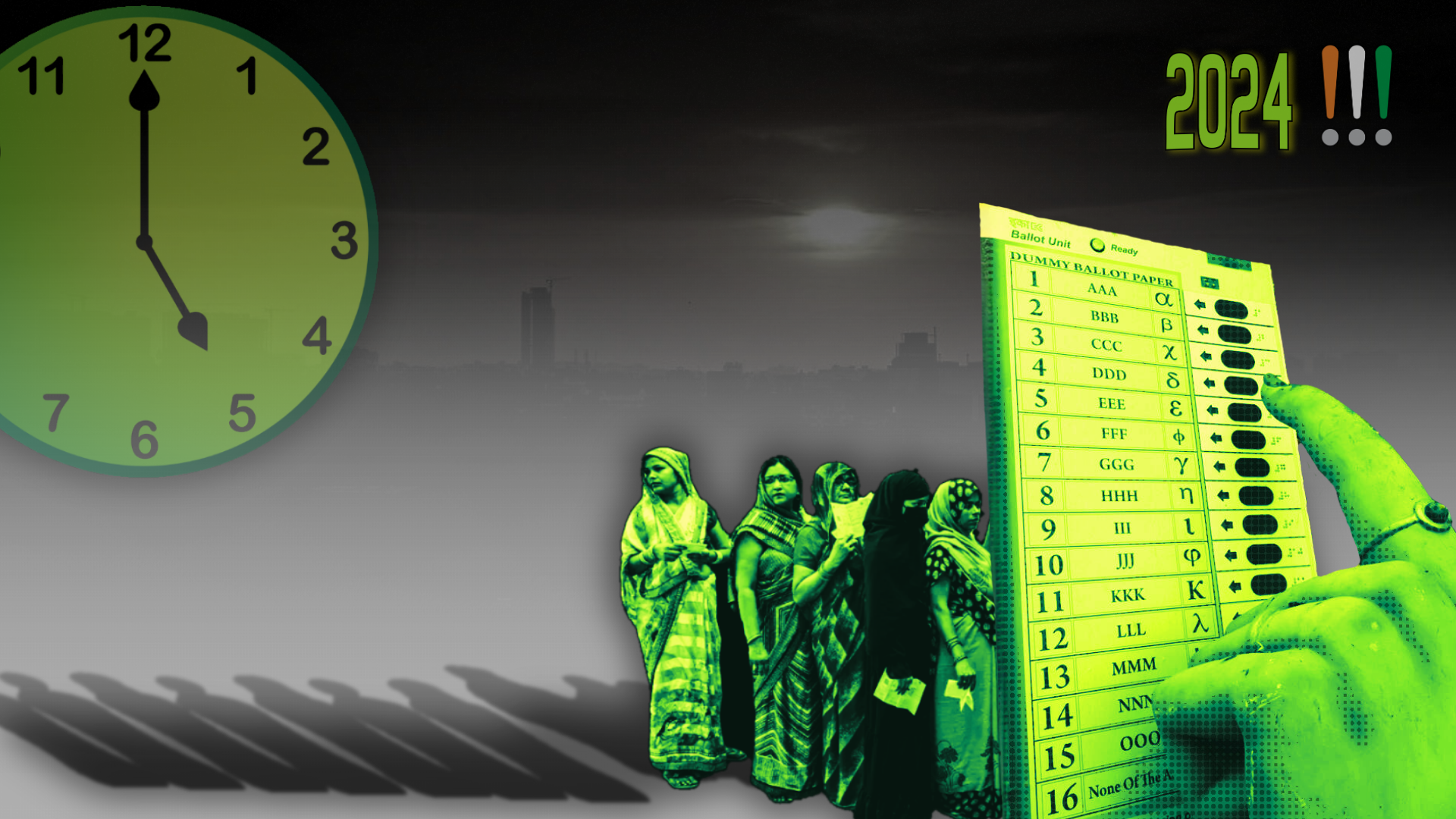


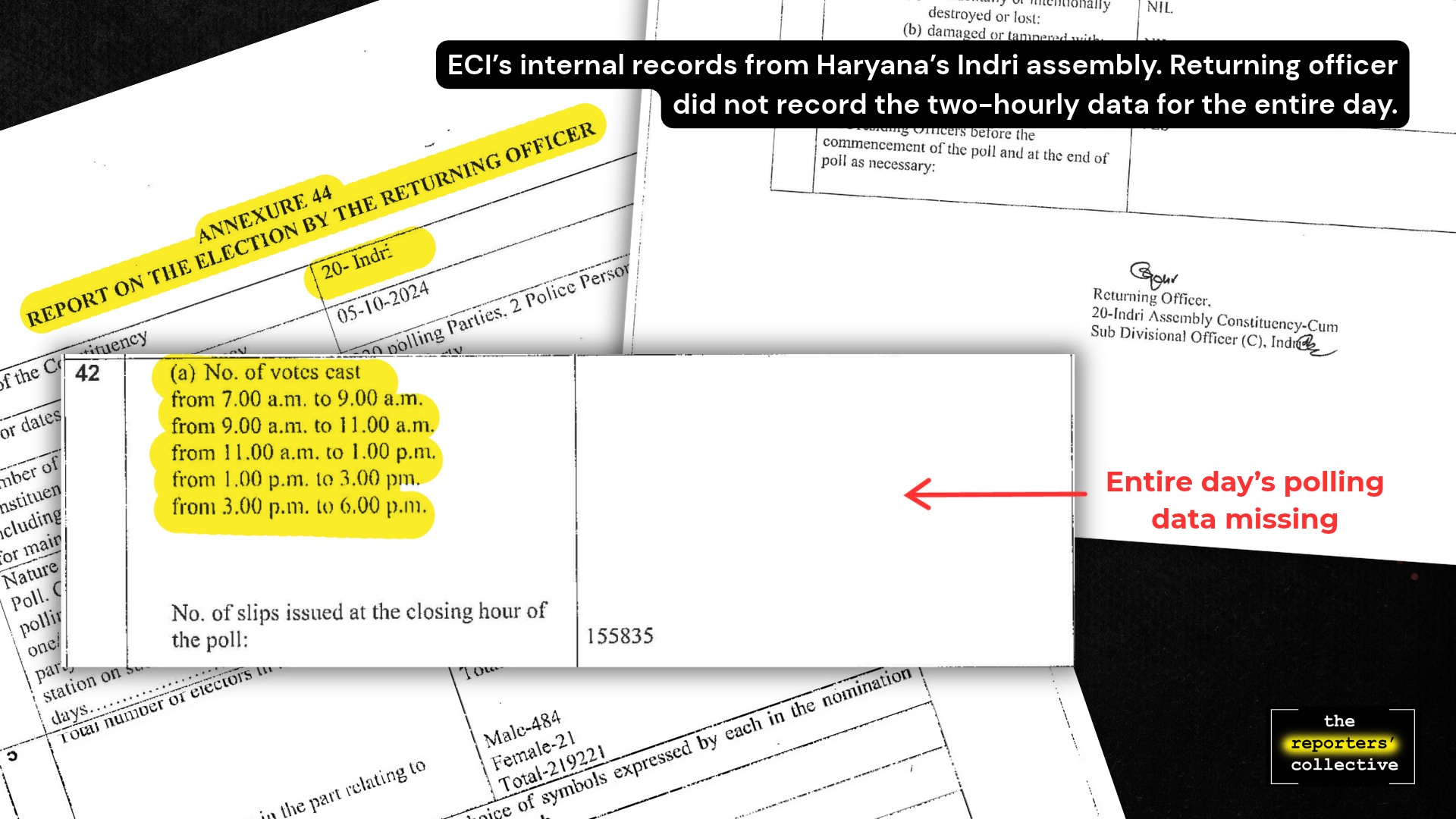
New Delhi: In 200 constituencies that went to either parliamentary or assembly polls in Maharashtra, Haryana and Jammu & Kashmir in 2024, the Election Commission of India (ECI) failed to record how many people voted after 5 pm.
Polling continues until a closing time announced by the ECI in advance, and even longer if people queuing outside polling booths have not been able to vote by then. In 2024, the scheduled closing time was 6 pm for the 530 parliamentary and assembly constituencies we reviewed.
Our investigation found a systemic hole in the ECI’s internal records of the 2024 elections. The ECI headquarters remained blind to how polling was conducted after 5 pm in these 200 constituencies, as the sun set on polling day.
Why should counting votes in the evening even matter? The last hours of polling, experts say, are vulnerable to bogus voting because many polling agents of political parties, particularly those not in a position of strength, leave the booths unattended by then.
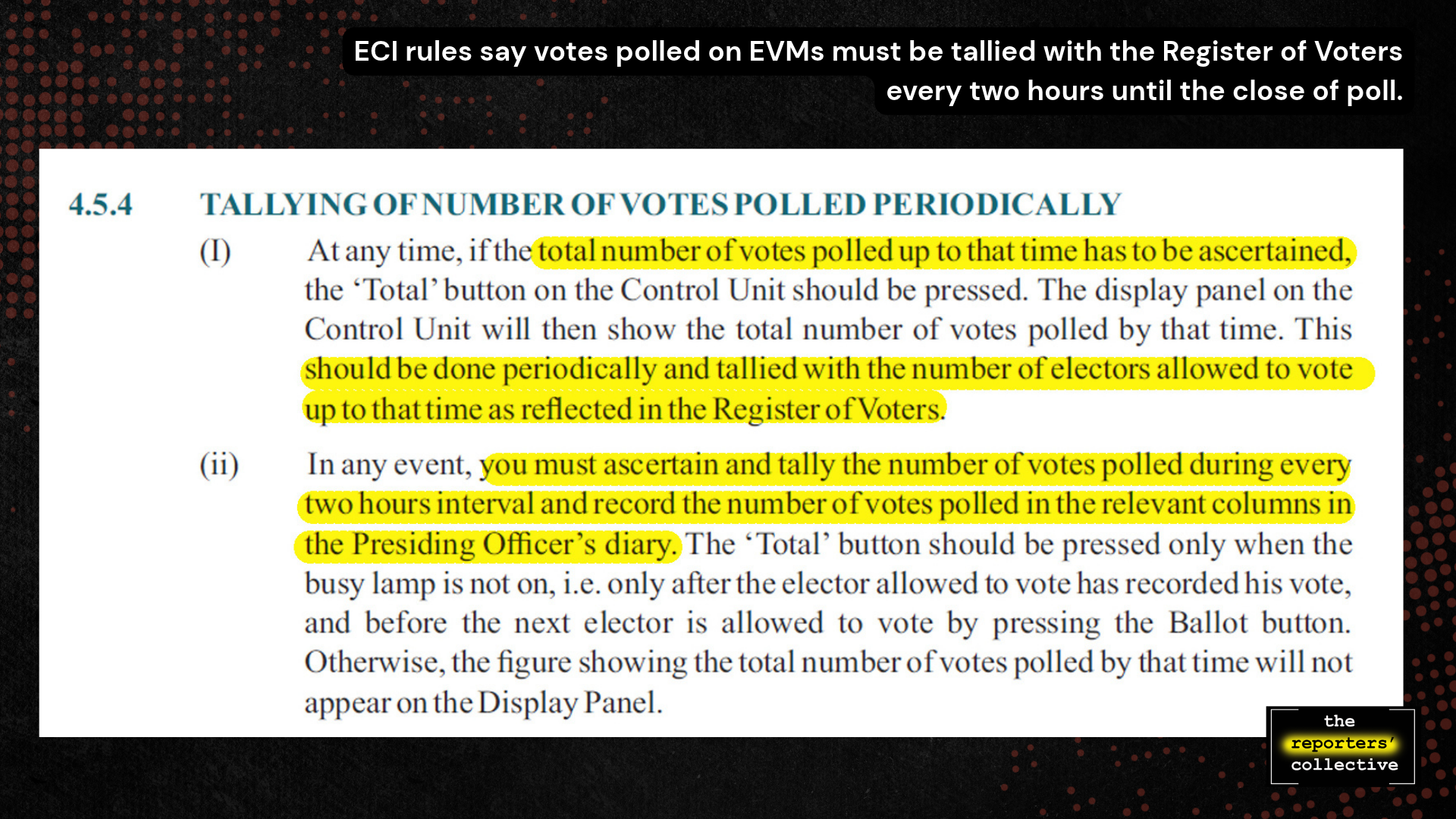
On polling day, the ECI requires its booth-level officials to record the votes polled on the electronic voting machine (EVM) every two hours until polling closes. This record is to be matched with the number of people walking into a booth to vote, which is recorded independently in a separate register known as Form 17A.
The ECI’s own rules say that these two numbers should tally. So they should also match at each two-hourly check and, naturally, at the end of the day when polling closes.
The Election Commission of India is the custodian of our votes. The Constitution charges it with holding free and fair elections and ensuring the sanctity of our electoral democracy.
When it turns blind, it should worry us all.
The Election Audit series shows that the ECI failed to watch over polling across the country in 2024, leaving the door open for malicious actors to potentially steal our votes. We do not conclude whether or where voting was rigged.
Indian citizens have never seen this evidence. We are making public the records the ECI kept hidden.
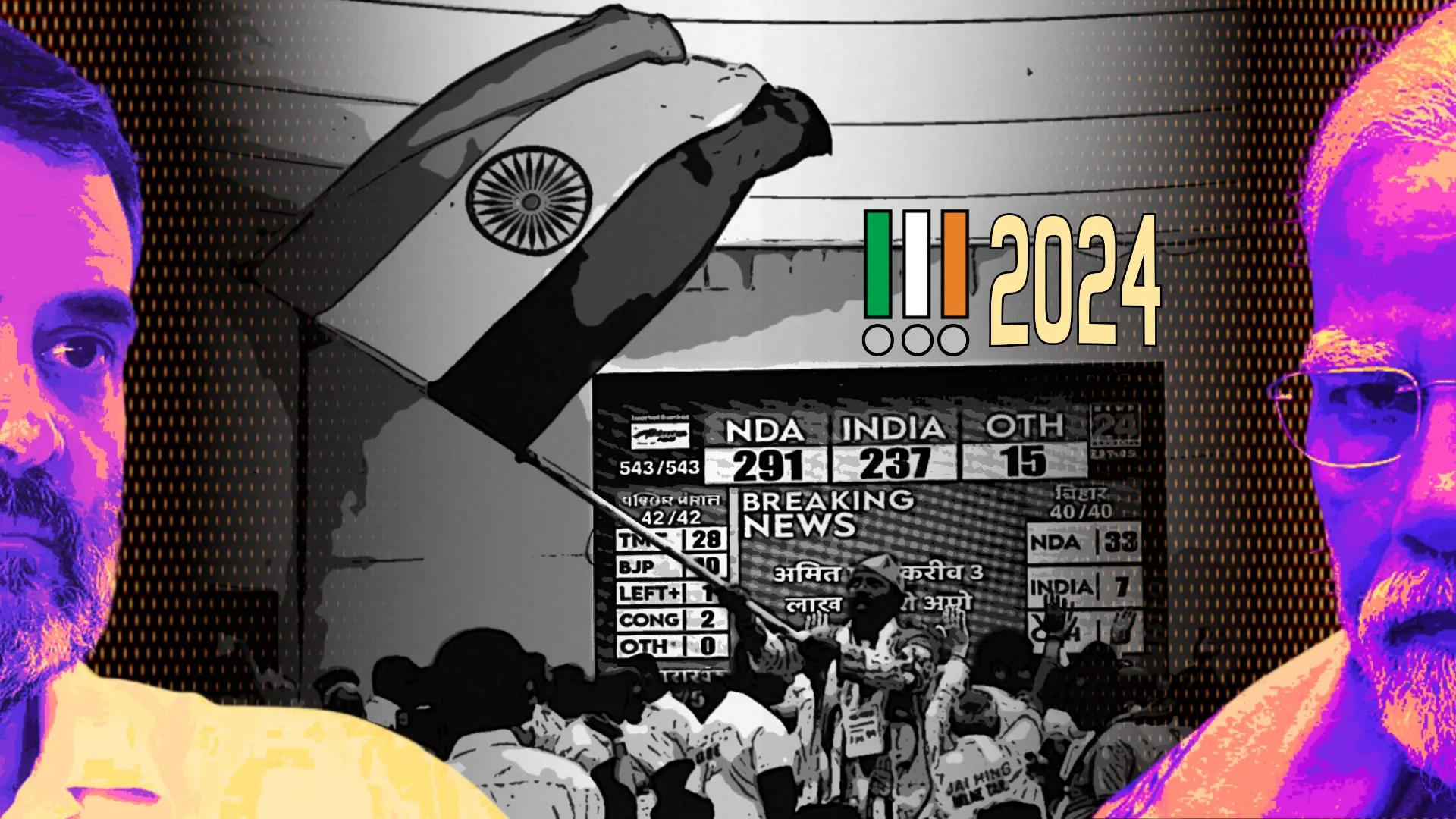
Since the ECI claims that the polling data it releases on polling day is merely provisional, maintaining this record independently becomes all the more important. Not recording this crucial poll data at all for the last hour of polling violates the commission’s rules.
The ECI receives summarised reports of the votes cast in every booth on polling day, as recorded by booth-level officials. The aggregated data is not enough for the headquarters to find out what transpired at a particular booth in a constituency after 5 pm. But when the data for all the booths of an entire constituency went dark, as it did in these 200 cases, it should have set off an alarm.
The Reporters’ Collective accessed the ECI’s internal records for 467 assembly and 63 parliamentary constituencies in Maharashtra, Haryana and Jammu & Kashmir, all of which went to the polls in 2024.
This is the first time anyone outside the ECI has examined these records at this scale, as the commission never makes them public.
Our investigation of the last hour of polling raises another red flag. In 23 of the 530 seats, ECI officials had not recorded the number of slips handed out to voters standing in the queue outside each booth when polling closed.
These slips are distributed in reverse order by booth-level officials to people waiting in line when polling closes at 6 pm. Only voters with these slips can vote after the booth officially closes.
The logic that applies to the missing after 5 pm records applies here too. Without an actual count of these slips, the commission cannot find out whether anyone was allowed to vote illegally.
This story is Part 2 of the Election Audit series. In the first part, using the same internal records, we found that in 51 of the 530 seats, the votes cast did not match the votes counted by the ECI. You can read Part 1 from the link below.

Since the 2024 general election, the opposition has alleged instances of bogus voting, especially after 5 pm. Every time, the commission has chosen to brush these allegations aside.
Such allegations cropped up after the Maharashtra assembly election the same year. On polling day, the state chief electoral office claimed a turnout of 58.22 percent at 5 pm. The very next day, it revised the figure to 66.05 percent.
That’s a jump of about 76 lakh votes, which opposition parties described as vote manipulation after polling closed.
Our analysis of the ECI’s internal data tells a different story. It shows that in the 174 seats where data after 5 pm was recorded, only 50.87 lakh votes were cast after 5 pm. That’s a third less than the 76 lakh last-hour voter jump claimed by the ECI.
Maharashtra chief electoral officer (CEO) S Chockalingam cited voter turnout trends in Jharkhand, which went to the polls around the same time. He claimed that, unlike in Jharkhand, Maharashtra’s surge in evening turnout was due to people turning up to vote late, with a large number queuing up after 5 pm.
But since the internal records show no record of voter turnout counted after 5 pm in 114 of 288 (about 40 percent) seats in Maharashtra, what was the basis of the state CEO’s claim?
This is where keeping physical records of voter walk-ins and votes polled, and tallying them at the end of polling day, is important and indispensable.
At present, the ECI waits for political parties and candidates to complain about rigging and electoral malpractice, and then addresses those complaints. But the commission need not wait. It could detect possible malpractice proactively, on its own, using the very records it requires booth officials to keep.
And when the opposition asked the ECI to share CCTV footage of polling after 5 pm, it flatly refused. Chief Election Commissioner Gyanesh Kumar told the press: “Should the Election Commission share CCTV footage of our mothers, daughters-in-law and daughters?"
ECI officials record this two-hourly polling data in the reports filed by returning officers.

Support Independent Journalism
We need your support. Your donations will help us remain independent and work without fear.
Donate now ↗The Collective accessed these internal election reports filed by the returning officers of 530 constituencies. We digitised, rechecked and evaluated 4,212 physical records for this investigation. We searched for the records of all 531 seats but could not find the report from one constituency, Devsar in Jammu and Kashmir.
ECI Treats Our Query as a Complaint, Again
We sent detailed questions to the ECI marking Chief Election Commissioner Kumar, Election Commissioners Sukhbir Singh Sandhu and Vivek Joshi and ECI’s spokesperson Ashish Goyal. We also sent questions to the respective CEOs of Maharashtra, Haryana and Jammu & Kashmir.
This time again, the commission treated our journalistic query as a complaint and sent it to its Public Grievance Redressal System. It again asked us to provide it with its own data and said this too would be kept confidential.
After the first part of this series, the Maharashtra CEO falsely claimed that we had not sent them questions, so we are making the questions sent for the second part public here.
In response to Part 1, the ECI claimed that it provides all data regarding “the electors, the number of votes polled in the EVM and the number of postal votes polled, and the total votes polled” in its index cards, which it puts up online.
Former Election Commissioner Ashok Lavasa told The Collective, “There should be no difference in the report of the returning officer and index cards (which ECI makes public) because they are prepared by the same officer.”
We reiterate that The Collective will be making all the raw data and original ECI records public with the concluding part of this Election Audit series. We will not be submitting a ‘grievance’ or communicating with the ECI in secret.
The Case of Missing Data
A returning officer is in charge of a constituency and sends these reports to the ECI two weeks after the results are announced. The reports compile all the electoral data collected at the booth level in the constituency.
At each booth, separate polling officials are tasked with recording the votes polled on the EVM every two hours and the number of voters who enter the polling booths to vote. This figure is obtained by simply pressing the “Total” button on the EVM’s control unit, which reveals only the vote count. The booth’s presiding officer records votes polled on the EVM every two hours. Another polling officer independently maintains a record of the voters who enter the polling station. When periodically checked the two numbers should tally.
Ensuring these counts are done independently of each other and matched is the audit. Fitting one to suit the other at the end of the day is akin to fixing the account books to hide a potential fraud.
A good parallel can be seen in financial account keeping. Ensuring each financial transaction is legitimate is the audit. Making entries in the books of accounts at the end of the year to hide sham transactions is fraud.
“These ECI reports are meant to act like a concurrent audit of the polls on the day of polling itself to alert the ECI to any possible irregularity. Any attempt at filling or retrofitting these reports post-facto vitiates this mechanism of identifying red-flags,” said Lavasa.
Similarly, leaving the slot for counting voters after 5 pm empty at the time, and retrospectively fitting it to match the overall numbers that the ECI announces to the public, can leave a window open for fraudulent voting to go undetected.
Take, for instance, the Kopri-Pachpakhadi assembly constituency in Maharashtra. Here, ECI officials recorded polling only until 5 pm. Shiv Sena’s Eknath Shinde, the deputy chief minister of Maharashtra, defeated Kedar Dighe of Shiv Sena (Uddhav Balasaheb Thackeray) by a margin of 1.20 lakh votes.
The votes polled by 5 pm numbered 1.13 lakh. The total number of votes polled by the end of the day was 2.03 lakh. This means 89,878 votes were polled in the last hour across just 366 booths.
In other words, going by the ECI’s records, an average of four voters cast their votes every minute at each booth in the constituency.
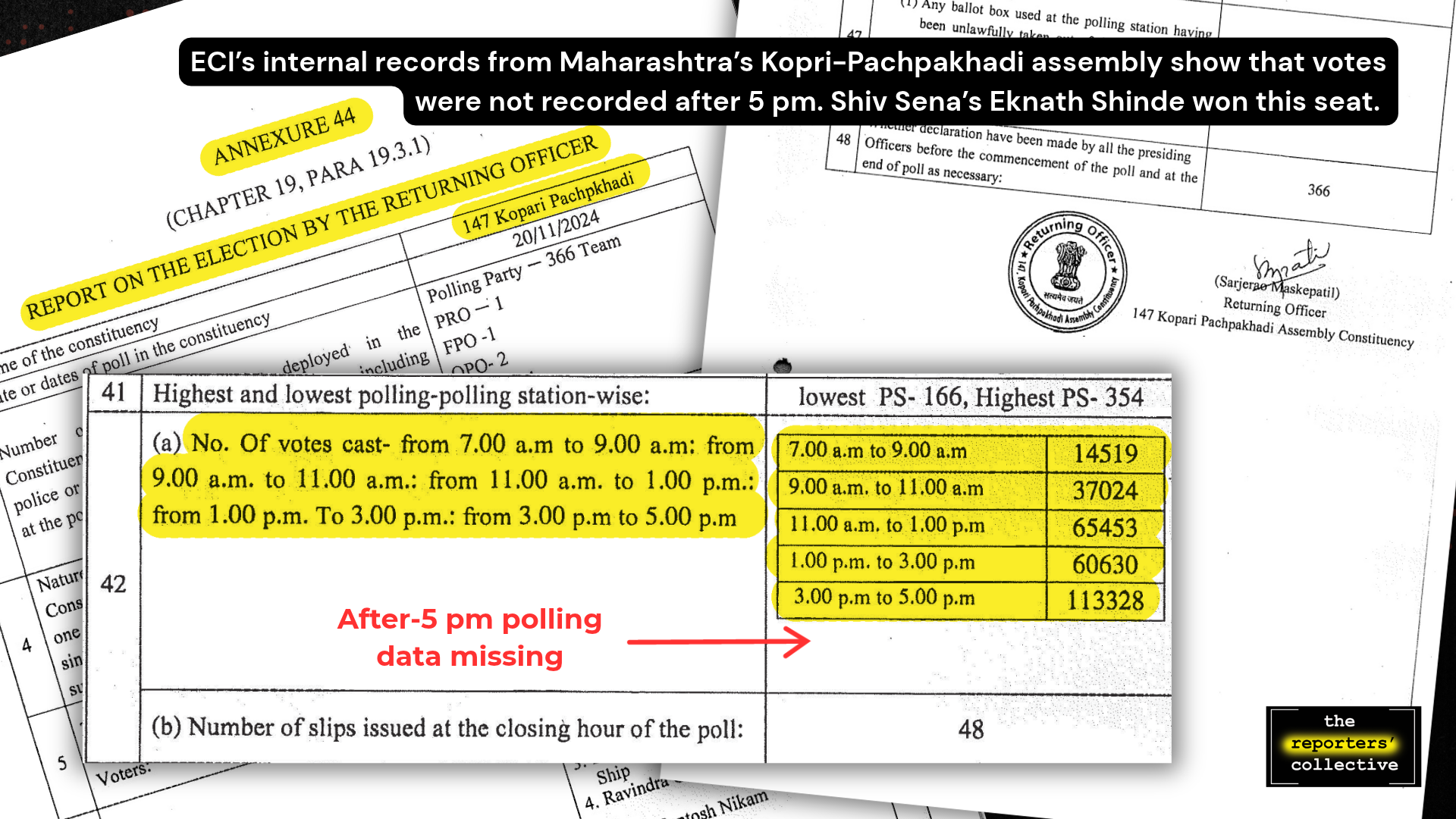
If one were to take this ECI record at face value, a voter in Kopri-Pachpakhadi would have walked into a polling booth, had her voter ID card checked, signed the register, had her index finger marked with ink, waited for her turn, cast her vote on the EVM and exited, completing all these steps in just 15 seconds. That is an unreal rate of polling. It also raises questions about the two-hourly records maintained by election officials. With the after 5 pm record missing, the ECI has no way to find out what actually happened at the seat.
Of the 200 seats where ECI officials did not keep records of polling between 5 pm and 6 pm, Maharashtra accounts for the most, with 114 assembly seats.
After Maharashtra, Jammu and Kashmir has the most constituencies where records of polling between 5 pm and 6 pm are missing. In nearly half its assembly seats, 44 of 90, the records were not prepared. Haryana follows, with records missing in 22 of its 90 seats.
The pattern repeats in the 2024 Lok Sabha election. Records of votes cast in the last hour of polling are missing for 18 of Maharashtra’s 48 parliamentary constituencies, one of Haryana’s 10 and one of Jammu and Kashmir’s five.
Why the ECI Keeps a Paper Trail
The election rules require a paper trail at every stage of polling, so that the ECI can audit elections later.
As we reported in Part 1, legally and logically, the number of voters who walk into the polling station to vote should equal the number of votes recorded on the EVM.
If the two figures do not match, it points to potential rigging. If more voters walked into the polling booth than the votes recorded on the EVM, it points to voter suppression. If fewer voters walked into a booth than the votes recorded, it could be a case of bogus voting.
The two can differ in only two situations: when a voter walks into the polling booth but refuses to vote, or when the presiding officer stops a voter from voting for breaching the secrecy of the ballot. Such cases are minuscule in number at the constituency level, according to the records we examined.
A day after polling, returning officers scrutinise these figures for red flags. But rather than wait a day to catch electoral malpractice, the ECI equips booth officials to catch it on polling day itself.
This is why the rules require the presiding officer, who is in charge of the booth, to tally these figures every two hours during polling.
The Conduct of Election Rules require an account of every voter to be kept as soon as they arrive at the polling station. This is recorded in Form 17A, or the Register of Voters.
Every two hours, the presiding officer checks that the total number entered in the Register of Voters matches the number of votes recorded on the EVM. To do this, the officer presses the “Total” button on the EVM’s control unit, which shows the number of votes cast up to that point, and records the figure in a record book called the Presiding Officer’s Diary.
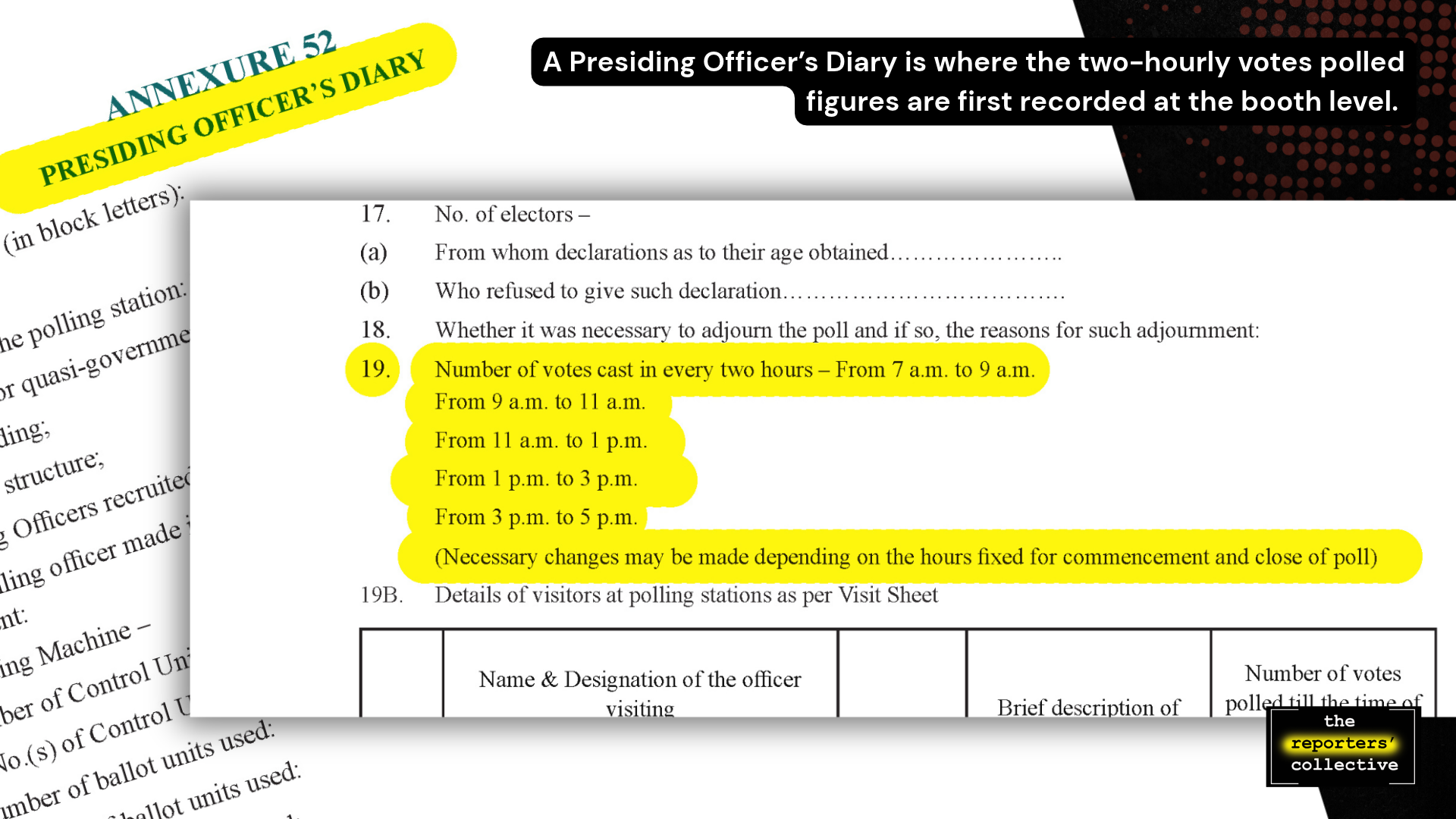
The ECI bars polling after closing time, which has been 6 pm since the 2024 Lok Sabha election. Only voters already standing in the queue outside a booth are allowed to vote beyond that.
To ensure no one joins the queue after the notified closing time of the poll, the presiding officer hands out serially numbered slips to every voter already waiting in the queue. Slip no. 1 goes to the last person standing in the queue, with slip numbering running towards the front. The presiding officer also records the total number of slips issued in the diary.
After polling closes, the presiding officer submits the diary and the Register of Voters to the returning officer, who scrutinises them the next day. If the officer spots a red flag, they recommend a re-poll to the ECI.
That is how the system is supposed to work. But in 200 of the 530 constituencies we reviewed, it did not. The returning officers’ reports had no record of how many votes were polled after 5 pm, the very hour when polling is most vulnerable to bogus voting. And in 23 seats, the number of slips handed to voters still waiting in line when polling closed was not recorded.
The ECI’s own rules are meant to catch fraud on polling day itself. In these seats, the record that could have caught it was never kept.