.avif)
.webp)


New Delhi: The Uttar Pradesh Chief Electoral Officer (UP CEO) has blamed the Election Commission of India (ECI) in Delhi for instructing him not to make public the details of 16.18 lakh voters whom The Reporters’ Collective had found to have been mysteriously added to the state voter rolls.
We have found that the UP CEO lied in his statement.
The ECI instructions, as highlighted by the UP CEO, had in fact mandated all states conducting the second round of the SIR to make each application public when adding voters through Form 6.
The ECI also instructed that all such applications for inclusion be accepted only after the draft voter list has been put out, when the claims and objections phase has begun. Contrary to these orders, UP CEO Navdeep Rinwa oversaw a purported 16.18 lakh voters filing their Form 6 applications even before the draft list was ready.
At that stage, legitimate voters would not even have known whether their names had been struck off the draft list and that they needed to apply afresh using a Form 6, to make it to the final voter roll.
It is the details of these 16.18 lakh applications filed before the publication of the draft voter list that the UP CEO has still not made public. Instead, the UP CEO has now doubled down, saying he is under orders to not reveal.
The Mysterious 16.18 Lakh
The Collective reported that the UP CEO had not disclosed details of 16.18 lakh applications for addition to the state’s voter roll. The disclosure is required under the law.
In the investigation, we showed that the state’s acceptance rate for these and other applications for addition during the SIR has been a staggering 96.27%, a number that no other state undergoing the SIR has shown. The story can be read here.
We called UP CEO Rinwa during our reporting to understand how this illegality had occurred and to seek an explanation for the incredulous SIR statistic in UP. At the time, Rinwa did not respond to specific queries and curtly cut the call, saying, “We don’t offer consultancy services to resolve your doubts or queries.”
Detailed questions were subsequently sent, giving Rinwa and the ECI headquarters in Delhi adequate time to respond before the publication of the story. Neither did.
The story was published on October 6 at 8:30 am. It was picked up by several opposition parties and leaders across the country as further evidence of SIR being maleficent.
Later in the evening, at 7:02 pm, the UP CEO put out a statement on X (formerly Twitter) claiming that no illegality had been committed.
Among other points, Rinwa made two important claims:
1. He confirmed that the 16.18 lakh forms were collected before the draft roll was published. He added that “these forms were collected as per the ECI’s instructions dated 27-10-2025 issued for conducting SIR in UP among other states.”
This matches our reporting.
2. He said that, following the Registration of Electors Rules, 1960, and as per the ECI’s instructions, only those names were to be made public which were received after the publication of the draft electoral roll.
This confirms that the details of the 16.18 lakh applications have not been made public and makes the additional assertion that this was done under instructions from the ECI headquarters.
The UP CEO’s full response can be read here.
UP CEO’s New False Claim
We dug out the ECI instruction that the CEO refers to in his response.
It is explicit. Electors who do not find their names on the draft list are allowed to file a Form 6 application only during the claims and objections phase. This phase starts once the draft voter list has been published. The instruction does not mention any exception for UP or any other state permitting them to accept these forms any earlier.
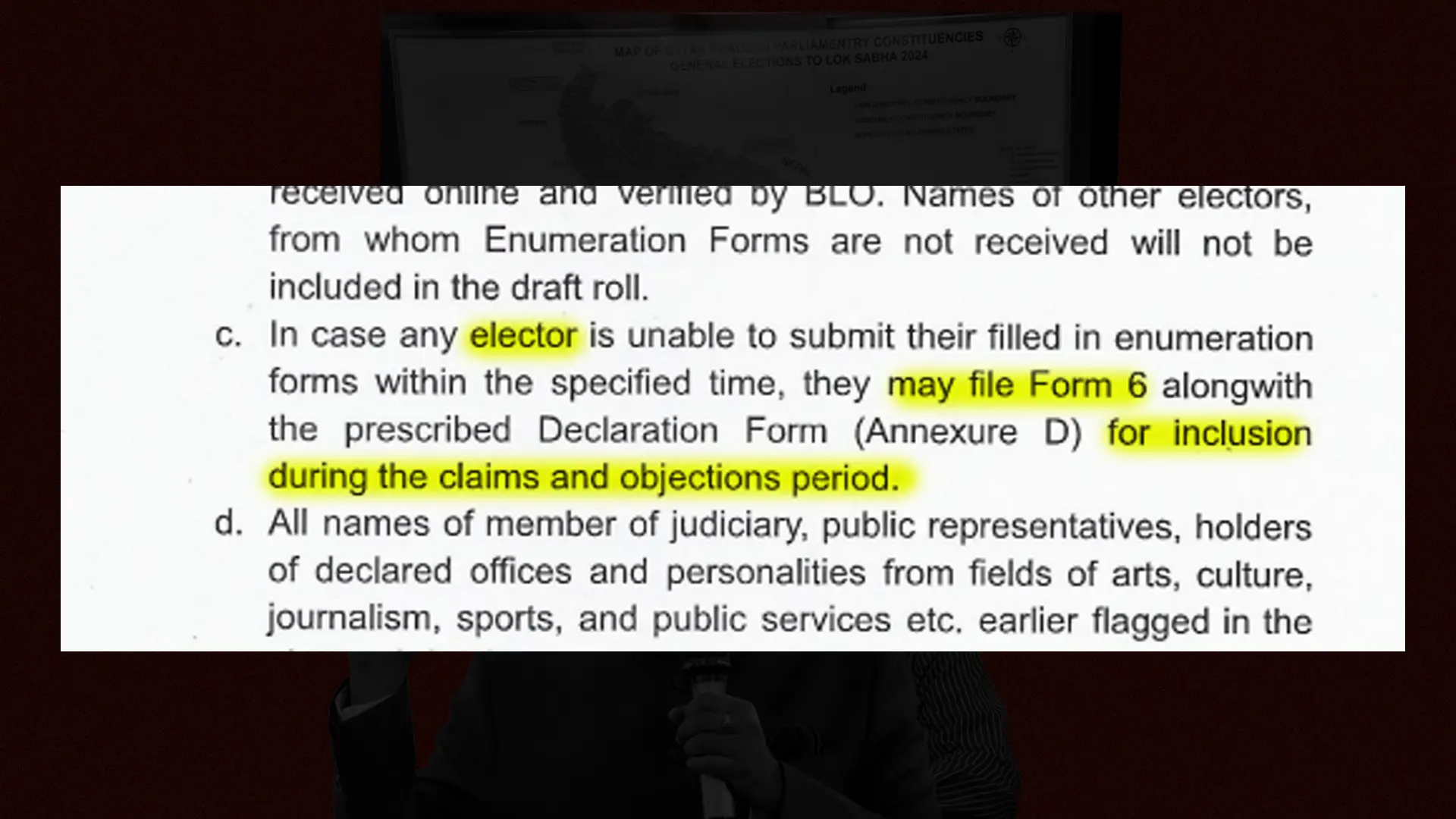
The instruction then goes on to clearly state that details of all applicants for inclusion through Form 6 must be made public. Aggregated Form 6s make up a Form 9 submitted by booth level officials and the same has to be made public.
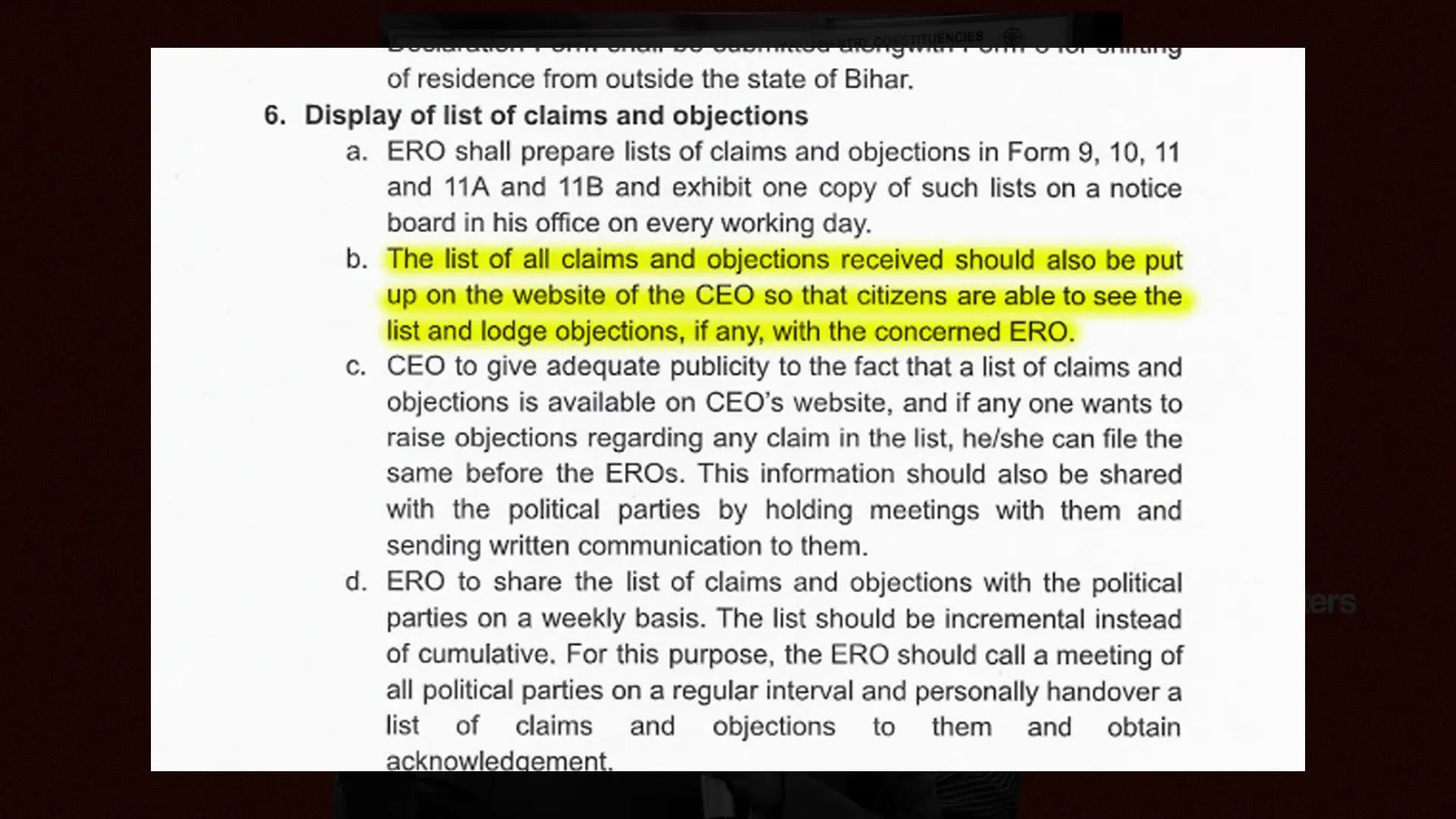
This contradicts the UP CEO’s claim that he was acting under the ECI’s orders.
Unlike the ECI manual, which was junked when the SIR began, the instructions we cite for this story and others from the commission have been hidden from the public, which permits officials such as the CEO to make claims that would be usually unverifiable. We could fact-check the UP CEO by unearthing these internal documents.
We have sent questions to UP CEO Rinwa to respond to their contradictory claim. The story will be updated if and when he responds.