

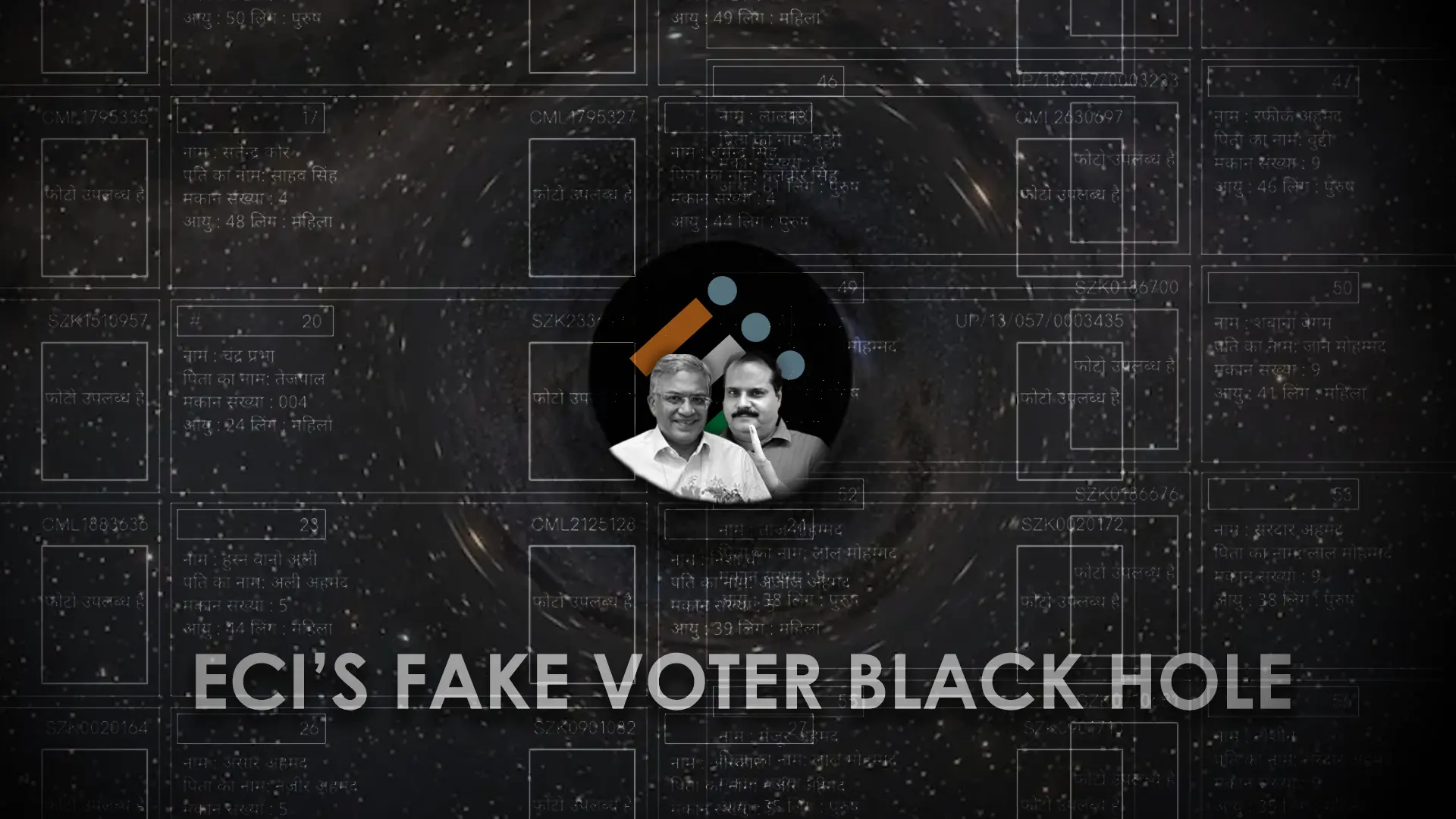


New Delhi: Thousands of voters were deleted in Uttar Pradesh’s Pilibhit assembly constituency and replaced with fake identities after the Special Intensive Revision (SIR) ended in the state. Had the fraud not been detected by the opposition parties, these fake voters could have voted in the upcoming election.
On October 22, the state’s chief electoral officer (CEO) acknowledged the fraud and said that voters had been deleted without formal applications being filed to change the voter roll. Such applications are mandatory and are meant to ensure there is a paper trail of proof and reasoning for any changes made to voters’ records.
Before his admission, we had independently verified the injection of 2,691 fake voters in just 55 booths of Pilibhit. Eight days after the Uttar Pradesh (UP) CEO acknowledged the fraud, we rechecked and found that 2,638 of these fake voters were still on the Pilibhit voter roll.
Our investigation has also found three systemic flaws that together made the Pilibhit voter fraud possible. We found that these flaws in the procedures and software of the Election Commission of India (ECI) are not limited to UP. These vulnerabilities impact the integrity of the post-SIR voter roll across the country.
The fraud happened during the regular updation of the voter roll, which, unlike the SIR, is carried out throughout the year.
We found that the constituency-level electoral registration officers (EROs) have been given immense discretionary powers to conduct this revision and the subsequent regular updation of the voter roll.
We found that the constituency-level EROs can initiate changes in voter data on their own without informing the voter or uploading any documentary evidence. They can also approve these changes without field verification of the voter.
We probed the ECI software, ECINET, and found that it does not make it mandatory for officers to keep a record of the changes they make. Nor is the ECI required to subsequently make public the basis on which EROs made changes to the voter rolls.
The Collective sent detailed questions to the ECI headquarters in Delhi and to the UP CEO of the commission. Neither had replied by the time of publication. We will update the report if and when they do.
{{cta-block}}
The Playbook for Voter Fraud, After SIR
The changes in Pilibhit took place after the SIR concluded and the final voter list was published on April 10. The names of thousands of voters and their relatives’ were replaced with entirely different identities, while their voter identity (ID) numbers remained the same.
Under the ECI’s rules, such changes require a correction application, known as Form 8, supported by documents establishing the voter’s identity.
But our investigation found that the ECI’s software allowed these applications to be processed without the required documents. This was the first major gap. These documents are meant to establish that the person requesting a correction is a genuine voter and that the changes sought are valid. Without this check, an existing voter’s identity could be replaced with someone else’s without any proof being submitted through the system.
The second gap was in the verification process. Under the ECI’s manual, booth-level officers (BLOs) must conduct field verification of correction applications, including checking whether the applicant voter lives at the stated address. But the ECI’s rules and software gave the EROs, officials responsible for maintaining a constituency’s electoral rolls, the power to bypass this verification and approve changes at their discretion.
Together, these two gaps meant that an official could replace a voter’s identity without documentary proof or field verification. The same voter ID number could now carry an entirely different name and family details, effectively creating a new electoral identity.
As a result, not only were legitimate voters removed, but fake voters added to the database. This laid the ground for bogus voting. A genuine voter whose identity had effectively been deleted would come to know of it only when they land at a polling booth to vote.
Officials would then tell them their names were not on the roll. Meanwhile, the substituted identity could potentially be used to impersonate a voter using an accepted photo identity document, creating an opportunity for fraudulent voting.
We independently examined data from 55 polling booths in Pilibhit and verified 2,691 manipulated entries, all involved Muslim voters.
Days before the opposition parties alleged voter fraud at a press conference, we had recorded testimonies of some of these deleted voters and verified with BLOs that the required correction applications had not been filed.
Take 33-year-old Akhlaq, who discovered his name had vanished from the voter rolls four months after the SIR. Attached to his unique voter ID (EPIC) number was a new identity, Akil Ahmed. His father’s name had been wiped as well, replaced with an unfamiliar one. According to Akhlaq, no one named Akil Ahmed lives in his village.
The UP CEO has acknowledged 10,470 such entries across the constituency. A computer operator and two EROs were suspended. But the ECI did not reveal how the fraud was undertaken using the loopholes it had left in its software and procedure.
How the ECI Allowed Officials to Bypass Voter Verification
The ECI allows three ways to update electoral rolls: Form 6 to add a voter, Form 7 to delete a voter, and Form 8 to correct a voter’s details.
These changes, quite naturally, should be made by officials only after verifying mandatory supporting documents. At the end of the day, the ERO is the sole authority to approve any changes to the roll.
But the ECI’s manual on using its software to process Form 8 corrections expose the loopholes.
This manual gives the ERO sweeping powers over both, correcting voter details and deleting a voter. An ERO can approve corrections without field verification or a hearing. The ERO can also initiate a correction application on their own, known as suo motu, without the voter filing a request. Hence, the same official can initiate the change, skip verification and grant final approval without the voter knowing.
By now, all such amendments and deletions to voter rolls are made only through the software, ECINET, following this manual. Once the ERO approves these changes, on their own or legitimately, they are automatically updated in the ECI’s central database of voters.
In Pilibhit, the UP CEO acknowledged that election officials in the constituency were involved in the irregularities. According to the CEO’s press note, no paper records of the correction forms were found in the ERO’s office. A computer operator was blamed for entering 10,470 irregular Form 8 applications that were subsequently approved.
We examined the ECINET app’s source code to understand how these applications could enter the system and be approved without supporting records. We found several gaps in the software that made this possible.
The ECI’s software allowed amendments to be made to voters’ details without requiring BLOs or other officials to mandatorily upload supporting documents.
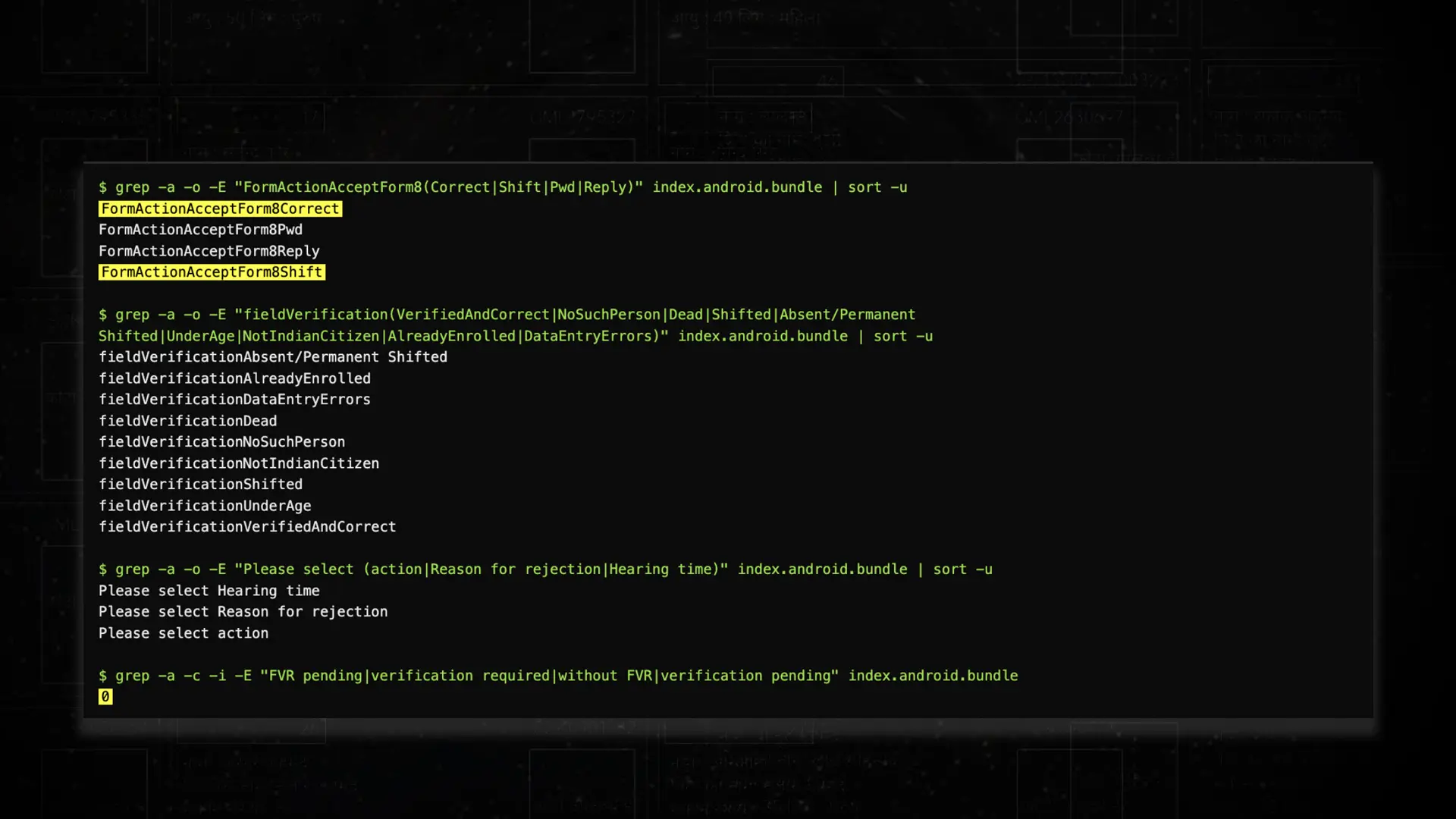
Computer operators accessed ECINET and they did so using the ERO’s login. In our previous reporting in West Bengal, we had found senior election officials sharing their login details with subordinates to access ECINET and process the applications on their behalf.
But entering thousands of irregular applications was only the first step. How did these applications get approved, especially when they lacked supporting documents and sought to replace existing voter identities?
This is where the ERO’s discretionary powers, provided by the ECI, come into play.
The ECI’s manual for voter rolls gives EROs this discretion. They can ask for a field verification by BLOs, or they can bypass this stage altogether. They can decide the fate of a voter without field verification and without adequate documentary evidence.
In Pilibhit, two BLOs we spoke to during our ground investigation described how this happened. They said the tehsil office, which houses the ERO’s office, had told them about a set of Form 8 correction applications and instructed them to verify the details of dozens of voters.
However, before they could begin the verification, the tehsil office told them that the correction applications had already been resolved.
The BLOs later discovered that existing voter identities at their booths had disappeared from the rolls and been replaced with what they described as fake voters. One of them found that their spouse’s name, too, had been illegally replaced with a fake voter’s.
Their accounts show how correction applications could be approved before the officials tasked with checking them had even begun their work.
In Pilibhit, the UP CEO was forced to act on this fraud because of the outcry. The EROs and the computer operator may have executed the fraud, but the ECI’s manual and its software permitted it to go through unchecked.
This procedure and the same loopholes in the software process are available to EROs across the country, leaving the door open to voter fraud after the SIR.
How This Manipulation Would Have Allowed Ghost Voting
Weeks before the opposition parties blew the lid on the voter fraud in Pilibhit, we were in the constituency. Politicians there spoke of it, and then led us to some of the cases where voters had been defrauded. We recorded their testimonies and verified their documents which prove that they had been wrongly erased.
We then worked with technology and data analysts to download and analyse two sets of voter data for 55 of Pilibhit’s 419 booths.
From the ECI data, they listed the EPIC numbers of all the voters whose information, their names and their parents’ names, had been ‘corrected’ by the ECI after the SIR, and during the continuous updation process.
They took the EPIC numbers of these altered voters and searched for them in the final voter roll that had been drawn up by the ECI after the SIR and made public.
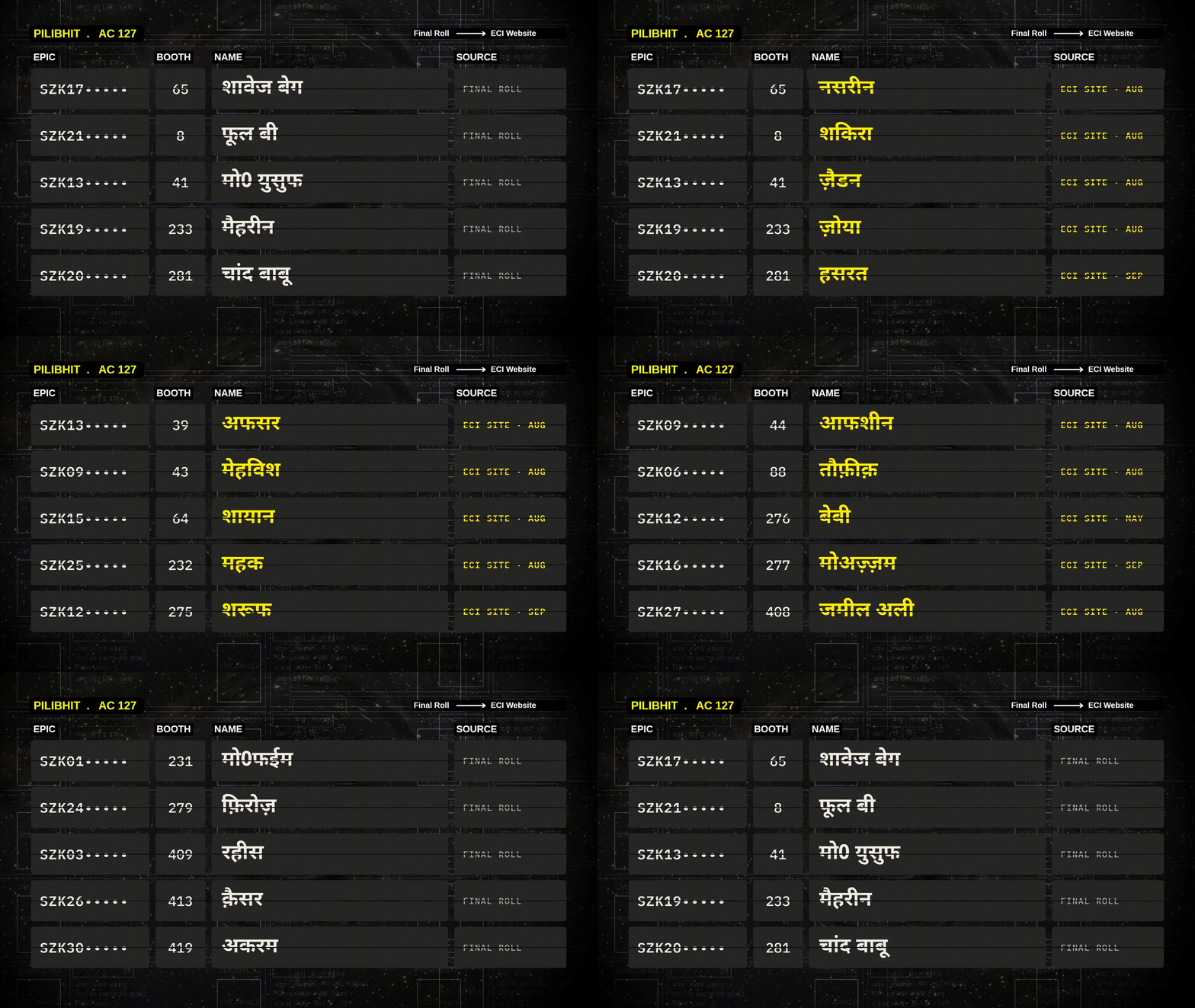
With the EPIC number as the common parameter, they algorithmically detected where the names of the voter and their parents had been entirely changed, ignoring minor corrections. For example, Nadeem Ahmed had been turned into Israr Ahamad, and his father’s name changed from Suraj Ahmed to Fayaz Khan. A voter had been erased. A fake voter injected.
Across just 55 booths, they found that 2,691 genuine voters had been surreptitiously deleted. That is 5.7 percent of the total voting population at these booths.
We examined how and when these real voters were deleted and fake ones injected into the records. We found that the fraud took place at lightning speed.
Most of the fake voters (2,372) were inserted into the voter roll in the month of August.
Of these, 656 fake voters were inserted on a single day, August 19. On the server, all these names were modified after office hours, within 7.4 minutes between 6.26 pm and 6.34 pm. The names of 89 legitimate voters were replaced by fraudulent ones within a minute.
The second busiest day for the fraud was August 31. On that day, 523 names were modified between 3.43 pm and 4.02 pm, within 19.4 minutes. That is 27 names modified per minute.
In Uttar Pradesh, the voter roll is maintained in English, Hindi and Urdu. We investigated whether the voter roll fraud had been carried out with diligence, that is, whether the officials had changed the data in all three languages.
They had not. The officials left a trace of their fraud. In the Urdu database, the legitimate voters’ details had not been changed, while in the other two languages they had been replaced with the fake voters’ details.
For instance, Arisa Bi’s name was changed to Jannat in the English and Hindi script, but in the Urdu script, it still read Arisa Bi.
In addition, we verified 15 such cases of deletions and insertion of fake voters on the ground. By examining two government-issued photo identity documents for each, such as Aadhaar, voter ID, and ration cards, we confirmed that the new names had no relation to the original voters at all. In fact, the details on their IDs matched their original entries in the UP SIR’s final voter rolls.
These legitimate voters would no longer be able to cast their ballots. At the booths electoral officers would not find their names on the roll.
But the injected fake voters could easily vote.
We read the ECI rules. They give fake voters whom officials have put on the roll the latitude to get away with voting using fake identity papers, such as Aadhaar.
According to the ECI’s rules, voters must carry their voter ID or any other photo identity document prescribed by the ECI, which is matched against the voter list prepared for the elections. For the 2024 parliamentary elections, it prescribed 12 identification documents besides the voter ID card.
Coupled with the fact that the ECI’s photo electoral rolls suffer from poorly rendered images, this discretion creates a gaping hole for fake voters who have been put on the voter roll to cast their votes.
Ahead of the 2024 Maharashtra assembly election, officials in Tuljapur constituency rejected more than 6,000 online applications to register new voters after finding that the applicants did not live at the stated addresses and had submitted forged Aadhaar cards.
ECI’s Non-Disclosure Hides Potential Fraud in Voter Roll Corrections
We went through the backend of the ECI portal and downloaded 12,082 correction forms submitted across the state between April and September this year. But the UP CEO’s own figures put the number of correction forms accepted in these months at 33.8 lakh.
The ECI has therefore not disclosed lakhs of forms. According to the election manual, outside the SIR process the ECI is not obligated to disclose all of these forms.
Our analysis of these 12,082 forms shows that the ECI makes it extremely difficult to trace the people who filed these forms to the ones whose corrections were accepted. The disclosures by the ECI contain only the voter’s name and assembly constituency. They do not include the EPIC number, that is, the unique voter ID number assigned to each voter.
This makes it nearly impossible to match the changed voter roll with the previous version. As a result, even when lakhs of corrections are approved, there is no reliable way for the public to identify whose names or other details have been replaced on the electoral rolls and on what basis.
This is a practice mandated by the ECI across India. The same manual and software are used across India for voter roll revisions and in all states for the regular updation of the roll, even after the SIR ends. It is a loophole-ridden procedure that systemically permits voter fraud.