


New Delhi: Election Commission of India (ECI) marked 43 lakh voters shifted or absent during Special Intensive Revision (SIR) in Delhi and deleted them from the electoral roll. Now, it wants to bring these voters back.
The ECI’s new order invents provisions to rediscover these deleted voters, including those marked dead, leaving the Deputy Chief Electoral Officer of Delhi exasperated.
He has shot off a letter to his bosses at the ECI Headquarters, complaining and demanding clarity on how to implement these orders.
All voters can now fill out a new enumeration form along with annexures.
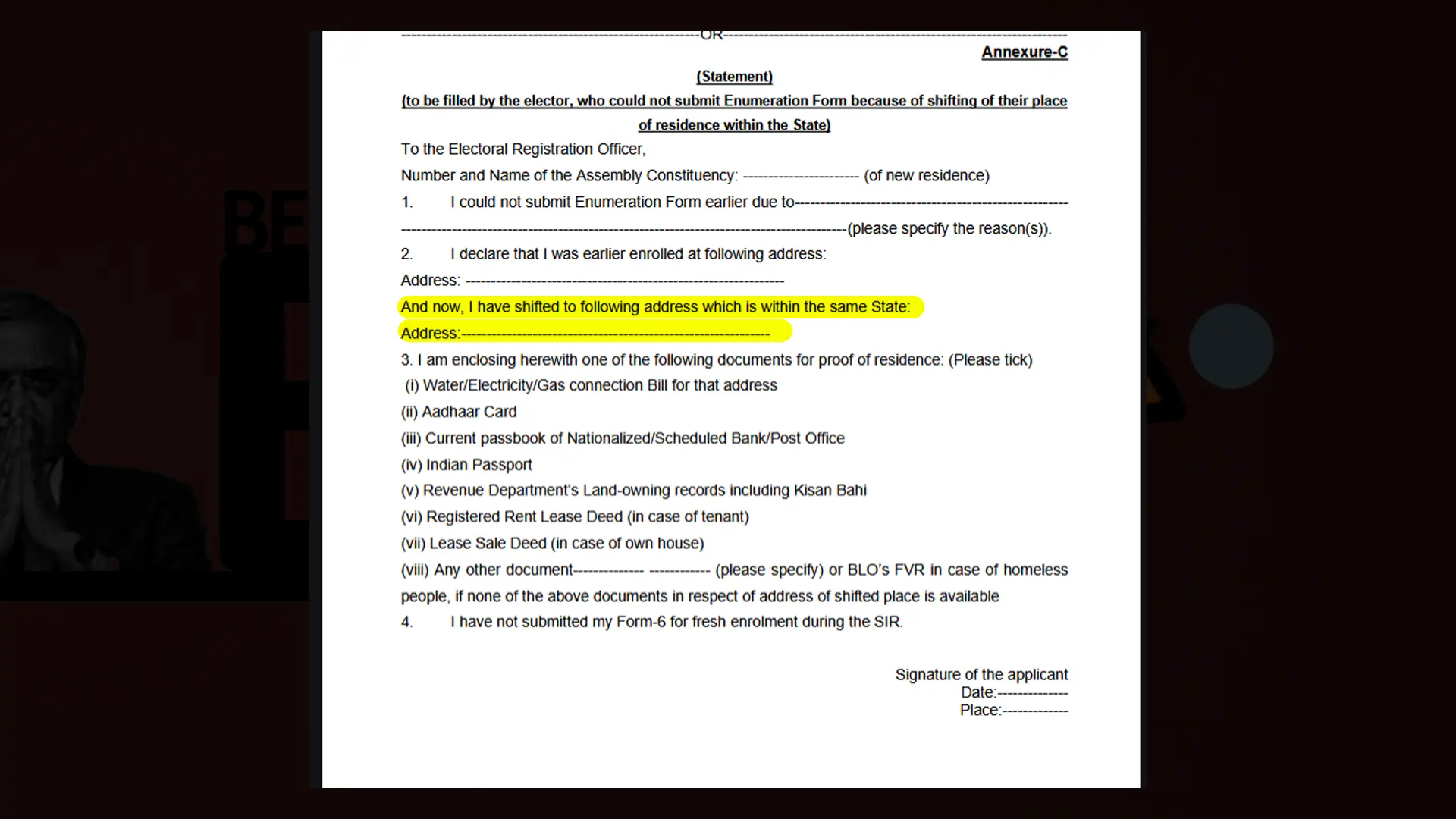
For instance, the ECI has said citizens it had earlier declared ‘missing’ can return to the voter roll by declaring they had shifted homes and were not actually ‘missing’.
To do this, it created a provision allowing these voters to bypass statutory Form 8, used to register voters who have shifted residence, by simply adding a declaration to the enumeration form.
This is the second time the ECI has changed a statutory form.
It had earlier landed in controversy before the Supreme Court for amending another statutory form (Form 6) to add new voters. At that time, the ECI had added a declaration to this form forcing voters to state that they had never voted before, even if they had.
This time around, it is doing away with the Form 8 for electors.
The ECI was forced to provide this bypass route because voter ID numbers of electors placed in the absent, shifted, dead and duplicate (ASDD) list were deleted from the database. A voter has to possess a voter ID number to fill out the Form 8 and officially shift to a new address.
The ECI has not admitted to a mea culpa: that eligible voters were deleted arbitrarily in the SIR. But the latest twist to trace these deleted voters adds multiple layers of chaos. According to the commission's timeline, enumeration forms have to be disposed of by December 10, and the final voter roll published by December 22.
Order First, Reengineer Later
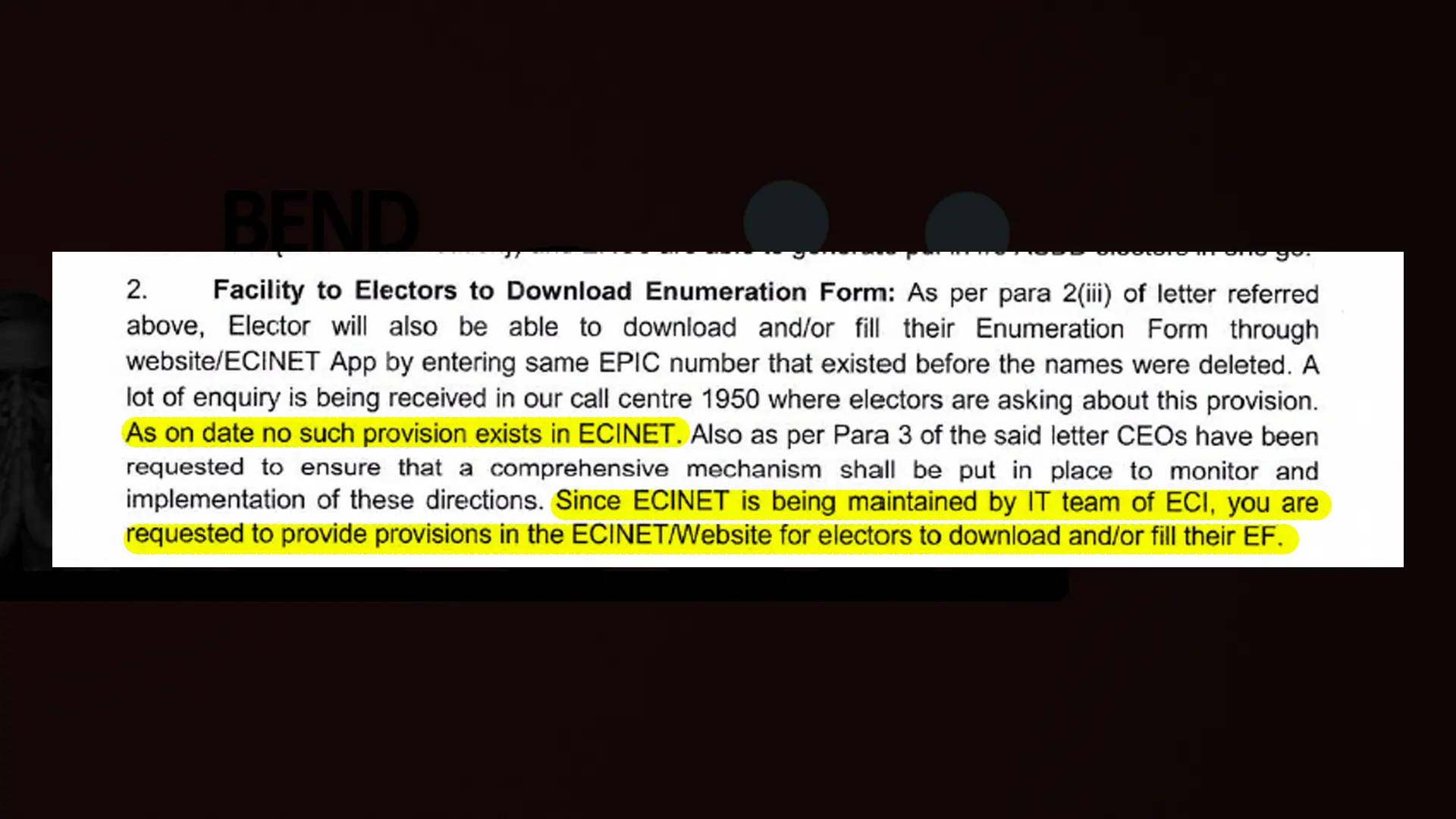
The Deputy CEO sought reengineering of the softwares, ECINET, ERONET and the BLO app to implement these orders.
The recent procedure begins with generating enumeration forms for the voters. This requires each elector’s voter ID to be pre-printed on the form and then delivered to the voters promptly.
To do so in the current context, election officials will have to regenerate the enumeration forms created at the start of the SIR three months ago. Then officials will have to comb through the forms and identify the 47.6 lakh electors, including 43 lakh shifted and absent, that were deleted. Then these forms will be physically or electronically delivered to the voters.
The Delhi CEO office wrote to the ECI, pointing out that printing and sorting through these forms “will take at least a month.”
He also noted that a lot of enquiries are being received by the CEO office asking if electors can download their enumeration forms using their old EPIC numbers. But “no such provision exists in ECINET.”
If an elector wants to download their form online, then their details and voter IDs need to be a part of the ECI database. Hence, the office of the Delhi CEO sought changes to the ECINET so that deleted voters’ EPIC numbers can be brought back into the database, allowing voters to download forms online.
But no provision allows deleted voters to be in the ECI database.
Moreover, the BLO app too would need changes so officers can redistribute these forms, verify the information and process the cases. The Delhi CEO’s office sought that the portal used by Electoral Registration Officers (EROs) should also be revamped to include new functions, allowing them to take final decisions on these voters.
We sent queries to the ECI and Delhi CEO’s office to understand how these changes would be implemented but they remain unanswered.
Twists En Route Delhi SIR
The sequence of the ECI’s U-turns in Delhi reveals how far the SIR exercise has strayed from its original aim of cleaning up the roll.
It began with the exclusion of 47.6 lakh voters (ASDD) from the draft electoral roll, followed by notices to another 33 lakh over logical discrepancies in their details or their failure to establish links with the 2002 voter list. What followed was a series of relaxations, reversals and fresh instructions, each aimed at fixing problems created by the frenzy of such deletions. Each added to the chaos.
The most notable was the commission trying a workaround for so many deletions. It began clearing cases involving logical discrepancies and mapping failures without any supporting documents. The Collective had reported how a new document, called a BLO certificate, was circulated, stating that BLOs had examined the relevant documents and verified voters' details.
A BLO told us earlier that these undertakings were obtained under pressure, leaving them no time to actually verify the documents as cases were rapidly cleared and flagged names added to the final voter list.
Never-Ending Misery
After these 33 lakh notice cases were dealt with, the ECI turned to the category of 47 lakh voters already excluded from the draft roll.
Informal WhatsApp instructions sent to BLOs, in the last week of October, accessed by The Collective, show that BLOs were asked to obtain copies of the ASDD list for their polling booths. These were the same lists the BLOs themselves had prepared months earlier.
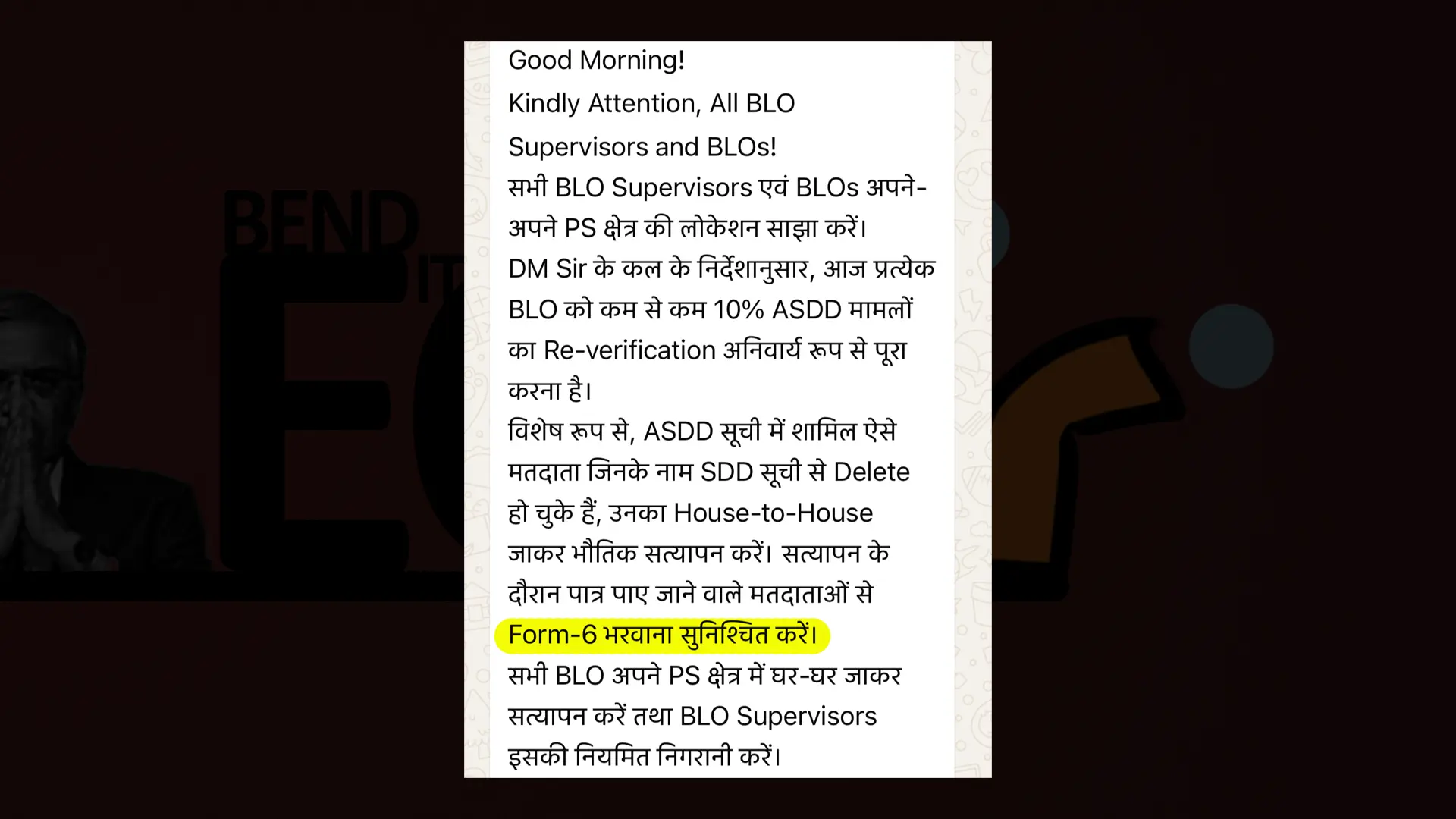
The same officers were asked to revisit those addresses and look for voters they had previously marked as missing. If found, the voters were to be brought back onto the electoral roll through Form 6, the application used to register new voters.
This created another fundamental problem. These are not first-time voters. Many were already registered, but their names were deleted after they were put in the ASDD category. Asking them to apply as new voters meant treating existing voters as fresh applicants, creating a contradiction within the process itself.
As concerns grew over the possibility of existing voters making false declarations when applying as new voters, the ECI on November 3 clarified that no punitive action would be initiated in such cases. This happened after a petition was filed in the Supreme Court.
Therefore, this opened a route for voters deleted during the SIR to return to the electoral roll without verification, appearing on the final roll as new voters.
Yet, just three days after the November 3 clarification, the commission once again changed the script. For the first time, the ECI directed that tweaked enumeration forms be regenerated for voters deleted during SIR. Instead of bringing them back as new voters, the commission now created a backdoor to the original process.
Similar opportunities, however, were not extended to voters in Bihar or West Bengal, where elections were conducted on voter rolls finalised post-SIR.
In Delhi, Maharashtra, Haryana, Andhra Pradesh, Jharkhand, Telangana and Nagaland, the commission has now acknowledged the need for an additional opportunity and renewed field verification of those it deleted.