.webp)
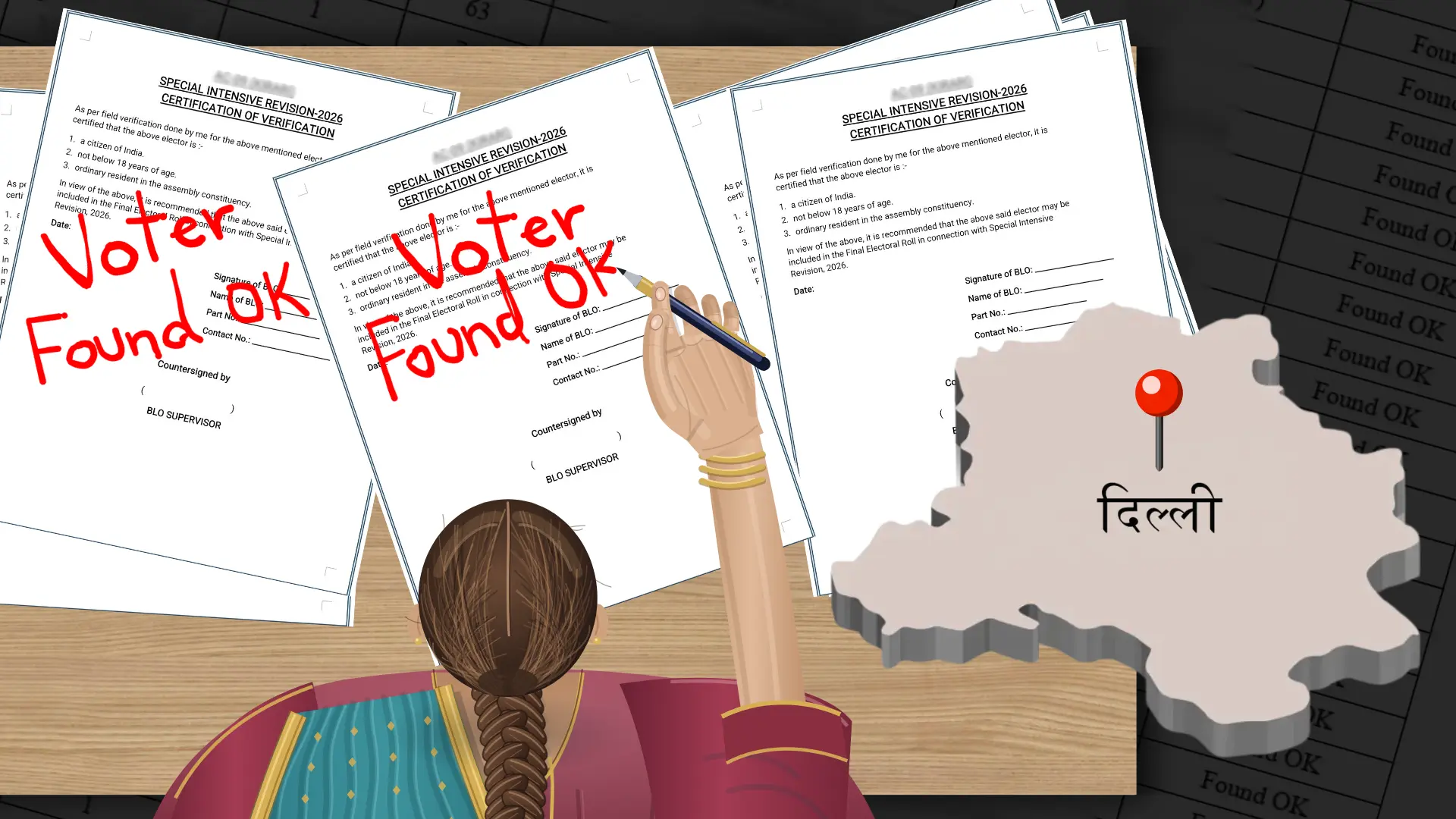


New Delhi: Doubtful voters in Delhi no longer need to submit any form of identity proof to be included in the final voter roll. Now booth-level officers (BLOs) can verify them by just signing a new form called a ‘certificate’.
The move turns the original logic of the Election Commission of India’s (ECI) Special Intensive Revision (SIR) upside down.
The existence of this certificate was revealed in WhatsApp directives issued to BLOs in the national capital. In these forms, they can certify that they have verified the voters in their booths who received notices, know them to be Indian citizens and are genuine voters in the said constituency.
The Reporters’ Collective cross-checked the use of these certificates across at least five assembly constituencies in Delhi.
According to conversations with BLOs, they have been ordered to use these certificates to quickly dispose of cases involving ‘logical discrepancies’.
A BLO told us about an informal message accompanying the latest change: no more voters should be deleted, and the remaining discrepancy cases should be cleared quickly so that the process can be wrapped up.
She said they have not checked the documents to clear the doubtful cases, and have instead just signed the certificates.
The move comes after the ECI was criticised for huge deletions during the Delhi SIR. In Delhi, 47 lakh voters were deleted from the draft roll. Another 33.11 lakh voters on the draft roll received notices over discrepancies in their documents or problems in mapping them to the 2002 rolls.
We analysed all 33.11 lakh notices issued to voters in Delhi. Of these, at least 20 lakh involve ‘logical discrepancies’, meaning mismatches in voters’ names or their parents’ names, and anomalies in parents’ ages, among other reasons. Many of these voters have already appeared for hearings.
The ECI’s SIR process mandates scrutiny of documents once a notice is issued. Voters are required to provide supporting documents, which are uploaded to the ECI’s main system ECINet. These documents are then assessed by electoral registration officers (EROs), who decide whether the voter should remain on the electoral roll.
Now, in Delhi, the ECI is asking BLOs to dispose of cases involving ‘logical discrepancies’ through signed undertakings. One BLO claimed that ‘unmapped’ cases are being quickly disposed of as well, but we couldn’t independently verify this.
The documents reviewed by The Collective state that once a BLO certifies a case, “no hearing is required to be scheduled,” and no additional documents may be “insisted upon.” The voter’s name can then be forwarded for inclusion in the final electoral roll.
The BLOs said the instructions from senior officers are clear. They just have to sign the certificates and dispose of the cases as soon as possible rather than conduct verification.
Knowingly making a false declaration in connection with an electoral roll is an offence under the Representation of the People Act, 1950, punishable with imprisonment of up to one year, a fine, or both.
What’s happening is a stark about-turn from the mandate.
Lakhs were first asked to map themselves to the 2002 rolls. Those who couldn’t were deleted. Of those who made it, lakhs more were made to appear for hearings and submit documents to resolve discrepancies.
Now, a majority of discrepancy cases are being cleared without any documents, on the basis of BLO certificates.
It is unclear whether these ‘certificates’ are uniform across Delhi. In the course of our reporting on the Delhi SIR, we have so far come across three different documents.
The first was an undertaking by BLOs certifying that an individual voter had been verified. The second was an undertaking submitted by voters themselves, declaring that the information they had provided during the hearing process was accurate. This new certificate is the third such document.
However, unlike the previous two, it is signed and filed by BLOs on a large scale, certifying that all voters with pending cases have been verified and cleared.
We reached out to the office of Delhi’s Chief Electoral Officer for comments on this new procedure. We will update the story if we get a reply.
{{cta-block}}
Constantly Changing Rules of SIR
The process for resolving notices in Delhi’s SIR has now changed three times.
In our earlier investigation, we showed how the rules governing enumeration, document uploads and hearings on notices were being bent for VIP voters in the city. VIP voters, such as Delhi Chief Minister Rekha Gupta, skipped the requirement to appear for a hearing despite receiving a notice. BLOs told us they were directed to visit the homes of VIP voters and collect their documents, making the process convenient for them. The directive was issued only informally, via WhatsApp.
After our report, the ECI formalised a change to the process. In an order issued on September 29, it announced that voters in Delhi would no longer need to visit hearing centres. Instead, BLOs would visit all voters at their homes and collect the supporting documents required to resolve their notices.
The Collective revealed that even this order was being violated on the ground, as BLOs claimed it was nearly impractical for them to resolve the discrepancies within the said time period.
But unlike the September 29 order, this latest change has again been communicated through WhatsApp, along with the newly circulated certificate forms. This time, supporting documents themselves are no longer required.
.webp)
All You Need is a BLO on Your Side
We cross-checked the practice across five constituencies in north and west Delhi, where such certificates have been given to BLOs at voting centres. Every constituency is coming up with its own version of these.
Certificates issued by election officials show BLOs being asked to prepare lists of voters in their polling booths who had received discrepancy notices, and to submit undertakings certifying that they have all been verified.
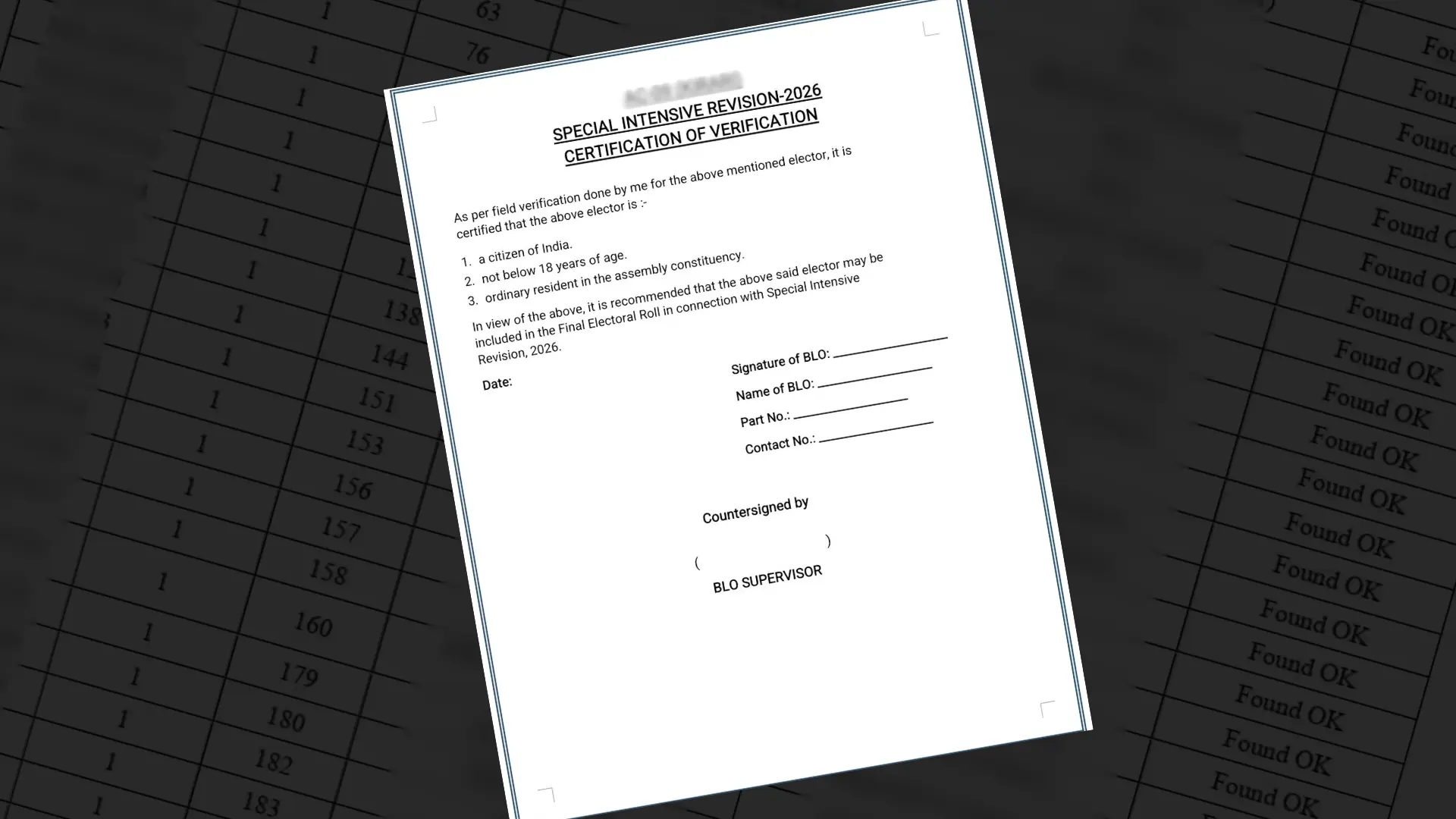
One such certificate states: “On the basis of the verification carried out by me and the records/information available, the cases listed… are found to be in order and the discrepancy in mapping stands resolved/clarified.”
The documents reviewed by The Collective show how this works in one constituency.
Polling booth-wise lists contain voters’ names, EPIC numbers, booth numbers and mapping categories, along with a column for remarks. Against an individual voter, the BLO can simply record: “Found OK.”
The list is then attached to the BLO’s certificate.
Once the BLO signs off on the cases, the instructions state that “no hearing is required to be scheduled and no additional documents may be insisted upon.” The names are then forwarded for inclusion in the final electoral roll.
“We were asked to visit the voting centre, where the certificate along with a printed list of discrepancy cases was handed to us. Each voter already had the remark “Found Ok” written on the side,” a BLO told us on condition of anonymity. They had no option but to sign it.
The BLO we spoke to also linked the latest change to the protests against the ECI in Delhi over the SIR. They said the message being conveyed informally is that no more voters should be deleted and that the remaining discrepancy cases should be cleared quickly so the process can be wrapped up.
Earlier in October, The Hindu reported that the ECI portal had introduced new options for EROs in Delhi to clear voters without documents or hearings. Now, as authorities rush to dispose of lakhs of pending cases, the ECI is shifting the responsibility for such blind clearance of voters onto BLOs through coerced signatures.