

Shimla: At 30, Bharat Bhushan Nanta still hopes to land a government job. Each morning, he carries his books to a state library in Shimla, preparing for competitive exams, just like thousands of others across Himachal Pradesh.
In the hill state, a stable government job is often the only route to a stable income and social security. Himachal is grappling with record-high unemployment. Union government data for 2024-25 shows the state has the highest youth unemployment rate in the country. At 33.9% for those aged 15 to 29, the figure is more than double the national average of 14.8%, and over three times that of large states like Maharashtra, where it stands at 13%. The situation is worse for urban women. Their unemployment rate in Himachal is 22.7%, more than twice the national average.
In response, the Himachal Pradesh government – first under the BJP in 2021-22 Budget and later continued by Congress – announced plans to provide employment to between 25,000 and 35,000 persons every financial year.
Yet, on the ground, the employment crisis in the state has only deepened, leaving more than six lakh registered jobseekers competing for a shrinking pool of secure public employment. The state government has increasingly relied on an outsourced workforce of contractual employees and those engaged under the “Mitra” model – temporary, low-paying roles that offer little job security – while permanent government recruitments remain stalled or fragmented.
This investigation traces how repeated examination delays, withdrawn advertisements, missing recruitment data and policy ambiguity have transformed the assurance of “pakki naukri” into a cycle of uncertainty for an entire generation of educated youth in Himachal Pradesh.
This increased reliance on outsourced roles and “Mitra cadres”, which are temporary part-time government work at best, has left people like Nanta feeling shortchanged. “The government labels these programs as employment,” he said, “but none of these roles offer any real future.”
The uncertainty shows up even in routine recruitment processes. In August 2025, the Himachal Pradesh Rajya Chayan Aayog announced 76 tentative vacancies across 10 post codes. Nearly five months after the application window closed on September 30, no examination schedule has been released. By the government’s own admission, the state’s public machinery depends on nearly 34,000 outsourced workers and contractual employees.
This shift towards gig-style, temporary jobs has coincided with a sharp slowdown, and in some departments, a near halt, in full-time government recruitment. The trend has continued despite successive Budgets announcing ambitious employment targets.
At the same time, the state government leans on a different solution. Last month, the Himachal Pradesh Revenue Department asked district administrations to bring back retired officials to clear pending cases. On January 6, the department issued a circular directing all Deputy Commissioners to re-engage retired revenue staff across four categories: Tehsildar, Naib-Tehsildar, Kanungo, and Patwari, with increased monthly honorariums.
The move was framed as a temporary administrative fix to reduce the backlog, but it came at a moment when regular government recruitment remained low in a state witnessing the highest unemployment rate in India. Under these circumstances, instead of filling vacant posts through fresh hiring, why was the state choosing to reopen the door for retirees?
Former MLA and CPI (M) leader Rakesh Singha contends that the Mitra model reflects a post-1991 neo-liberal shift toward contractual employment. By replacing permanent jobs with temporary ones, the government diminishes long-term liabilities through the casualisation of jobs in the public sector.
{{cta-block}}
Reliance on Gig-Style Workers
Mitra schemes in Himachal Pradesh began as limited, sector-specific initiatives, pitched as ways to involve local communities and provide youth employment. The earliest versions appeared around 2018-19, largely as a short-term student programme linked to forest conservation.
The model took a more formal shape in October 2023, when the state cabinet approved the Van Mitra scheme. Under it, locals were engaged across 2,061 forest beats for protection and development work, on a monthly stipend of ₹10,000. The positions were non-transferable, temporary, and tied to a single department.
Since then, similar Mitra roles have been rolled out or proposed across other departments. The Animal Husbandry department introduced Pashu Mitras, the Health and Family Welfare department proposed Rogi Mitras, and the Himachal Pradesh State Electricity Board Limited began the process of hiring 1,602 Bijli Upbhokta Mitras, all on an outsourced basis. Collectively, these roles have come to be informally referred to as a “Mitra cadre,” different posts, but similar deals.
The state government sees the Mitra model as a better alternative to private employment. In an interview with local channel Live Times TV, Chief Minister Sukhvinder Singh Sukhu said such government positions offered greater security than private-sector work. “Aage future mein inke liye acha hee hoga,” he said. “Baddi [an industrial city] ki 10000 ki private naukri se 10-15000 ki sarkari naukri acchi hai.” (It will be good for them in the future... A government job with a salary of ₹10,000-15,000 is better than a ₹10,000 private job in Baddi.)”
Centre of Indian Trade Unions state president Vijendra Mehra told The Reporters’ Collective that the number of regular government employees in Himachal Pradesh has not kept pace with the state’s growing population and expanding public services. While the state population nearly doubled from around 34 lakh in 1971 to around 68 lakh in 2011, the strength of regular government staff has largely stagnated in recent years. According to figures cited by Mehra, the state had around 1.81 lakh regular employees in 2019, which rose to about 1.90 lakh in 2022 before falling to roughly 1.80 lakh in 2024 – the lowest level in more than five years.
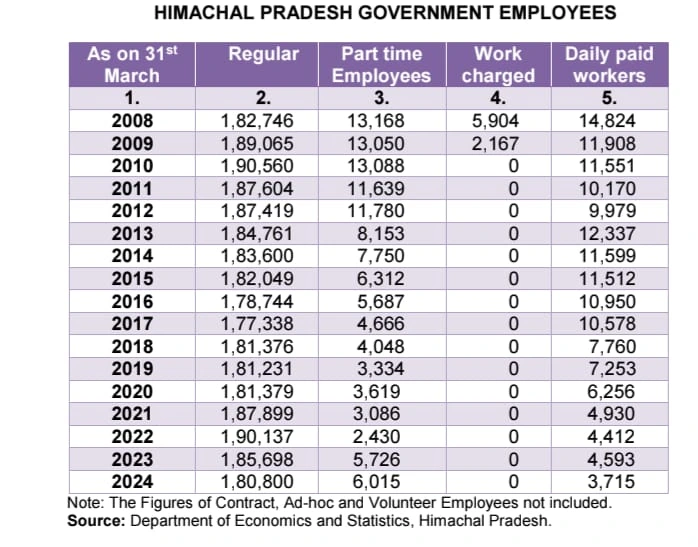
During the same period, the number of part-time employees has almost doubled, increasing from 3,334 in 2019 to 6,015 in 2024. At the same time, daily paid workers declined sharply from 7,253 to 3,715. Mehra said these trends suggest a gradual shift in the state’s employment structure.
With fewer regular and daily wage positions available, he added, departments have increasingly relied on alternative engagement models such as the “Mitra” schemes.
But when the matter reached the state assembly, the government’s position was nothing close to reassuring. During the winter session in November 2025, Dharamshala MLA Sudhir Sharma raised concerns about the job security of Mitra workers. In response, the chief minister categorically stated that none of the Mitra positions across departments carried any long-term job security.
On the ground, the lack of security is explicit from the start. Van Mitras in Shimla district say they were required to submit affidavits at the time of joining, acknowledging that they were “aware and fully understand” that this engagement was “purely on a temporary basis.” The contracts came with penalty clauses too. If a candidate leaves before completing one year as a Mitra, the expenses incurred by the state on training and uniform will be recovered from them.
For 25-year-old Lokender Barogi from Rampur, the contrast between government claims and lived reality could not be starker. “On paper, the government talks about creating jobs for thousands,” Barogi said, “but on the ground, only files move in offices.” He points to stalled recruitment proposals – such as the long-pending Naib Tehsildar recruitment, whose file has been doing the rounds of the secretariat for two to three years – as evidence that regular hiring has stalled while the government itself acknowledges the lack of comprehensive data.
Barogi argues that the Mitra model rests on a flawed assumption about the state’s workforce and employment opportunities. “Himachal is largely rural, but that doesn’t mean villages only have Class 10 and 12 pass youth,” he said. “There are thousands of graduates and postgraduates in rural areas. It seems like the government is offering only low-level, temporary jobs, as if all Group A, B, and C posts [higher categories] are already filled. That is not the reality.”
Left with Fee Receipts
The consequences of this stopgap approach are most visible in recruitment drives across the state, particularly at Himachal Pradesh University (HPU), where a stalled recruitment drive for non-teaching staff has trapped tens of thousands of applicants in bureaucratic limbo.
The process began on June 1, 2020, when HPU issued an advertisement for non-teaching posts across three categories: B, C, and D. After repeated delays, the university re-advertised the same vacancies in January 2022, assuring applicants that fresh applications were not required. Despite this, the selection process had come to a halt by late 2022.
RTI replies accessed for this investigation show the scale of what followed. Nearly 53,000 candidates applied for just 29 non-teaching posts, paying about ₹4.5 crore in examination fees. Not a single appointment has been made since the first advertisement was issued in 2020.
An official letter from the state’s General Administration Department dated December 12, 2022, directed that all ongoing recruitments in boards, corporations, and public universities be “kept in abeyance,” the letter read.
The financial burden fell disproportionately on aspirants for lower-level posts – positions often sought by those from economically disadvantaged backgrounds. For 92 Peon posts, 13,464 applicants paid over ₹1.05 crore in fees. Another 1,709 candidates paid ₹12.68 lakh for just 28 Chowkidar posts. Together, applicants for these two entry-level categories accounted for nearly 30 percent of all candidates.
According to another RTI response received in December 2025, the recruitment advertisements have since exceeded their one-year validity period. This means that while the money remains with the government university, the recruitment process itself now has no operative standing and can proceed only with fresh government approval.
The RTI responses also detail how the gridlock unfolded under political pressure. After an initial pause during the Model Code of Conduct in October 2022, as the state went to polls, it was followed by a state-wide freeze on university recruitments imposed by the new government. This paralysis stands in contrast to the government’s earlier claims of transparency.
In September 2023, soon after taking office, the Sukhu government released three years of recruitment data, disclosing the exact number of jobs the previous government filled. In the same month, the government also halted ongoing recruitments and reviewed the previous government’s decisions from April 2022, terminating extensions and probing paper leaks. Chief Minister Sukhu also announced a new Himachal Pradesh Staff Service Commission to replace the existing one, assuring fairness with the introduction of computer-based recruitments and minimal human intervention.
As per government data, 5,907 permanent posts had been filled between January 2020 and January 2023 through the state’s recruitment commissions, in strict accordance with Recruitment & Promotion Rules – nearly 2,000 in education and over 1,700 in health. Today, however, the government maintains that employment data is “still being collected.”
HPU is not the only institution caught in this holding pattern. In a reply to the state assembly in December 2025, the state government acknowledged that Himachal Pradesh Technical University (HPTU) in Hamirpur has 32 vacant permanent faculty positions and 40 other posts lying unfilled, with most departments currently staffed by guest faculty.
A similar uncertainty surrounds key competitive exams. In December 2024, the revenue minister informed the assembly that the government was considering merging the Naib Tehsildar examination with the Himachal Pradesh Administrative Services (HPAS) exam, a proposal that remains under review. Until a decision is reached, regular recruitment to the post remains on hold.
For the thousands of aspirants who pinned their hopes on these advertisements and examinations are left with nothing except paid fee receipts, cancelled examinations, and a promise that quietly expired.
Detailed queries regarding this story were emailed to the Chief Minister’s office, the Finance Secretary, and the Department of Personnel, seeking their response. This copy will be updated if and when a response is received.
The Depth of the Employment Crisis
Behind the stalled processes lies a deeper structural shift in Himachal Pradesh’s job landscape, one marked by rising informality within the public sector. The Mitra model is a prime example.
A senior faculty member at Himachal Pradesh University, speaking on condition of anonymity, described the trend as a quiet restructuring of the state’s labour model. “We are witnessing a gradual shift towards ‘informalisation’ within the formal public sector. While the state maintains its services as formal, it is rendering its workers informal,” they said.
Official data already points to the scale of the employment crisis. In a reply to the Assembly on March 21, 2023, the state government acknowledged that Himachal Pradesh had over 2.43 lakh qualified and skilled unemployed persons. For young people, the situation is especially concerning. Periodic Labour Force Survey data for 2025 shows Himachal with the highest youth unemployment rate in the country, at 33.9 percent for those aged 15–29.
But beyond headline figures, newer disclosures reveal how the state is responding to pressure – not by expanding permanent employment, but by reshaping the nature of government work.
One fault line is wages. Pointing to the high unemployment rate in the state, Sanjay Chauhan, former Mayor of Shimla, criticised the government’s growing reliance on the Mitra recruitment model as “concerning and exploitative.” In his view, initiatives such as Pashu Mitra, which offer only ₹5,000 a month, fall well short of the minimum wage and push skilled youth into low-paying employment.
As per the Economic Survey 2024–25, the state revised minimum wages from April 1, 2024, raising the monthly wages for unskilled workers to around ₹12,000 across sectors. Yet several Mitra schemes continue to offer honorariums below the state’s minimum wage benchmark. The contrast raises questions about whether these outsourced and stipend-based government roles potentially violate the state’s own labour standards.
The lack of clarity deepens when we look at data. In response to a starred question in the assembly seeking details on outsourced, para, and contract workers – including their numbers and wages – the government admitted that comprehensive data from departments was still pending. Based on incomplete submissions as of March 31, 2025, the state reported around 19,800 outsourced workers, just 13 multipurpose para-workers, and over 13,400 contract employees. The government, however, maintained that all categories of workers were being paid minimum wages applicable to their posts.
At the same time, sanctioned posts are shrinking even as vacancies mount. In August 2025, a starred question in the assembly revealed that across 30 state boards and corporations, three had formally abolished posts – resulting in the withdrawal of 417 positions. This downsizing came amid chronic staffing shortages.
The Himachal Pradesh State Electricity Board Limited illustrates the contradiction. Of its 24,866 sanctioned posts, over 10,000 remain vacant. Despite this, a rationalisation exercise led to the withdrawal of 337 posts across all categories, from Class I to Class IV positions. Similar reductions were reported in the Shimla Municipal Corporation (52 posts) and the Himachal Pradesh State Industrial Development Corporation (28 posts).
The staffing pressure in the power sector had been officially acknowledged earlier. In September 2023, the government informed the assembly that more than 660 junior engineer posts in HPSEBL were lying vacant, with no system in place to fill them on a regular, batch-wise basis. Yet instead of accelerating recruitment, the response has leaned towards rationalisation and outsourcing.
Legal experts see clear incentives behind this shift. Kamal Thakur, a practising lawyer in Shimla who fights government service cases, argues that replacing permanent posts with outsourced or temporary roles allows the government to reduce pension liabilities, long-term contractual commitments, and other fiscal obligations.
Sanjay Chauhan told The Collective that rising unemployment reflects a structural gap, where a limited private sector fails to absorb the state’s educated youth, while government delays stall the creation of stable public sector jobs.
Losing Track of its Own Jobs
If one reads through the Sukhu government’s response to questions asked inside the assembly, a quieter but equally consequential problem emerges – the government’s repeated inability to account for its own employment machinery.
Over multiple sessions of the 14th Vidhan Sabha, MLAs from across parties sought basic information on vacancies, appointments, examinations, and recruitment timelines. In response, the government has repeatedly given the same answer – “information is still being collected.”
This reply has appeared across departments and on consecutive days, covering everything from the number of posts advertised to how many candidates were appointed – whether through the Public Service Commission, the State Selection Commission, or individual departments. Taken together, the responses point not just to delay, but to a deeper administrative problem. The government does not appear to have a consolidated picture of its own workforce.
What makes this all the more striking is that the state has no such difficulty tracking jobseekers. Employment Exchange data shows that the demand for work is recorded. In the financial year 2024-25, over 90,000 applicants registered with employment exchanges. As of December 2024, the live registers across the state stood at more than 6.75 lakh.
Actual placements, however, remain minimal. During the same period, just over 1,000 placements were made in government jobs, including non-notified vacancies. The private sector accounted for around 4,400 placements. The gap between those seeking work and those being absorbed into employment remains vast.
Even reforms announced to streamline recruitment have made little visible difference. In November 2025, the government informed the state assembly that a Directorate had been set up to handle recruitment for Group-C (common posts). Departments were asked to provide details of these common posts, and a Standard Operating Procedure was said to be under review.
But as of October 31, 2025, the Directorate had not filled a single post. While the government stated that recruitment for a few hundred JOA (IT) and Dispenser posts was reportedly “in progress,” the new mechanism itself remains largely inactive.
Uncertainty also continues around competitive examinations. In December 2025, the Chief Minister Sukhu told the House that data on candidates selected by the State Selection Commission up to July 2025 was still being compiled. When MLAs sought details on how many posts had been advertised, how many exams had been held, and how many results declared over the past three years, the government again replied that the information had not yet been collected.
This lack of clarity persists despite major changes in the recruitment system. After paper leaks and irregularities led to the dissolution of the earlier Himachal Pradesh Staff Selection Commission, the government set up the Himachal Pradesh Rajya Chayan Aayog, promising a more transparent and efficient process. Yet nearly two years later, assembly replies continue to reflect partial data and unanswered questions.
During the 2022 assembly elections, the government had promised large-scale regular recruitment. Later, Deputy Chief Minister Mukesh Agnihotri went even further, declaring, “Naukri milegi to pakki milegi, thunja (58) saal wali milegi.” (If a job is given, it will be a permanent one – job that lasts 58 years until retirement).
“Three years later, many of those promises remain unfulfilled. Numerous aspirants like me find ourselves in a state of prolonged uncertainty,” said Lokesh Thakur, a law student at Himachal Pradesh University.
Some figures have been shared – the chief minister disclosed limited appointments of around 4,500 candidates through the Public Service Commission and the State Selection Commission between December 2022 and February 2025 – but these disclosures sit alongside broader admissions of missing data, stalled exams, and departments unable to furnish vacancy details.
The pattern suggests that government recruitment in Himachal Pradesh is no longer functioning as a continuous, trackable process. Instead, it appears fragmented – advertisements issued, exams delayed, institutions restructured, and data scattered across departments.
While the reset has been framed as a move toward transparency via a ‘single window system’, it has effectively wiped out years of waiting for many candidates without offering clear timelines for fresh recruitment.
Meanwhile, at the state library in Shimla, Bharat Bhushan Nanta looks away from the books laid out on his desk and says, “Each year, thousands of students aspire for permanent government jobs. But recruitment processes hit roadblocks, and now we are being offered temporary positions that offer no long-term prospects.”