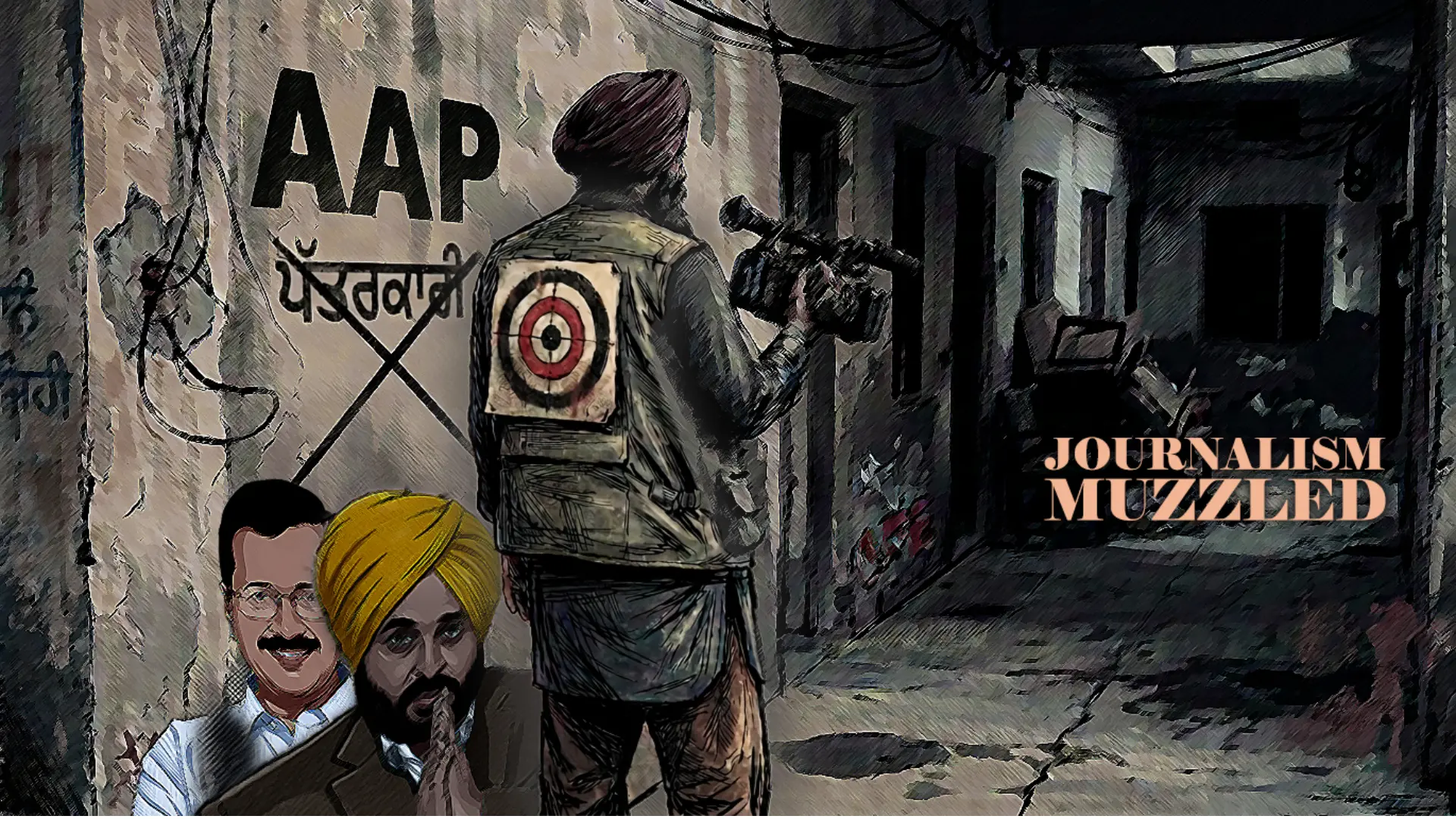


Khudian Gulab Singh, Punjab: Gulzar Singh stood before Punjab Finance Minister and Aam Aadmi Party leader Harpal Singh Cheema at a public meeting in Sangrur district on September 6. The 47-year-old Dalit daily wager asked a question: Why was chitta (heroin) so easily available in his village of Toor Banjara?
He spoke out of anguish. His son, he said, was an addict who had sold off household belongings to sustain the addiction to chitta.
The next day, Gulzar Singh was called by panchayat members and allegedly asked to apologise for posing the question to the minister. Humiliated, he poisoned himself.
Before his death, Gulzar in a video declared that minister Cheema and the panchayat members should be held responsible if he died.
After being shuttled between four hospitals, he passed away. Cheema was not named as an accused in the First Information Report. Instead, Gulzar Singh’s family was reportedly offered a job and compensation under the Scheduled Castes/Scheduled Tribes Act by the AAP government.
Subsequently, his family absolved the minister of any role in the suicide. The family flipped again, this time demanding Cheema be jailed. They accused the government of forcibly cremating Gulzar’s body amid heavy police presence.
In another incident this month, a man was detained and tortured for raising a black flag during a public meeting held by Punjab Chief Minister Bhagwant Mann, questioning the government’s handling of the drug menace.
Last year on March 1, the AAP government ambitiously pledged to make Punjab drug-free within three months under its Yudh Nashian Virudh campaign, the fourth such deadline in three years. The promise, as one would expect, remains largely unfulfilled.
With Punjab elections looming closer, the state government has taken to muzzling the messenger. In Punjab, speaking of the drug menace can invite trouble from the government and its agencies.
Maninderjeet Singh Sidhu, a Faridkot-based journalist, found this the hard way.
This is Sidhu’s story. It is also the story of a Punjab roiled by chitta and a brittle government which has developed a habit of censoring the media.
The Reporters’ Collective has documented over 50 instances of media censorship under the AAP government in the form of FIRs, copyright strikes, police raids, and disruptions of news coverage critical of the government.
In this story, we focus on Sidhu, who made a video report on the drug menace and found himself accused of abetting the suicide of an alleged drug addict.
In Muktsar
On August 17, journalist Maninderjeet Singh Sidhu published a video report exposing drug addiction in Sri Muktsar Sahib district’s Khudian Gulab Singh village, home to Punjab cabinet minister Gurmeet Singh Khuddian. A first-time MLA from Lambi, AAP leader Khuddian defeated Shiromani Akali Dal patriarch Prakash Singh Badal in the 2022 assembly elections. The Badals’ residence is around 15 km from Khudian village.
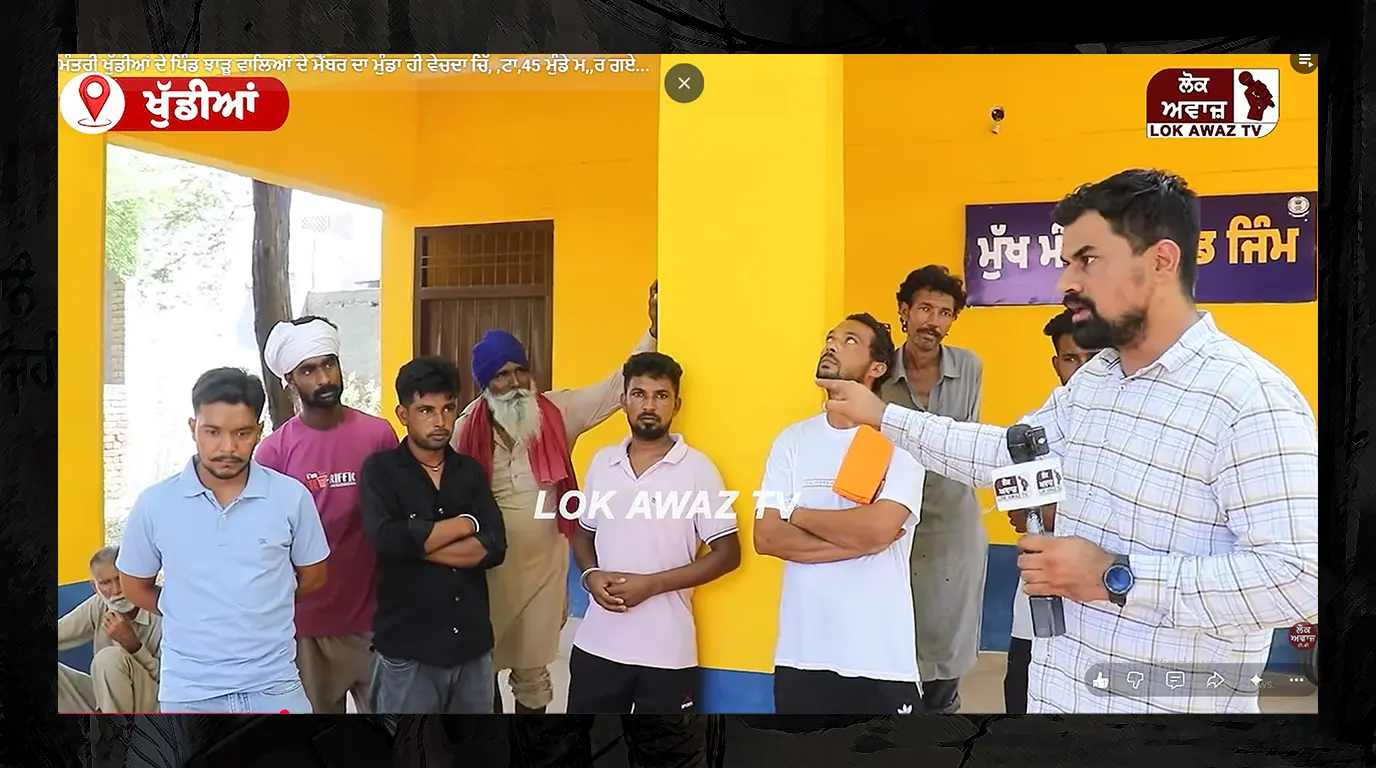
In the video, Sidhu showed a dharamshala (community hall) strewn with syringes and needles, foil papers, bottle caps and poly bags — articles used for chitta abuse.
At the outset, Sidhu clarified that the villagers he was interviewing were themselves battling drug addiction. “It’s the minister’s village. Take as much [chitta] as you want here. You can get gaba (Pregabalin tablets misused by opioid users) like toffees, you can get as much as you want. There is no hindrance,” one of the villagers told Sidhu.
Villagers told him on camera that 25 young people had died from chitta, a common term used for heroin in Punjab. One of them blamed four village youths, including “Chhinda”, for allegedly selling chitta.
Sidhu ran with the claims on the video.
A day later, Chhinda, also known as Sukhjinder Singh, was found dead inside his home.
The police booked the journalist Sidhu and five others whom he had interviewed for abetment to suicide, a crime under Bharatiya Nyaya Sanhita Section 108 that carries a jail term of up to 10 years.
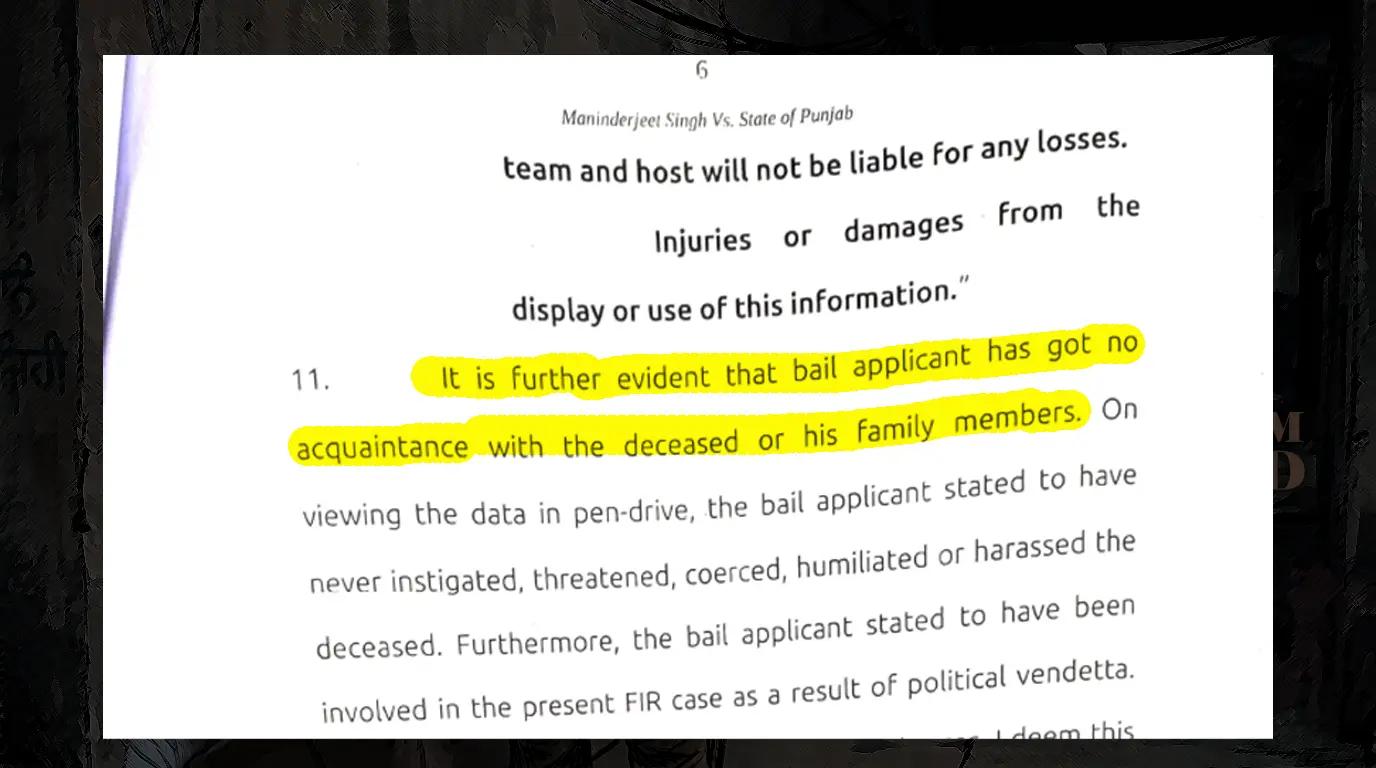
Around 10 days later, Sidhu secured anticipatory bail, with the sessions court noting that Sidhu had “no acquaintance with the deceased or his family members”.
Of the rest, only one accused was arrested later.
Sidhu might have saved himself from police custody, but he now faces a long-drawn legal battle for showing how rampant drug abuse is in Punjab. Sidhu, the digital journalist, has been turned by Punjab police into Sidhu, the alleged criminal.
This is not the first time that Sidhu has questioned the AAP government or its functionaries on drug abuses (here, here, here) and other issues related to floods, police brutality, farmers’ protest, government’s advertisement spend.
This is also not the first time Sidhu has suffered the state government’s wrath. He runs Lok Awaz TV, a social media-based news platform with over two million followers, and has repeatedly found himself on the wrong side of the law for his critical coverage of the ruling AAP government.
The AAP had illegally got Lok Awaz TV's Facebook page taken down through copyright strikes. The Punjab police had got Sidhu’s second Facebook page deleted in March after he reported on police brutality against protesting farmers.
Before that, in December 2025, he was named in an FIR over his reporting on the alleged misuse of Chief Minister Mann’s helicopter. The high court later stayed the investigation.
The Collective travelled to Khudian Gulab Singh village to reconstruct how Sidhu landed in this trap.
At Khudian Gulab Singh village
The police’s shoddy case against Sidhu began to fall apart without effort.
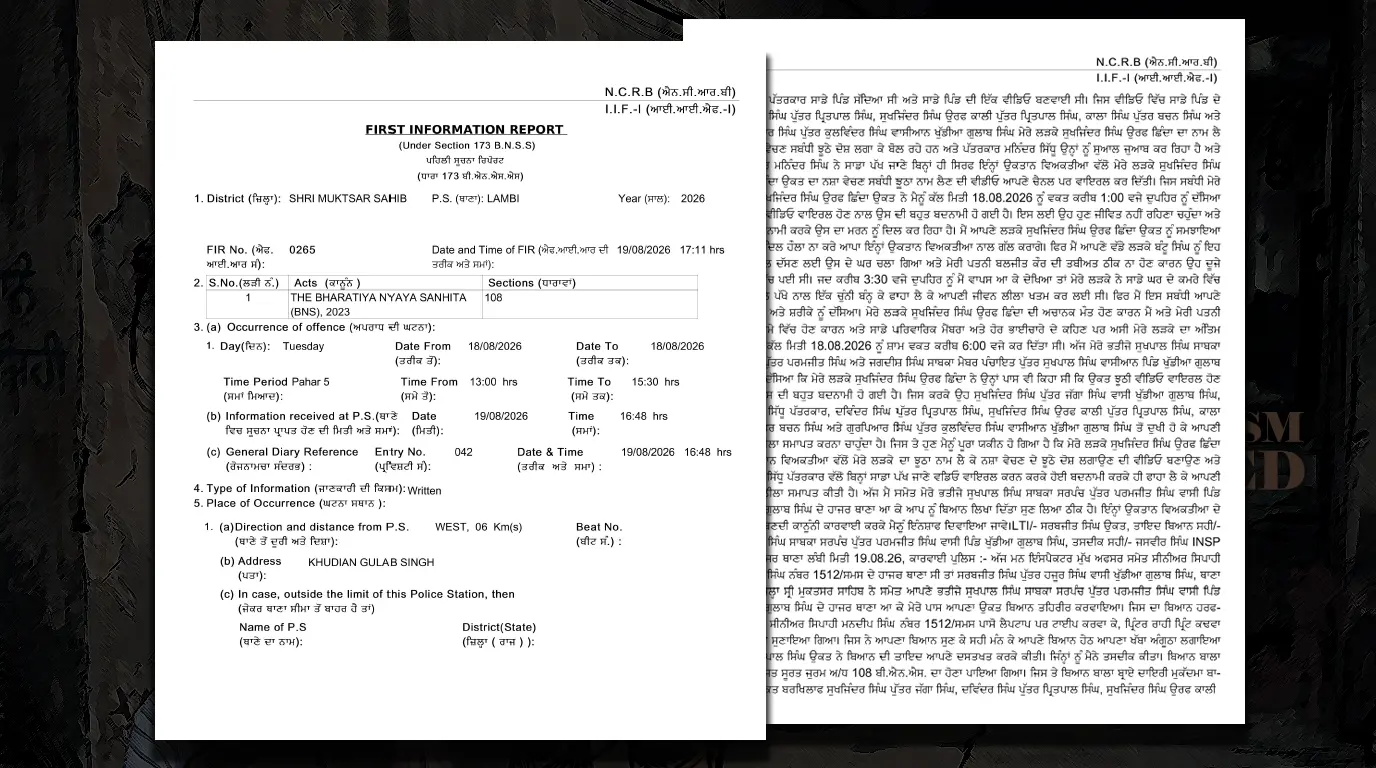
The case was based on an FIR filed by the deceased’s father, Sarabjit Singh.
On August 19, a day after his son’s death, Sarabjit, accompanied by two former panchayat officials, went to the Lambi police station to record his statement.
The FIR said that Sukhjinder, alias Chhinda, informed his father, Sarabjit, that the journalist and others had defamed him. “My son Sukhjinder Singh alias Chhinda on August 18 around 1pm told me that the viral video has defamed him. That’s why he did not wish to live anymore,” Sarabjit said in his statement.
Sukhjinder had hanged himself soon after, between 1.30 pm and 3.30 pm.
His body was cremated at around 6 pm the same day by the family.
The police were informed the next day at 4.48 pm, the FIR notes.
In the case of an unnatural death, including suicide, a police officer is required to prepare an on-the-spot report (called an inquest report) and submit it to the executive magistrate. The report contains details of “wounds, fractures, bruises, and other marks of injury,” essentially everything that may have caused death, according to Section 194(1) of the Bharatiya Nagrik Suraksha Sanhita (BNSS).
In this case, Chhinda was cremated without an inquest and a post-mortem. The scene of the crime had been disturbed.
We spoke to senior lawyers in Punjab to understand what evidence and proof are required to declare that a person has died by suicide and that someone has pushed the deceased to do so.
“The inquest report is the epicentre in cases of unnatural death. The case revolves around it,” said Loveneet Thakur, a lawyer at the Punjab and Haryana High Court.
Ravinder Singh Dhull, senior lawyer at the high court, underlined that the police should have instead registered a case for destruction of evidence as it is not clear if the youth died by suicide.
Dhull, the former additional advocate general of Haryana, told The Collective that the case suffers from legal infirmities. The cause of death cannot be ascertained for lack of post-mortem, and there is no “active instigation” by the journalist, as he did not know the deceased.
We visited the deceased Sukhjinder’s house. The Dalit family owns a rudimentary two-room house. It was built under a government scheme, in need of repairs, cracked cement floor and wall paint peeling off. It was almost empty except for a tilted fan, a storage trunk, two charpoys, dust-covered utensils and a gas stove without the cylinder.
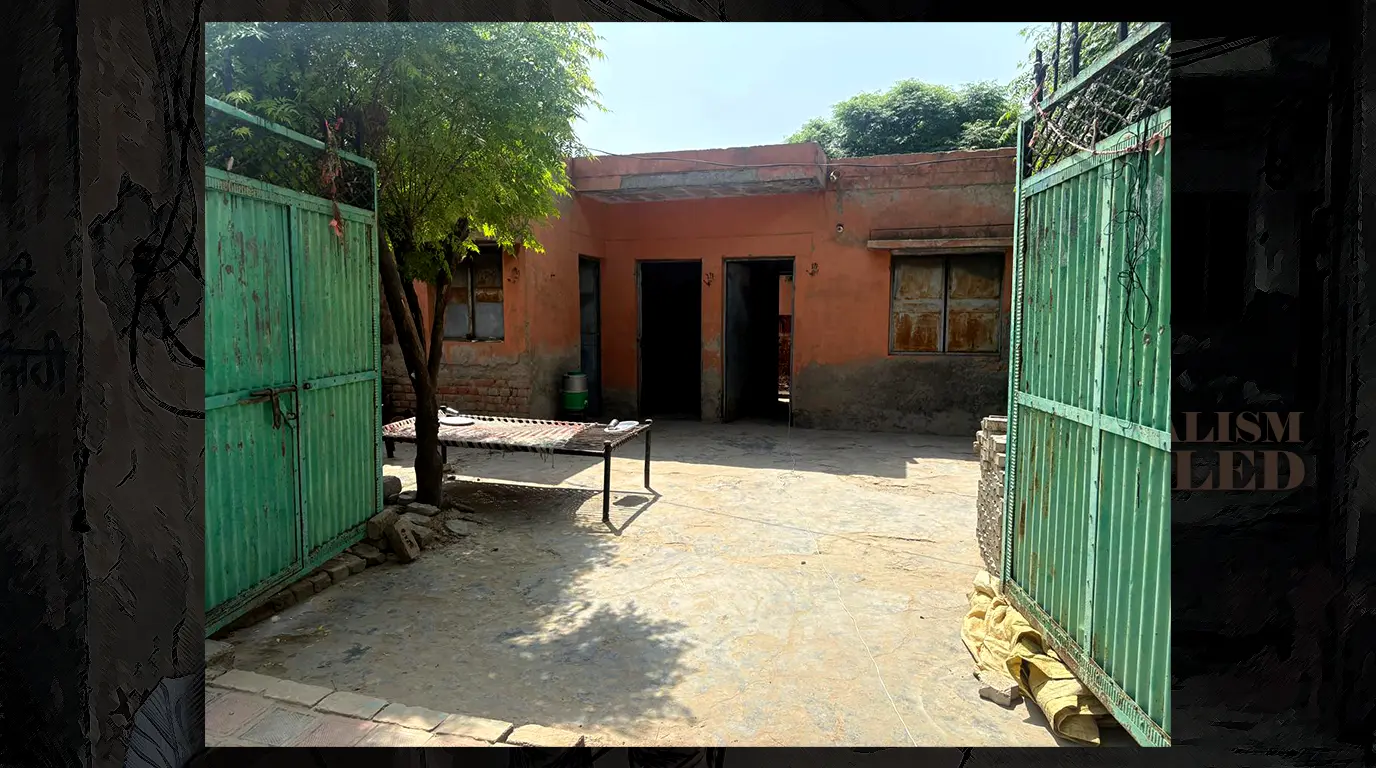
His mother, Baljeet Kaur, told us, “He was restless after the video... He feared that he would be picked up by police. I told him that we can sell our house to bribe our way out of a police case.”
We asked why a post-mortem had not been conducted. Kaur claimed they had opted against it because of “mutilation” of the body at the hospital.
Accompanied by the same two former elected members of the panchayat, his father sat quietly listening to us.
The two former panchayat members then took over the conversation. They claimed the video was an attempt to defame agriculture minister Gurmeet Singh Khuddian. Only one or two out of 100 youths in the village take chitta. The ones recorded in the video Sidhu had shot.
A few minutes into our conversation, we were joined by another person, Mohit Soni, the media point person for Khuddian. He introduced himself as a journalist.
But his questions were focussed only on The Reporters’ Collective.
He asked why we had come all the way from Delhi. While we conversed, his phone rang twice and we noticed the caller ID read, “Agriculture Ministry.”
When he learnt of our previous reporting on the AAP government’s illegal way of silencing its critics in journalism, he ‘cautioned’ us that we could be held responsible for vitiating the village’s atmosphere.
Mohit was referring to our conversations earlier in the day with the villagers at the local dharamshala. The same dharamshala that Sidhu had shot drug addicts at.
Khudian Gulab Singh village has around 1,000 families, and most of them depend on agriculture or daily wages. The dharamshala is symptomatic of the challenge the village is wrestling with. The hall, meant for guests, has been cleaned of its iron window grills allegedly by drug addicts.
That day, a group of 20 men and women, including those from the accused’s families, had assembled to meet our reporter. Initially, most were hesitant to share anything on the case.
Slowly, they opened up. Some termed the suicide abetment case against journalist Sidhu and the five villagers a “political conspiracy”. Except for one, others did not say who had hatched the conspiracy. One villager claimed the minister Khuddian was behind it.
Several said Sidhu had shown the reality of the village. They said 20-25 young men had died of chitta overdose in the last five years. At least five of the villagers alleged that Sukhjinder sold chitta to fund his own habit.
Ten days before his death, he was seen in a video (which we reviewed independently) trying to break up a fight between two alleged groups of drug-peddlers, the villagers told us.
While our reporter was conversing, a group of people sympathetic to Sukhjinder’s family turned up at the dharamshala to defend the deceased and claim drug addiction was not a serious problem in the village. This led to an argument between the villagers.
Soni, the minister’s pointsman, had referred to this altercation, attempting to blame it on The Collective.
We digested the veiled threat from Soni and decided to leave the village.
Khudian Gulab Singh village sits around 40 km from Muktsar city. We drove back to the city to meet the Senior Superintendent of Police (SSP) Abhimanyu Rana. We could not catch him that day but spoke to him later on the phone.
Muktsar district statistics have a story to tell.
As many as 1,012 cases under the Narcotic Drugs and Psychotropic Substances (NDPS) Act have been registered and 1,537 people have been arrested in the district in just 2026.
Of these, minister Khuddian’s constituency has accounted for 264 cases and 377 arrests.
Khudian Gulab Singh village accounts for six such cases and nine arrests.
SSP Rana told us later on phone that since the Yudh Nashian Virudh campaign was launched, the police had registered over 1,000 FIRs under the NDPS Act and more than 3,000 people had been arrested across the district. He claimed that the drug use had declined in the district. According to the Punjab government, police have arrested over 77,000 people under the campaign across the state.
In Sidhu’s case, he claimed, the police could swing into action only after they were informed of the death more than 24 hours after the incident. He said the police would rely on circumstantial evidence and eyewitness accounts.
“That (no post-mortem was conducted and the crime scene was tampered with) is part of the investigation. There are different types of evidence, circumstantial evidence and eyewitness accounts. We have to take them into account,” he said.
The minister Khuddian, on his part, has blamed it all on the political opposition in the state.
Sidhu, the journalist, calls it a case of “political vendetta” against him for his journalism.
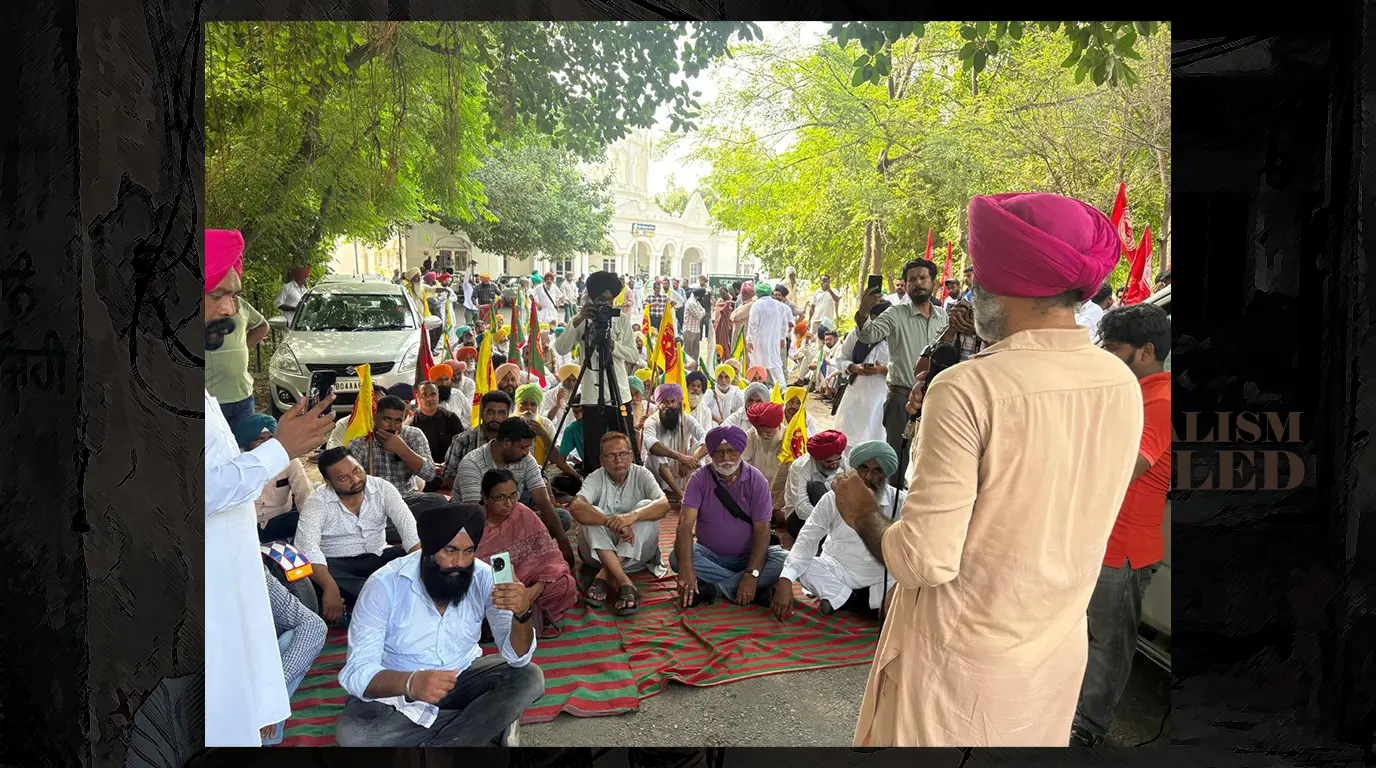
State’s journalist associations and others, including unions representing journalists, farmers, government employees, students and the unemployed, have come out in Sidhu’s support, calling the case false and demanding it be quashed.
The case took another turn a few days after The Collective’s visit. In a recent interview with an online news platform Punjab Dastavez, Sukhjinder’s father, Sarabjit, denied his role in the FIR and claimed it was done at Khuddian’s behest.
“Who filed the case?” journalist Rajinder Singh Taggar asked Sarabjit.
“I don’t know. Jathedaar [minister] sent for it [FIR],” Sarabjit replied.
“So the minister’s people got the case registered?” Taggar asked again.
“Yes,” replied Sarabjit.
When asked about his role in the case, the minister told The Collective: “Show me if I have made any call to the SHO or DSP. I was in Delhi on that day (of the FIR). The case was filed by the family.” Khuddian also downplayed the drug menace in his constituency.
Questions emailed to AAP leaders and the chief minister’s office went unanswered. The copy will be updated if and when we receive a response.
SSP Rana, too, denied any political angle to the case.
“I did not get any political call to register FIR. It is strictly registered as per the Supreme Court guidelines,” he said, referring to the 2013 landmark judgment in Lalita Kumari vs State of Uttar Pradesh, which mandated that the police are duty-bound to register FIRs without delay in cognisable offences.
Meanwhile, Punjab’s chitta epidemic and AAP’s political campaign roll on.