.webp)


Chandigarh and New Delhi: They gained millions of views on their news content on social media. Then the Aam Aadmi Party came for them.
Since October last year, the ruling party in Punjab has claimed copyright ownership of at least 48 videos and posts uploaded by journalists on Facebook that were critical of the Aam Aadmi Party (AAP) government.
Four Facebook pages were taken down between January and April 2026 after copyright infringement notices for content AAP claimed as its own. A fifth was removed after a Punjab police notice was sent, which was separately hit with five copyright notices as well.
Together, the five pages had over 30 lakh followers when they were taken down.
AAP has repeatedly accused other parties, including the Bharatiya Janata Party, of controlling and gagging the media. On August 7, AAP chief Arvind Kejriwal accused the Narendra Modi government of targeting social media users who posted anti-establishment content during the Gen Z protests, after his own Instagram account, along with those of journalists and media houses, was restricted. He called it an attack on fundamental rights.
But, in Punjab, where AAP is in power, the party has used the same tactic it accuses others of. Over several months, AAP filed copyright infringement claims against journalists to legally force takedowns of their pages that were critical of the Punjab government.
A copyright strike is a legal penalty issued by an online platform to take down content when a genuine copyright owner claims their work was used without permission.
The content AAP flagged as copyright infringement included press releases from a Sikh religious body, an opposition MLA’s photo, Punjab Chief Minister Bhagwant Mann’s own social media posts, AI-generated images, a government notification on state board appointments, and photos of the state legislative assembly. Photos of Mann and other AAP leaders accounted for the most copyright strikes. Much of this content was evidently not AAP’s to claim.
This is not the first time AAP has targeted the press. Since forming the government in Punjab in 2022, the party has faced accusations of threatening journalists and RTI activists with police cases, blocking the circulation of newspapers including The Indian Express, running a “targeted witch-hunt” of the Punjab Kesari group, and getting journalists’ social media accounts suspended. Opposition parties called it a “chilling attack on press freedom.”
The five cases we looked into included Facebook accounts of RMB Television, Lok Awaz TV, Maninderjeet Sidhu, Rattandeep Singh Dhaliwal, and Parmeet Singh Bidowali. These pages are run by four vernacular journalists working out of small towns to tier three cities in Punjab.
Between January and April, the affected journalists wrote to Facebook’s grievance officer and filed appeals for content and page restoration.
Two of them approached the Punjab and Haryana High Court, alleging censorship through copyright strikes. One of them is still in court. The second was withdrawn after the state government filed its reply detailing reasons for takedown.
None of these measures led to restoration of pages.
The pages stayed inaccessible for months, until The Reporters’ Collective sent a questionnaire to Meta, which owns Facebook. “The content and accounts were removed in error and have since been restored,” a Meta spokesperson said. Four of the five pages were restored, we found.
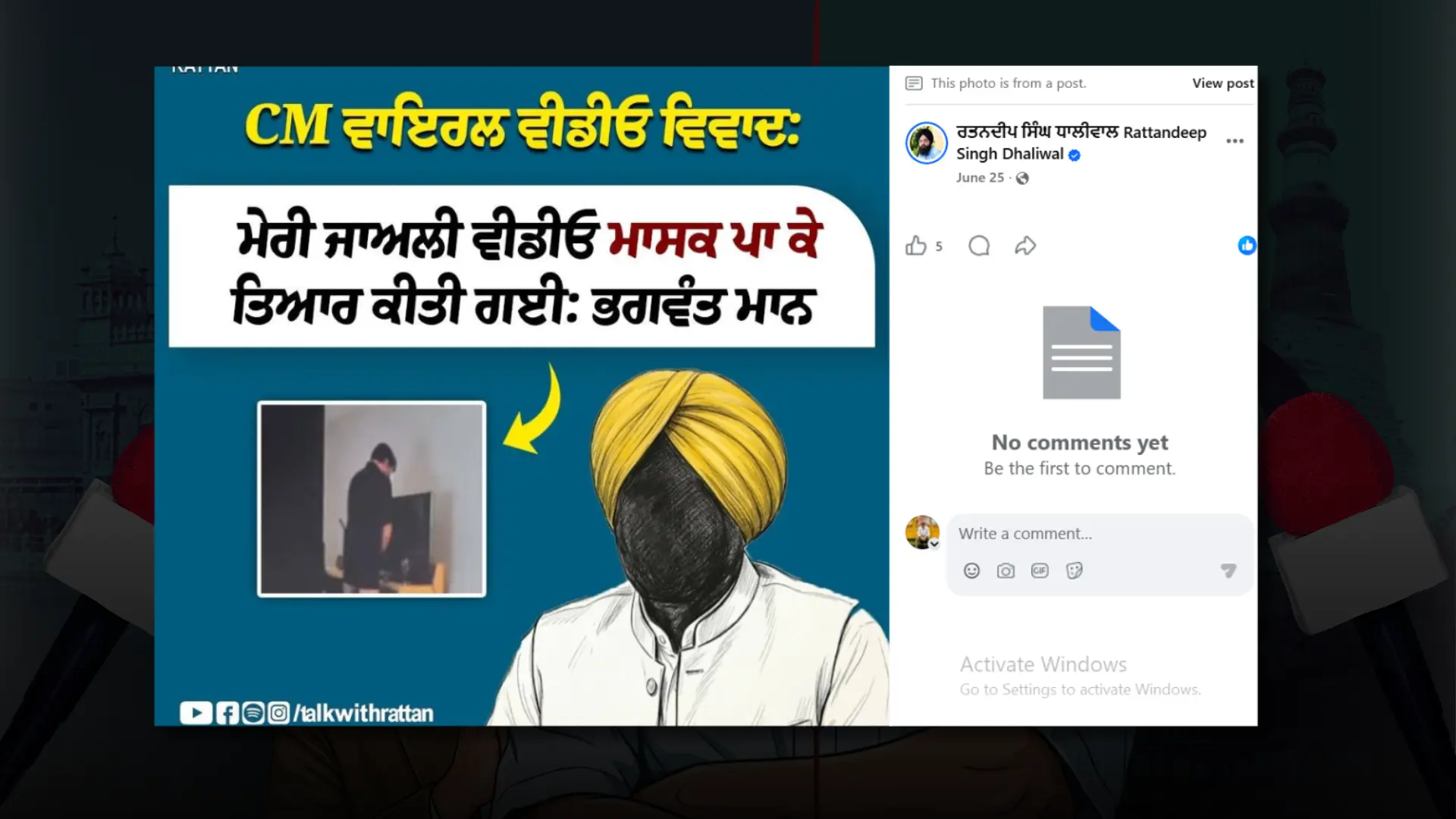
RMB Television was restored on June 17, two days after the questions were sent. The other three – Lok Awaz TV, Rattandeep Singh Dhaliwal and Parmeet Singh Bidowali – were restored on June 22. The ‘Maninderjeet Sidhu’ page remains down, blocked by a legal demand from Punjab police.
As a precaution, Maninderjeet Singh Sidhu, who runs Lok Awaz TV, cleaned the page of all AAP-related content to avoid further copyright strikes. The other journalists have kept their old content up on their restored pages.
The Software Freedom Law Centre, a Delhi-based non-profit working on digital rights, said the pages’ restoration shows that automated moderation results in “opaque and overbroad censorship.”
When asked about the copyright strikes, AAP-Punjab’s media in-charge Baltej Pannu claimed the four men whose Facebook pages were deleted were “not journalists.”
“If anyone who does not have a proper degree or qualification, and is indulging in baseless allegations [against AAP], we have to take action,” said Pannu.
In India, journalists require no degree to practice journalism. Media practitioners along with common citizens have the right to critique any government and their policies. By exploiting intellectual property laws, AAP-Punjab has found a new way to target journalists critical of the state government. Usually, private parties use other legal routes available to them such as defamation to go after critics.
Nevertheless, we found three of the journalists targeted by AAP have journalism degrees, and the fourth is currently enrolled in a journalism course. One of them even interviewed Mann in 2019 before AAP came to power in Punjab.
{{cta-block}}
What AAP Claimed as Their Content
Digital rights experts say this may be the first time a political party in India has used copyright strikes for “censorship” at this scale. One expert The Collective spoke to said platforms are more likely to remove reported content because they can be held liable under the Information Technology Rules, 2021.
Punjab’s vernacular digital outlets grew out of the 2020-21 farmers’ protest, as journalists frustrated with constraints of mainstream media moved online. Advertisement revenue from views too attracted them to the online content game. While there is no official count, journalists in Punjab estimate around 200 such outlets, mostly on Facebook and YouTube.
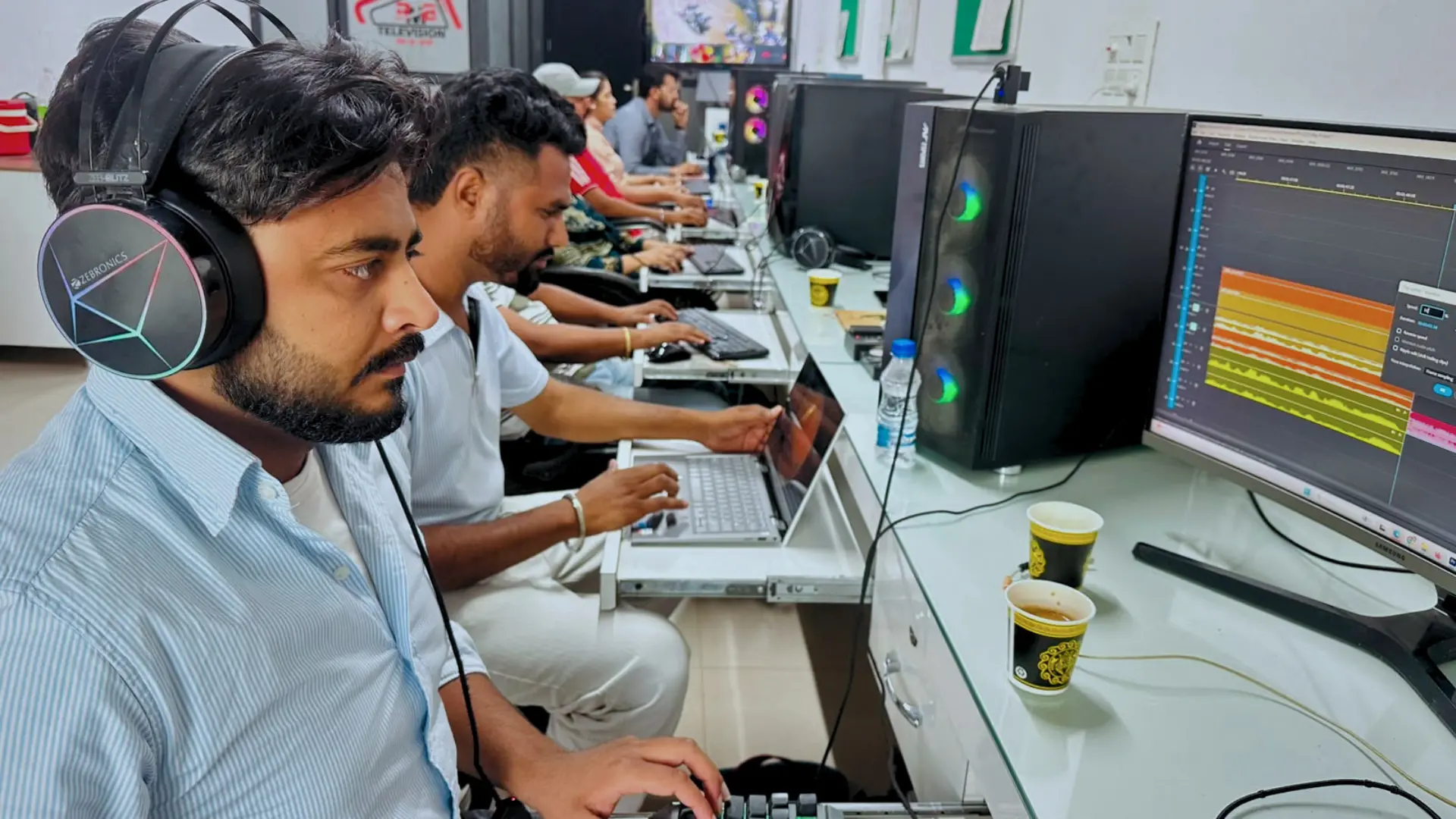
Two of these platforms, Lok Awaz TV and Maninderjeet Sidhu, with 9.7 lakh and 4.5 lakh followers respectively, are run by Faridkot-based journalist Maninderjeet Singh Sidhu, who employs around 15 people. He runs his newsroom from a rented two-room office in Faridkot’s Jaitu.
AAP filed at least 20 copyright strikes against Sidhu’s two pages. At least 15 strikes brought down the Lok Awaz TV page in January. The Maninderjeet Sidhu page was removed separately, for allegedly violating the IT Act in March. It was also hit with at least five intellectual property rights (IPR) claims.
The flagged content included photo of Mann, Kejriwal, and AAP MLAs protesting in the Punjab assembly. AAP told Facebook that even AI-generated images of Mann and Kejriwal, and a photo of a Congress MLA, infringed its IPR.
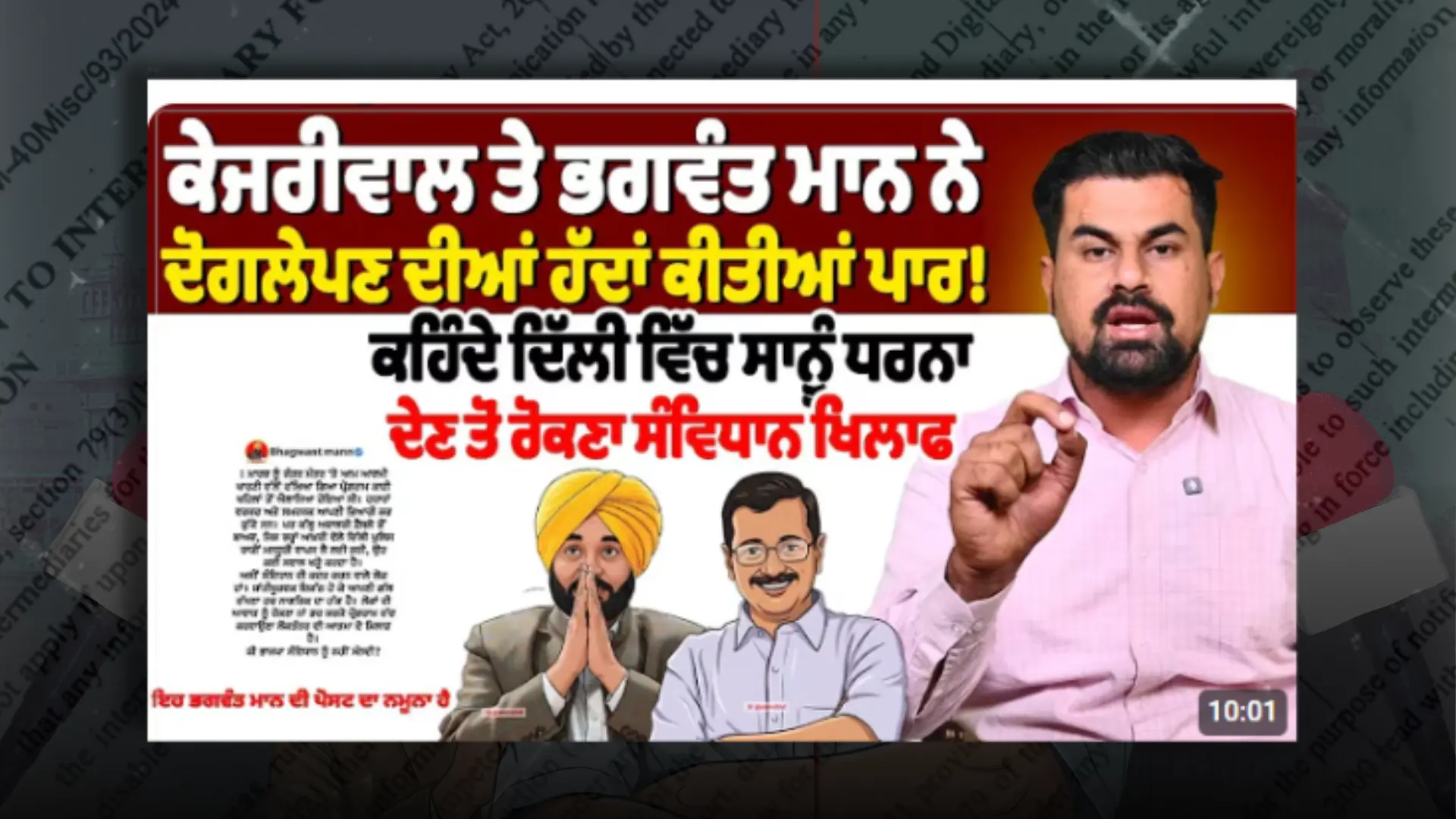
On September 26, 2025, Lok Awaz TV posted a video of Sidhu commenting on AAP MLAs protesting against the Union government in the assembly. The video, still available on YouTube, contained five photos of AAP MLAs holding placards calling Prime Minister Narendra Modi’s Rs 1,600-crore flood relief a “jumla.”
The Collective traced one of these photos to AAP-Punjab’s own handle on X (formerly Twitter). However, Surinder Singh Moti, secretary to Speaker Kultar Singh Sandhwan, said no political party is authorised to take photographs inside the assembly. And yet AAP claimed ownership of photos taken from inside it. Repeated calls and email to the assembly secretary, Ram Lok Khatana, have gone unanswered. A questionnaire was sent to the speaker as well.
The Punjab government also telecasts assembly proceedings on its YouTube channel.
The assembly rulebook bars journalists from photographing assembly proceedings. Reporters instead rely on video grabs from the government’s own Youtube telecast and official press releases.
In his January 20 letter to Facebook’s grievance officer, Sidhu argued that posting publicly available government content does not infringe upon “proprietary rights” for AAP. Repeated attempts, he wrote, to resolve this matter amicably didn’t yield any substantive response from the party.
“Moreover, the Vidhan Sabha Secretariat has not objected to the use of its content, and the strikes have been issued evidently by a political party with no legal control over the Vidhan Sabha,” the letter said.
Sidhu’s other page, Maninderjeet Sidhu, received at least five IP claims along with legal notices for eight videos separately under section 79(3)(b) of the Information Technology (IT) Act, 2000, which says that platforms can be held liable if content objected to by authorities is not removed. Facebook pulled the videos down after Punjab police’s legal notice.
The eight videos from February documented (here, here, here) alleged police action against farmers in Bhatinda, among others. Sidhu approached the Punjab and Haryana High Court seeking restoration and the grounds for takedown.
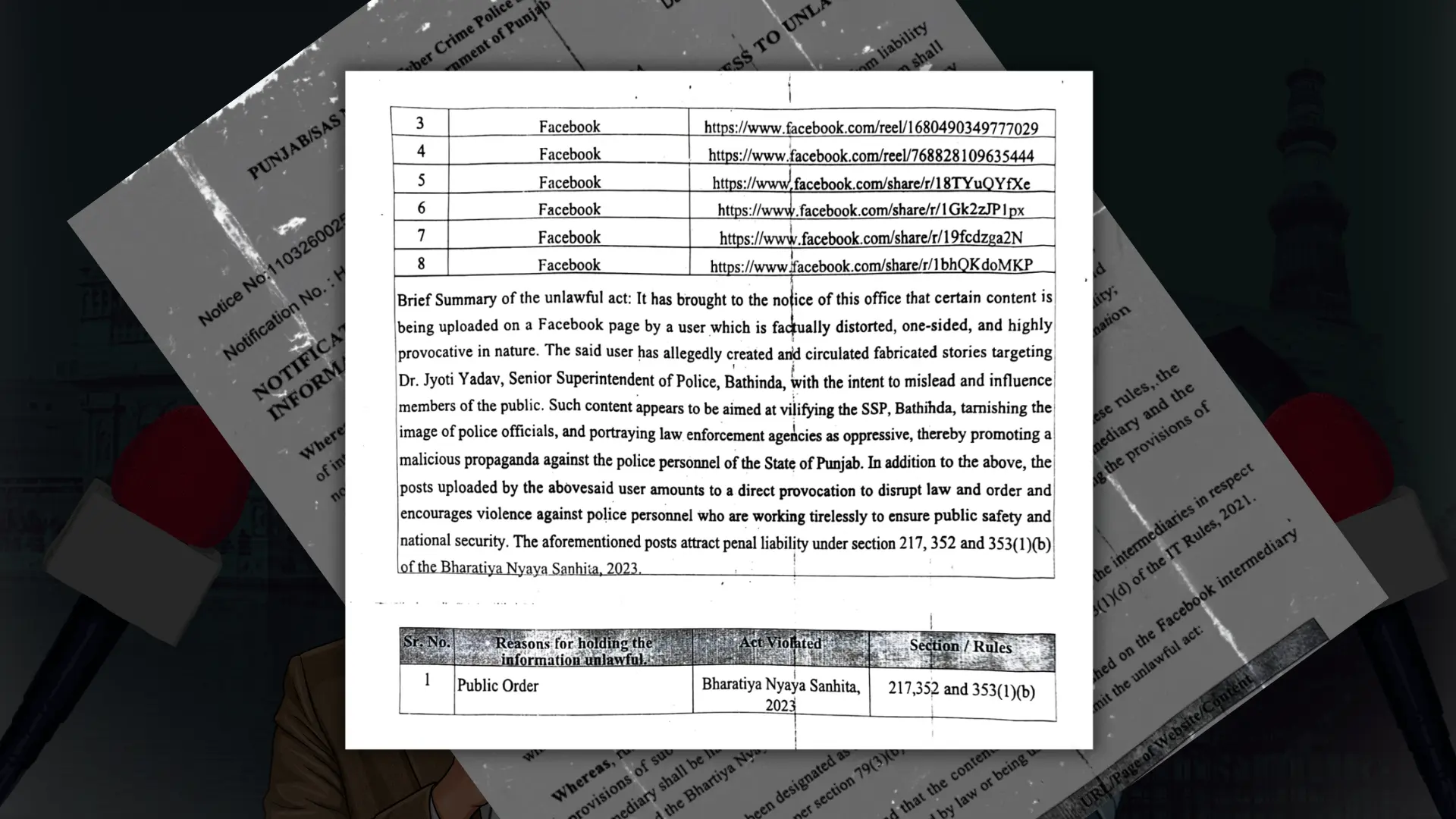
In a March 20 notice to Facebook, V Neeraja, additional director general of police (cyber crime), called the content “factually distorted, one-sided, and highly provocative,” targeting Bhatinda’s senior superintendent of police, Jyoti Yadav, according to the notice. Yadav is married to state Information & Public Relations Minister Harjot Singh Bains. Sidhu withdrew the petition on May 20. Sidhu’s lawyer, Nikhil Ghai, said, “We wanted to know the grounds for the page deletion. Since we now know the reason, we will proceed in accordance with the law.” Sidhu is expected to file a fresh case challenging the grounds.
“Anyone who questions the government is attacked… through this new method of copyright claims,” Sidhu told The Collective.
Around 50 km south of Sidhu’s office, in Bhatinda’s Rampura Phul, Rattandeep Singh Dhaliwal runs a studio with a three-person team from his house. His eponymous Facebook page bore 19 copyright strikes from AAP, leading to its removal on February 27. The page had 3.24 lakh followers and 3,200 posts when it was taken down.
In an email on March 10, Facebook told Dhaliwal that his content had been “reported multiple times by third parties for infringing their intellectual property rights” and that the account was disabled “as a result of detection by our technology.”
One deleted post related to a press release from Sri Akal Takhat Sahib, the highest temporal body of the Sikhs. On January 13, Dhaliwal’s page had shared the release with a comment noting that Chief Minister Mann’s appearance at the Akal Takhat secretariat had been changed from 10 am to 4.30 pm.
More than a month later, Facebook told Dhaliwal the post had been removed after an AAP-Punjab’s strike over a copyrighted material, “a photo.” The press release or the post contained no photo pointing to the arbitrariness of the process.
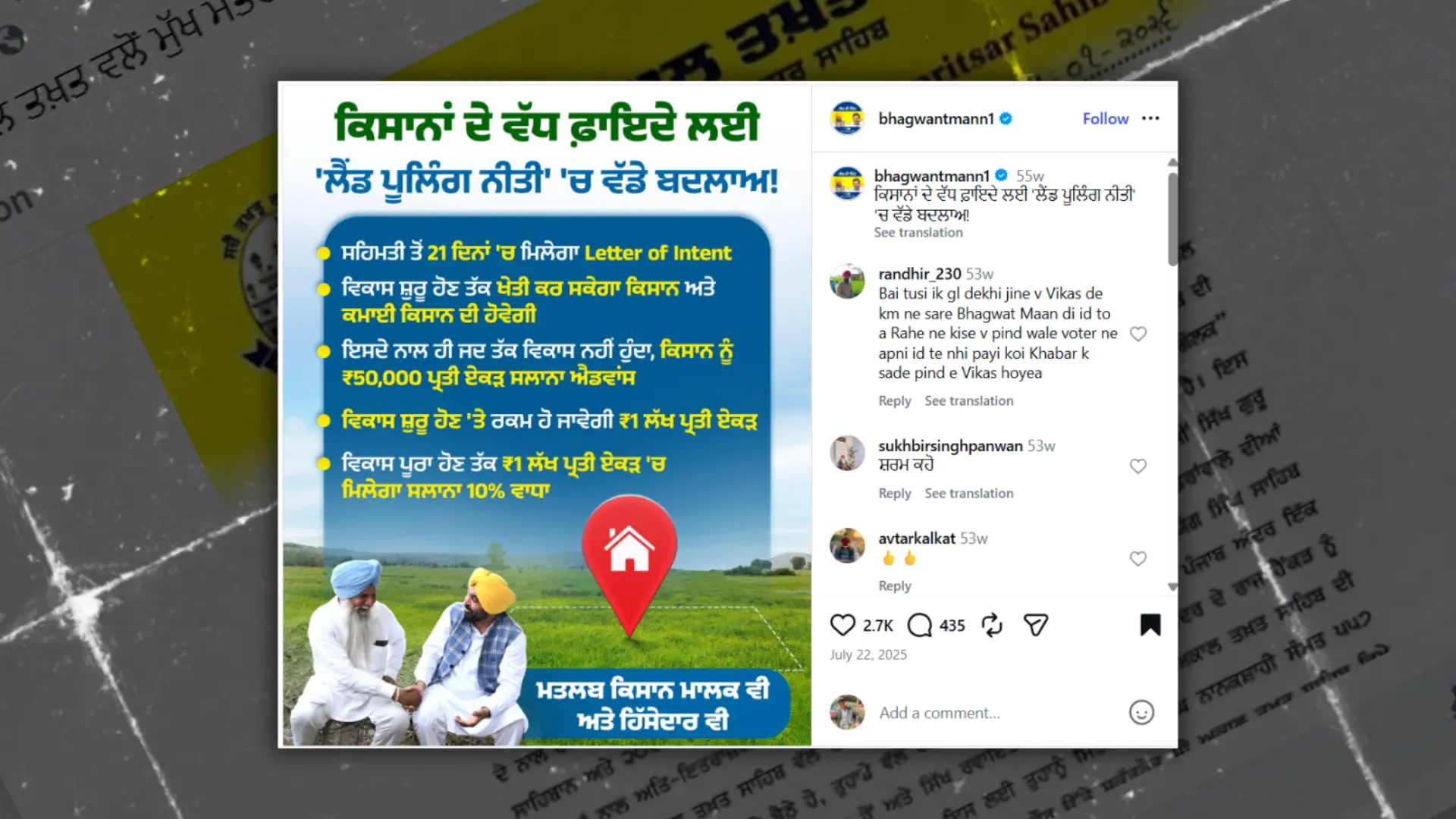
Another removed post used the same digital poster Mann and AAP-Punjab had posted on their own Instagram and Facebook pages. The poster promoted Mann government’s land pooling policy. We couldn’t independently verify the ownership of the poster. Dhaliwal’s page was later restored but this poster and the Akal Takhat press release are still not visible.
A day after The Collective met Dhaliwal on May 25, Punjab police visited his house over a video in which he claimed around 32 sitting AAP MLAs may not be fielded again in the upcoming Punjab elections. Several AAP MLAs filed, Dhaliwal claimed, pre-filled police complaints alleging the video spread “false, fabricated and misleading” information likely to create “unrest and disturb the peace,” an act they termed anti-national. Cops from at least six districts came to question him over the following week. Dhaliwal has approached the high court to stay the police proceedings against him.
In Bhatinda, digital journalist Jass Grewal lost his Facebook page, with 1.4 million followers, after three AAP copyright claims in April.
Among the 48 posts removed, RMB Television’s was the oldest, uploaded on January 7, 2022, announcing the eighth list of AAP’s candidates for the assembly polls. Facebook told RMB Television it had removed the post after a third-party copyright complaint over a “photo.”
“In Delhi, Kejriwal keeps talking about Godi media. The reality is that press freedom is worse in Punjab than in Delhi. In Delhi, you have Godi media, here we have Keji media… If you speak up, you are choked,” Grewal said, sitting in his rented office with 10 employees. He has since started a new page with the same name.
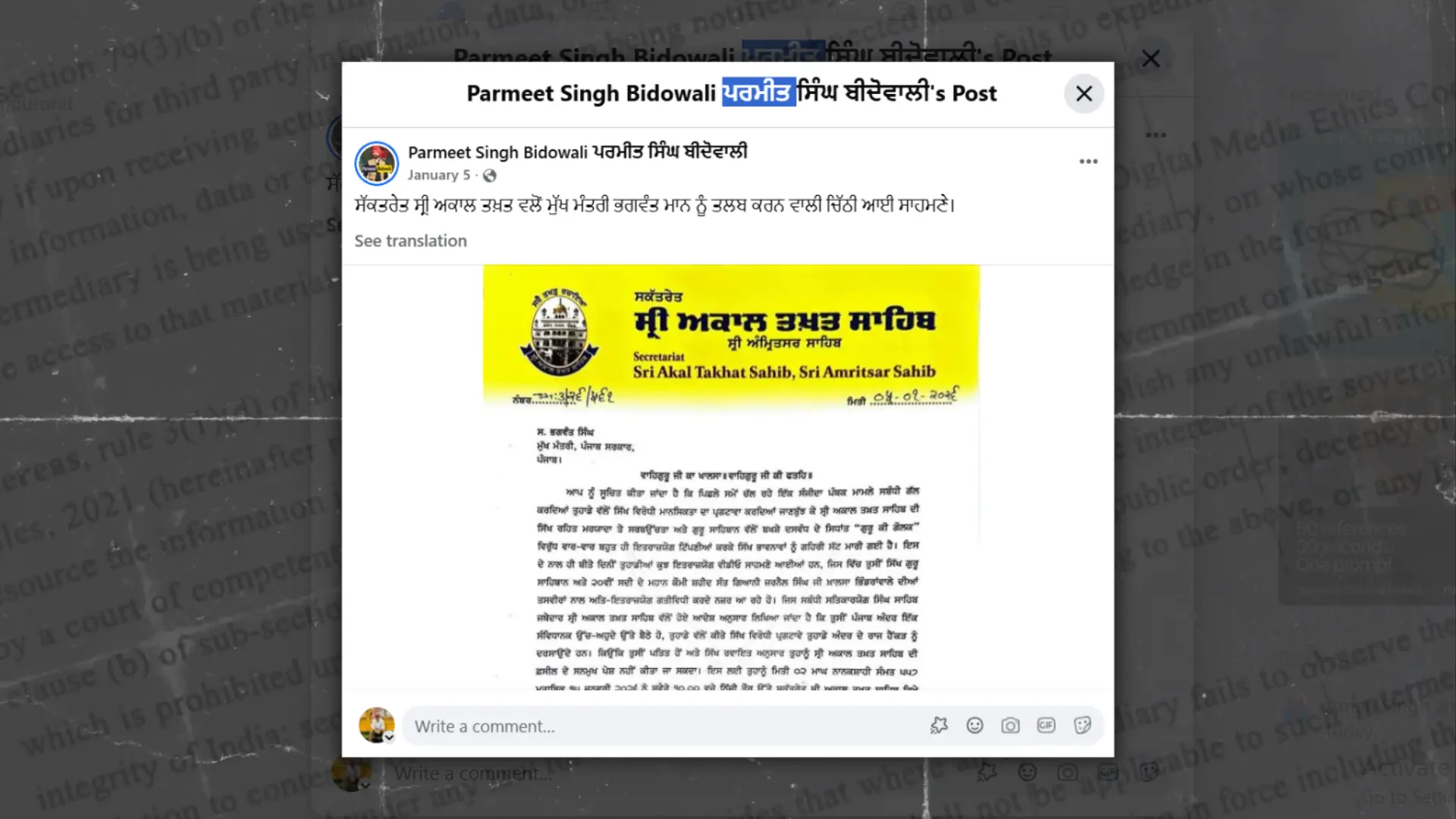
Parmeet Singh Bidowali’s page, which started in 2021 and has 66,000 followers, was hit with at least six IPR claims in February, leading to its removal. AAP claimed ownership of another Sri Akal Takhat Sahib press release that Bidowali had posted on January 5. Here too, the AAP wrongly claimed that its photo was used in the post.
In his email to Facebook, Bidowali wrote, “The copyright strike sent by the Aam Aadmi Party is wrong. Because it is not the property of Chief Minister Punjab Bhagwant Mann and the Aam Aadmi Party.”
Facebook also removed four of Bidowali’s posts that had reshared Mann’s own social media comments, including one which republished Mann’s tweet. The post reportedly referred to a meeting between Radha Soami Satsang Beas head Gurinder Singh Dhillon and Shiromani Akali Dal leader Bikram Singh Majithia in jail. A few hours after the meeting, Majithia was granted bail in a disproportionate assets case. The Collective has seen three more reshared posts (here, here, here). All have since been restored.
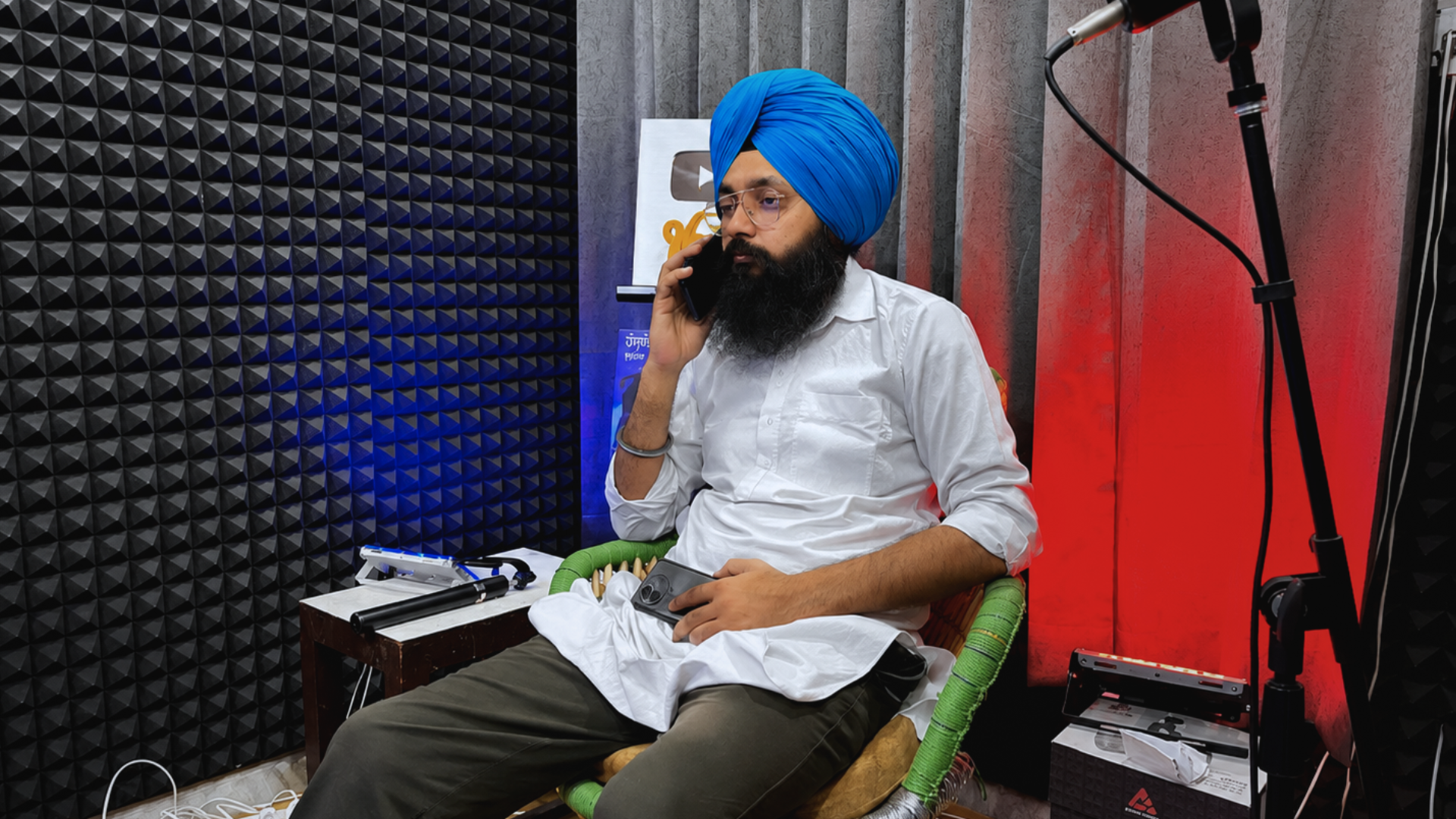
Amid all of this, Bidowali managed to protect a second Facebook page, Punjab Inside TV, with 45,000 followers, by deleting anything remotely linked to AAP as strikes piled up. He no longer uses photos of Mann or any AAP leader, instead he blacks out faces or uses AI sketches.
“During the Emergency, newspapers ran blank editorial columns. Similarly, in Punjab, we don’t show Mann’s face, as a precaution and mark of protest,” he said.
Weaponising the Copyright Law
Not all journalists have switched to AI sketches. Some prominent digital platforms in Punjab continue to use videos and photos of Mann and other cabinet ministers (here, here, here), suggesting the five Facebook pages we reviewed were targeted by AAP for their criticism of the state government.
“The Mann government wanted to make an example out of us. That’s why they have picked on us,” said Sidhu.
The takedowns also led to a financial crunch. Journalists said Facebook accounted for nearly half their income, the rest coming from YouTube.
All five journalists started new pages after losing their old ones. “After our page was removed, it has, at times, become difficult to pay salaries. But we are managing,” said Grewal, who employs around 10 people. The targeted journalists have their YouTube and Instagram accounts intact.
Since November last year, Chandigarh Press Club has issued at least seven press releases expressing concerns over the state government’s “suppression” of press freedom.
Matters came to a head on December 12, 2025, when Punjab cybercrime police filed an FIR against nine people, including three digital journalists and an RTI activist, and Lok Awaz TV, over reporting on the alleged misuse of Mann’s helicopter while he was in Japan. The high court stayed the investigation.
Following this, digital journalists formed a collective, the Press Di Azadi Bahal Karo Sangarsh Committee. It has held four protests since January in the state, the latest on May 5 in Bhatinda.
A January 2, 2026 press release by the Chandigarh Press Club said, “In recent times, there have been repeated incidents involving governments and state functionaries attempting to control, intimidate, or curb press freedom.” In a memorandum submitted to the Punjab governor Gulab Chand Kataria in June, the Club flagged targeting of social pages of independent journalists through copyright claims by AAP.
AAP’s Pannu said the party was within its right to send copyright strikes. “If the property, like video or other content, belongs to the Aam Aadmi Party, they can send it (copyright strike),” he said.
When asked about copyright for others’ content such as press releases of Sri Akal Takhat, he said he was not aware of such instances.
The Collective’s questionnaire emailed to Kejriwal, Mann, AAP national media in-charge Anurag Dhanda, and state president Aman Arora has not been responded to.
Private vs Public Owned
Facebook removes flagged content for violating its “community standards,” through what it describes as “automated technology or a review team.” It says it “may promptly” remove reported content before contacting the person who posted it. According to its own IP report, roughly 70 to 80 per cent of the reported content on Facebook and Instagram are taken down.
After a takedown, creators are informed by email or in-app notification, and given two options: appeal, or contact the copyright owner. Facebook shares the report number, the rights owner’s name and email, details of the complaint, and instructions to file an appeal.
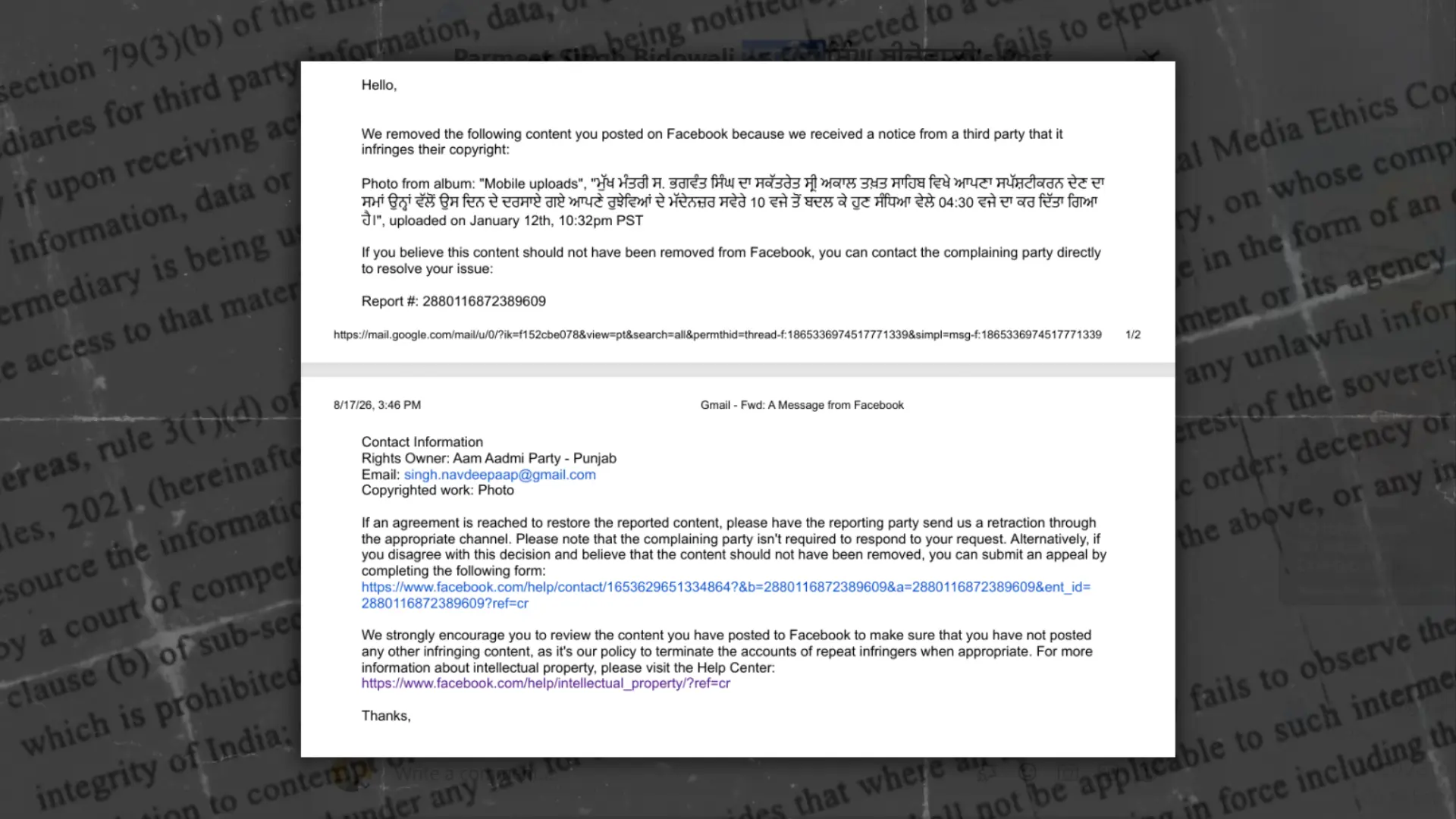
Appeal decisions can be challenged with an intermediary’s grievance officer, and can be escalated to the Ministry of Electronics and Information Technology’s Grievance Appellate Committee.
Facebook defines copyright as a legal right that “protects original expression such as words or images,” not facts or ideas, though it may protect the original words or images used to describe an idea.
Its fair use policy takes into account certain parameters like “purpose and character of the use”, nature of the copyrighted work, and the portion of content used. The company also notes that fair use exceptions vary by country.
Dhaliwal’s high court petition argued that under Section 52 of the 1957 Copyright Act, use of content for reporting current events, criticism, and review does not count as infringement. It also cited a section under which government work is owned by the government unless said otherwise, questioning AAP-Punjab’s copyright claim.
A Supreme Court lawyer who has dealt with several copyright cases said resharing Mann’s tweets for news falls within fair use.
“Bhagwant Mann arguably has the copyright claim on his tweets. Retweeting them with a commentary should come under fair use. So, that’s arguably not a copyright violation,” said the lawyer.
The petition said such strikes have held journalism “hostage to political sensitivity,” and that a chief minister performing public functions cannot, by any stretch of law, become private intellectual or personal property.
The high court, admitting the petition, directed the Union and Punjab governments, Meta, and AAP-Punjab to file affidavits by July 27 later extended to September 14.
Sidhu has made similar arguments in his petition. Sidhu argued the removed content was journalistic, based on public events or statements, and that AAP can’t claim copyright over it. Sidhu’s petition centres on the police demand, while claiming his page was erroneously struck.
Nikhil Pahwa, digital rights activist and editor of MediaNama, said this may be the first time that a political party is using copyright strikes as a press “censorship” tool.
“Of course, there have been copyright strike cases most prominently involving ANI. But it was different in its nature [commercial]. I have not come across any instance where a political party has used copyright strikes as a mechanism for censorship,” he told The Collective.
He added that social media platforms are prone to acting hastily on such complaints because they have little time to review them and can be held liable. “It’s safer for them to remove content instead of letting it be,” said Pahwa.
Surprised at the scale of copyright strikes, a representative of Software Freedom Law Centre, the Delhi-based non-profit, said targeting creators through copyright strikes on Facebook is a relatively new trend, which happened mostly on YouTube until recently.
“There has been a rising trend of copyright strikes on Meta platforms in the last three months,” said the representative. “We don’t know if the review of the copyrighted content is automated or manual. It’s opaque.”