.avif)
.webp)
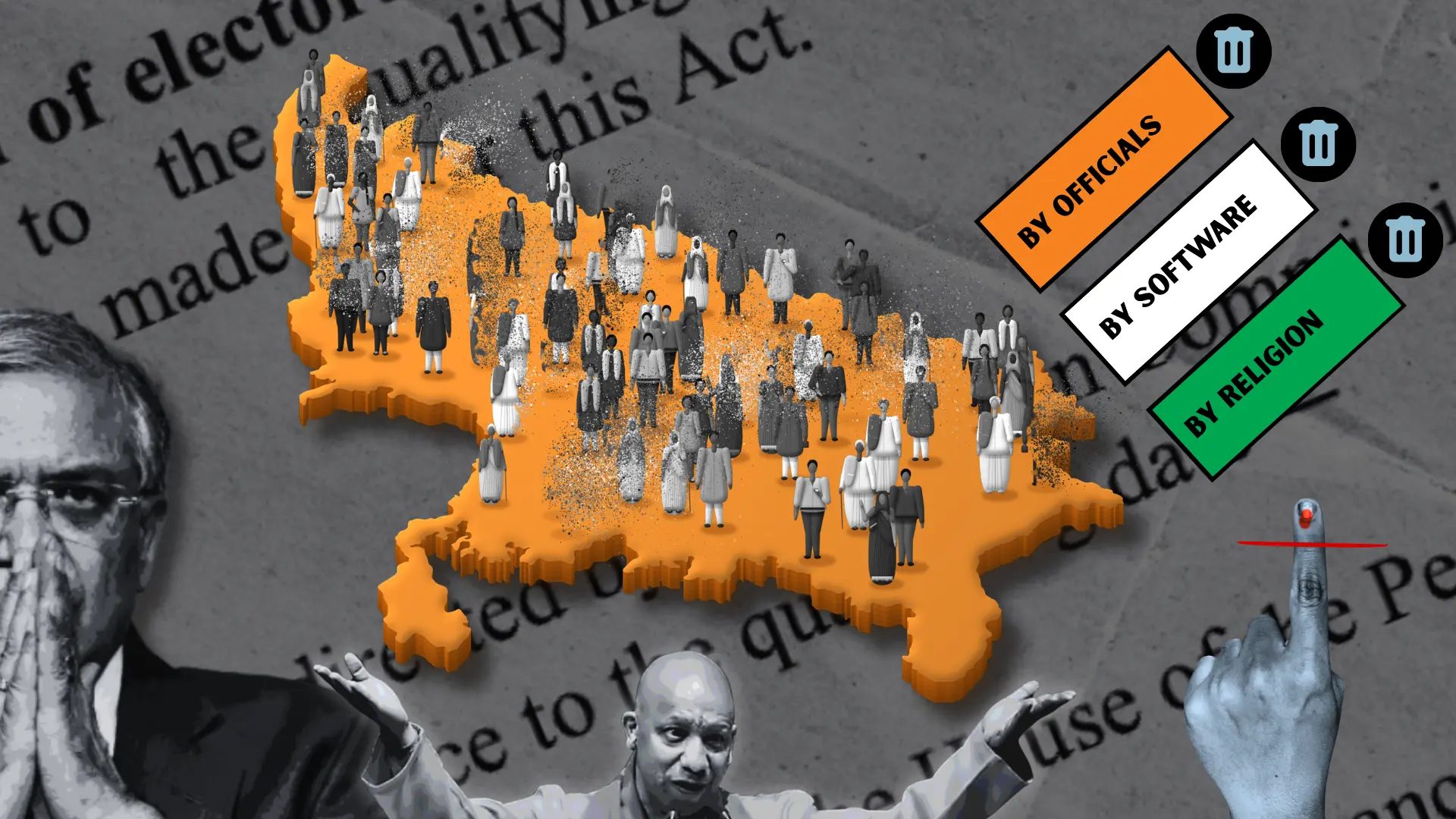


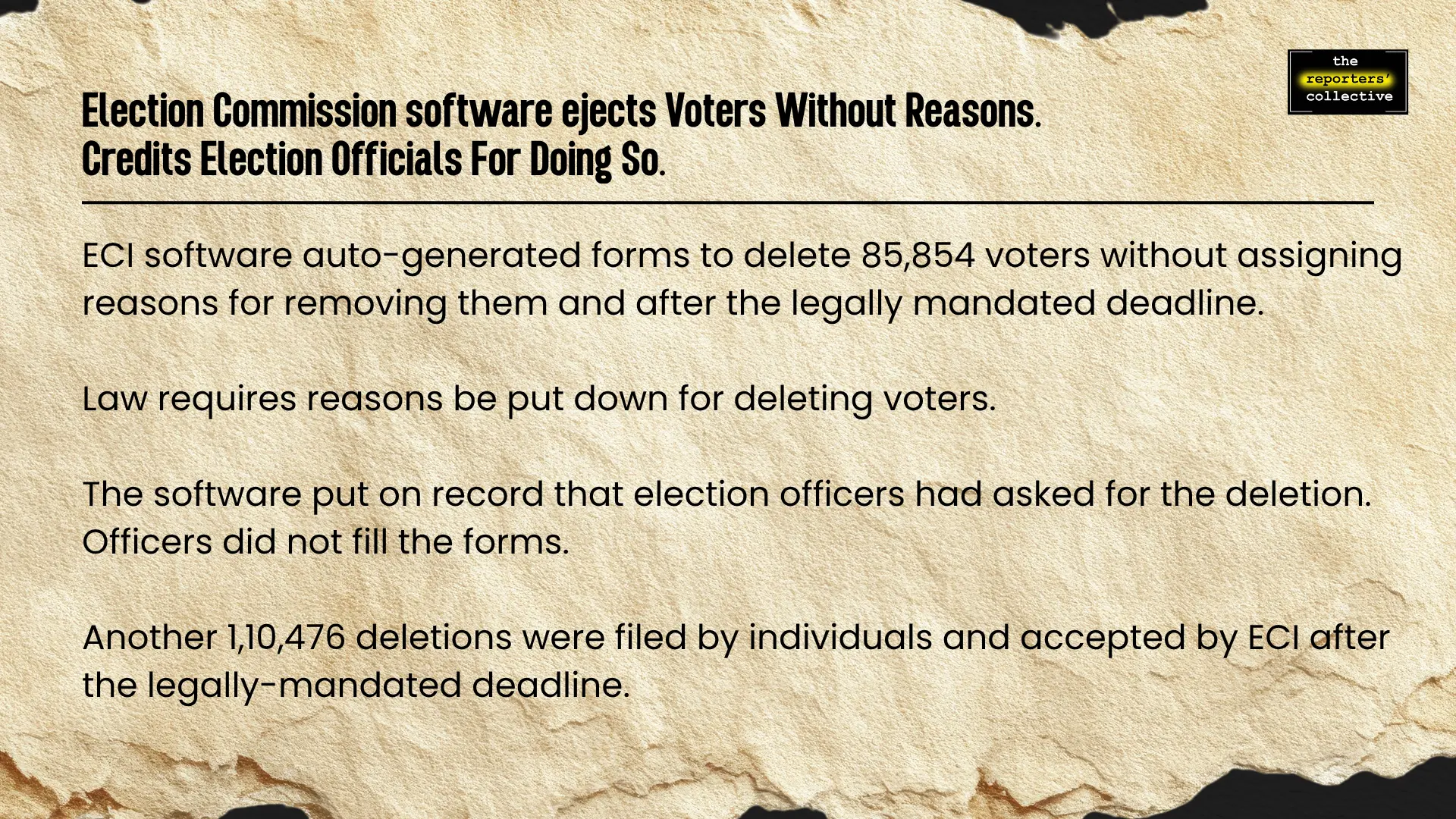
New Delhi: The Election Commission of India (ECI) forced officers in Uttar Pradesh to sign deletion forms for 85,854 voters without giving any reason during the Special Intensive Revision (SIR) in the state.
All these deletion forms were submitted after the legally mandated deadline.
The deletion requests came en masse from election officers during the claims and objections period of the SIR in Uttar Pradesh (UP), between January 6, 2026, when the draft voter list was published, and April 10, when the final voter list was released.
The Uttar Pradesh chief electoral officer (UP CEO) displayed all the deletion forms, officially called Form 7 objection requests, on its website. More than 4.3 lakh such forms were submitted.
Working with a team of data analysts, The Reporters’ Collective scraped all the Form 7 disclosures from the UP CEO’s website. We found that 20 percent of these removal requests were submitted directly by the ECI’s own assembly-level officers.
But the officers did not fill the forms. The ECI’s own software, ERONET automatically generated these forms, when officials deleted voters during the SIR hearings. The auto-generated forms came loaded with the officers’ digital signatures and were sent up for approval by their seniors.
The job of these election officers is to adjudicate such claims of deletion. But in these cases they were acting as both the prosecutor and the judge.
Under the law, citizens filing objections are required to put down specific reasons for requesting the deletion of voters.
The ECI rules are clear on this. Applicants submitting Form 7 to seek deletions are required to select one of the justifications mentioned in the form. The reasons can be: the person is dead, underage, absent/permanently shifted, already enrolled or not an Indian citizen.
In our investigation, we also found that a total of 1,10,476 voter deletion requests were submitted by individuals and accepted by the ECI after the legally mandated deadline.
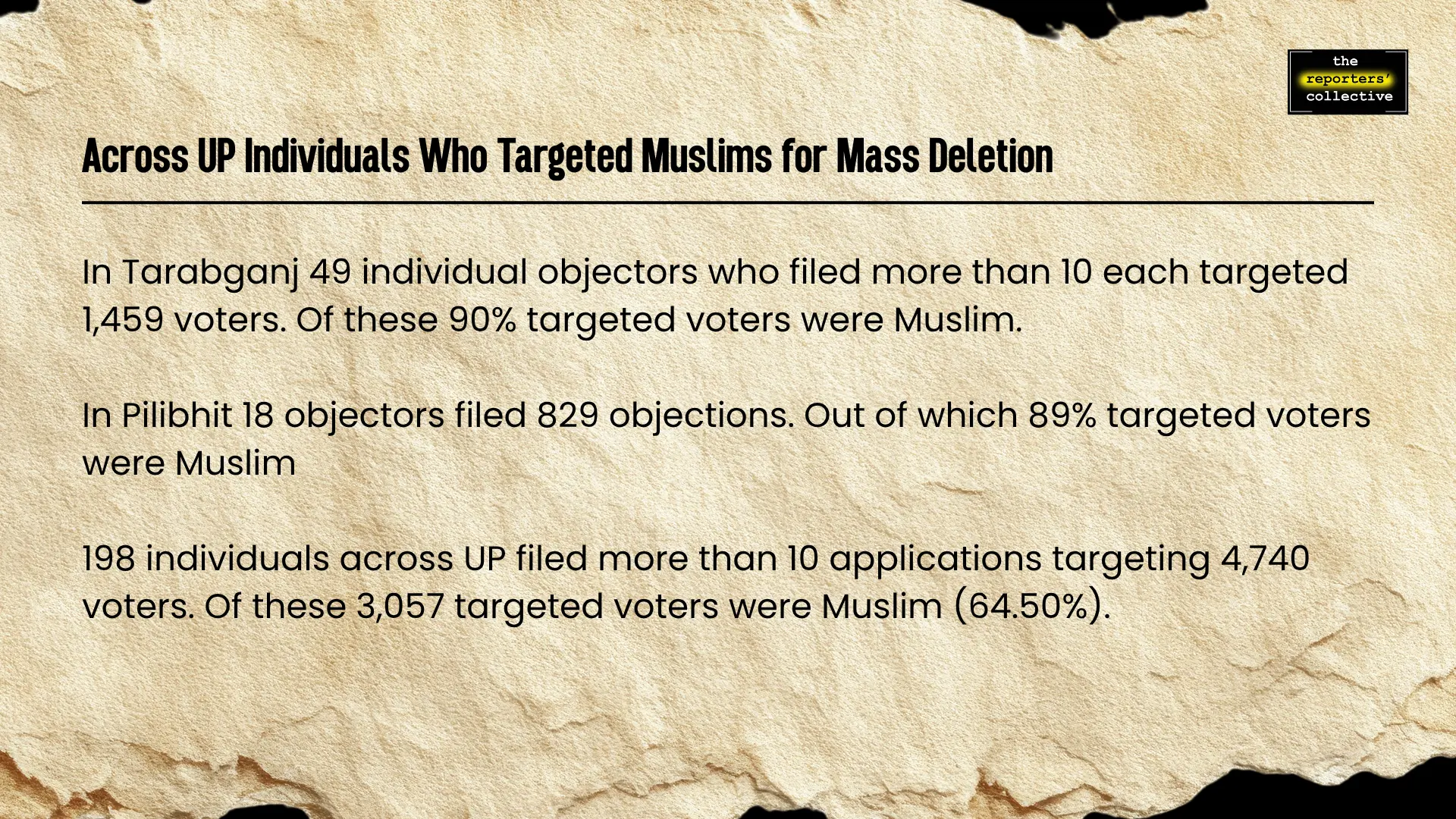
Out of 4.3 lakh Form 7 applications, in two assembly constituencies in UP, people with the same name filed hundreds of requests almost exclusively against Muslim voters. In Tarabganj and Pilibhit assembly constituencies, 90 percent of the deletion requests filed were against Muslims.
In Tarabganj, 188 objections were raised under one name ‘Reshma’. When we dug further we found that all were filed on the same date against people from the same booth.
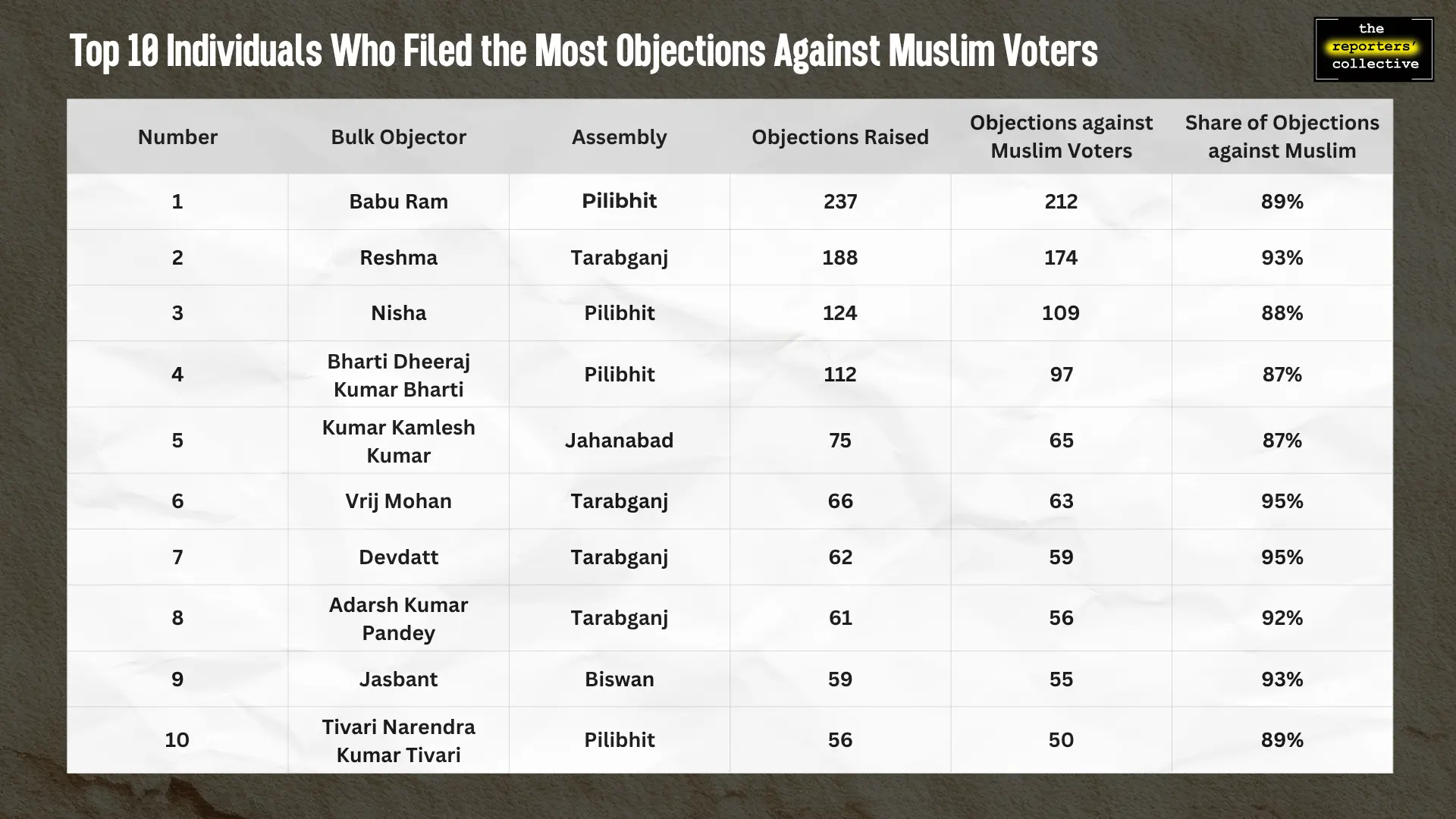
The pattern repeats across the state. However, the ECI data does not provide identity details, beyond the name, of those who have proposed the deletions. Therefore citizens cannot independently verify or identify them.
We sent detailed questions to UP Chief Electoral Officer Navdeep Rinwa as well as to the ECI in Delhi. They had not replied by the time of publication.
Deleted Without Reason
We analysed the scraped data and spoke to four election officials at the assembly level. We learnt that the Form 7 requests were automatically generated when officers removed voters during the SIR hearings they conducted. All the forms already had the official’s digital signature, leaving them no choice but to send them up the chain for approval.
While 3.43 lakh individual objectors followed the process and specified the reasons for seeking a voter's removal, election officers failed to provide any reasons.
{{cta-block}}
We know that the ECI was auto-generating Form 7 requests through its software earlier during the enumeration process, as well. These were being submitted by booth-level officers (BLOs) who found voters to be absent, shifted, dead, or duplicate (ASDD) during enumeration. The BLOs had to specify one of the six reasons while filing deletions that would later be determined by election officers in each assembly, the electoral registration officers (EROs) and assistant electoral registration officers (AEROs), before they were put on the ASDD list.
But we have now found that the ECI’s software compelled EROs and AEROs, who have quasi-judicial powers under the Representation of People Act, 1950 to both file and approve the deletion of voters after the SIR hearings were over.
.webp)
This goes against the ECI’s rules for SIR hearings. They explicitly state that a reason must be given or put on record for the voter to be removed.
This change in procedure violates the Registration of Electors Rules, 1960. The rules say that election authorities must outright reject any claim or objection that is not submitted in the prescribed manner, including specifying a clear reason.
But, changes in the software forced election officers to sign off on unlawful forms anyway.
Hearings During UP SIR
UP was one of the 12 states and union territories to conduct the second round of the SIR exercise. It ran in three broad phases.
In the first phase, starting November 4, 2025, BLOs were tasked with distributing and collecting enumeration forms from every voter listed in the state electoral roll as of October 2025. Voters whose forms could not be collected were placed on the ASDD list for deletion.
For this step, the ECI’s central software, ERONET, automatically generated a Form 7 that the BLO was required to sign with a specified reason. Of the 15.44 crore voters originally registered in UP, 2.89 crore names were placed on the ASDD list.
.webp)
On January 6, the state CEO published its draft electoral roll. In the following claims and objections phase, hearings were conducted for voters who were flagged as doubtful by the ECI algorithm but placed on the draft list.
The ECI marked 3.26 crore electors as doubtful due to ‘logical discrepancies’ or for being ‘unmapped’. Assembly-level officers, including EROs and AEROs, summoned these flagged voters for hearings to prove their identity. If officers failed to verify them, they were struck off the final rolls.
On April 10, UP published the final voter roll with 13.4 crore electors. At the press conference, UP CEO Navdeep Rinwa did not specify the number of voters removed during these SIR hearings.
But we spoke to four EROs about the en masse Form 7 deletions our investigation found. They claimed the forms were submitted to delete unverified voters during the SIR hearings.
‘It Was Bound to Bear My Signature’
The ECI rules for the SIR define the window between the publication of the draft and final rolls – the claims and objections phase – as the period for receiving addition and deletion requests from voters.
Draft rolls allow citizens to first inspect who has been wrongfully included or marked under ASDD so that they can submit Form 7 deletion or Form 6 addition requests.
The fact that a significant portion of the deletion requests at the time, more than 20%, were filed by election officers raises suspicion.
Our analysis of the data scraped from the ECI’s website shows that 85,854 (98.5 percent) of the 87,127 requests filed by EROs and AEROs have no reason mentioned for deletion. For 62 of those, only letters such as ‘A, N, H, E’ had been mentioned as the reason. In 1,211 forms, “absent/shifted” is mentioned as the reason for deletion.
All the 87,127 requests by EROs and AEROs were filed within 19 days, between March 15 and April 2, 2026.
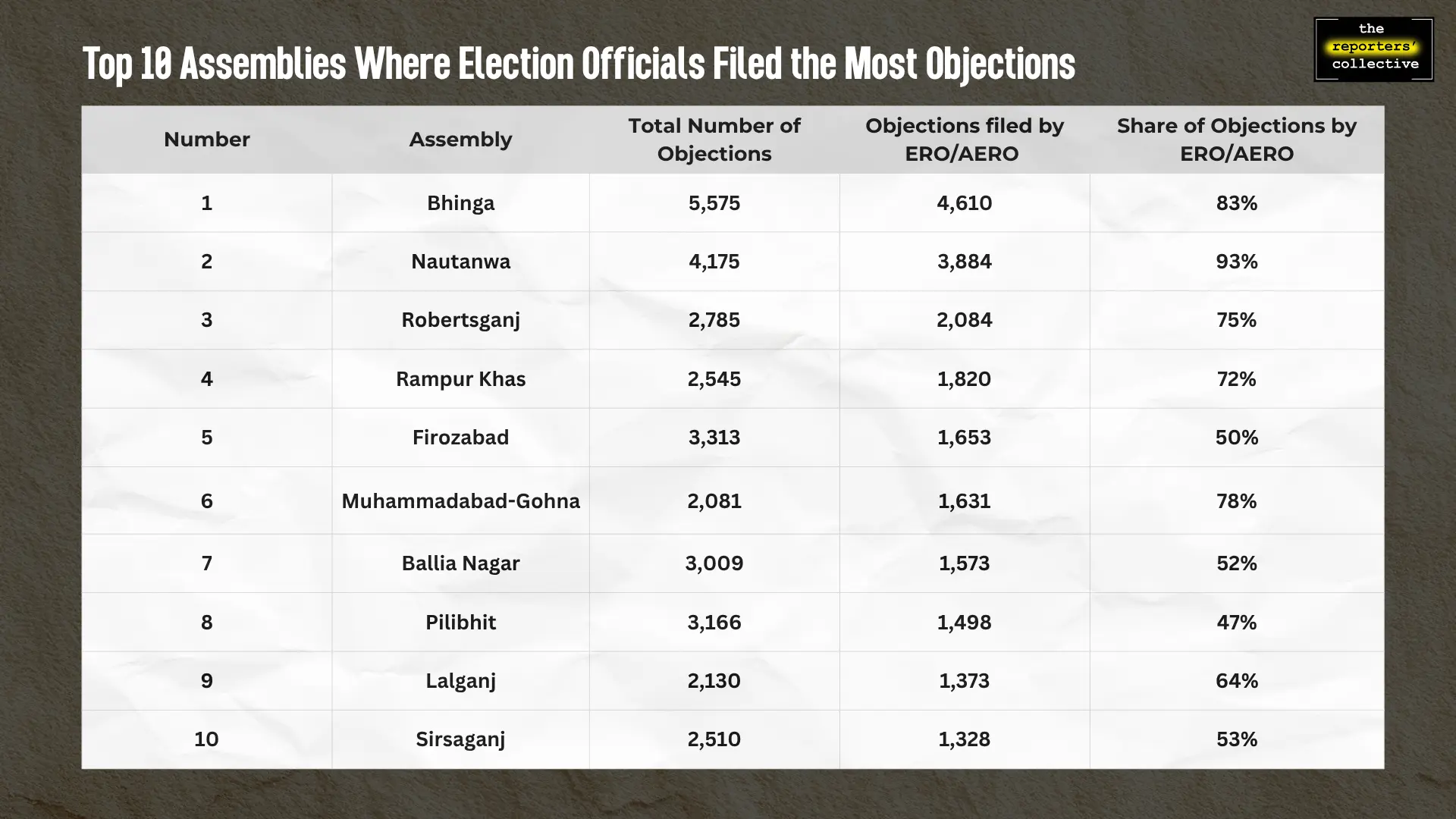
The four EROs we spoke to claimed these deletion requests were initiated for voters flagged for logical discrepancies or for being unmapped.
“As an ERO, whenever we did not approve a voter during a hearing, the system automatically generated a Form 7 on our behalf,” one ERO told The Collective.
He clarified that since the mechanism for approving voters in the app was accessible only through their credentials, “it was bound to bear my signature.”
We reviewed the ECI’s rules for SIR hearings, which were circulated only to officials and were never made public. They require that, after issuing a suo motu notice, officers put down an explanation for why a person is being removed from the roll.
However, UP’s electoral officials claimed the ECI’s software had been tweaked in such a manner that they were left with no option but to become signatories to the deletion of thousands across the state.
The EROs suggested the process had been turned on its head in the SIR. Hearings were held first and notices for the deletion of voters were generated next.