.webp)

.webp)


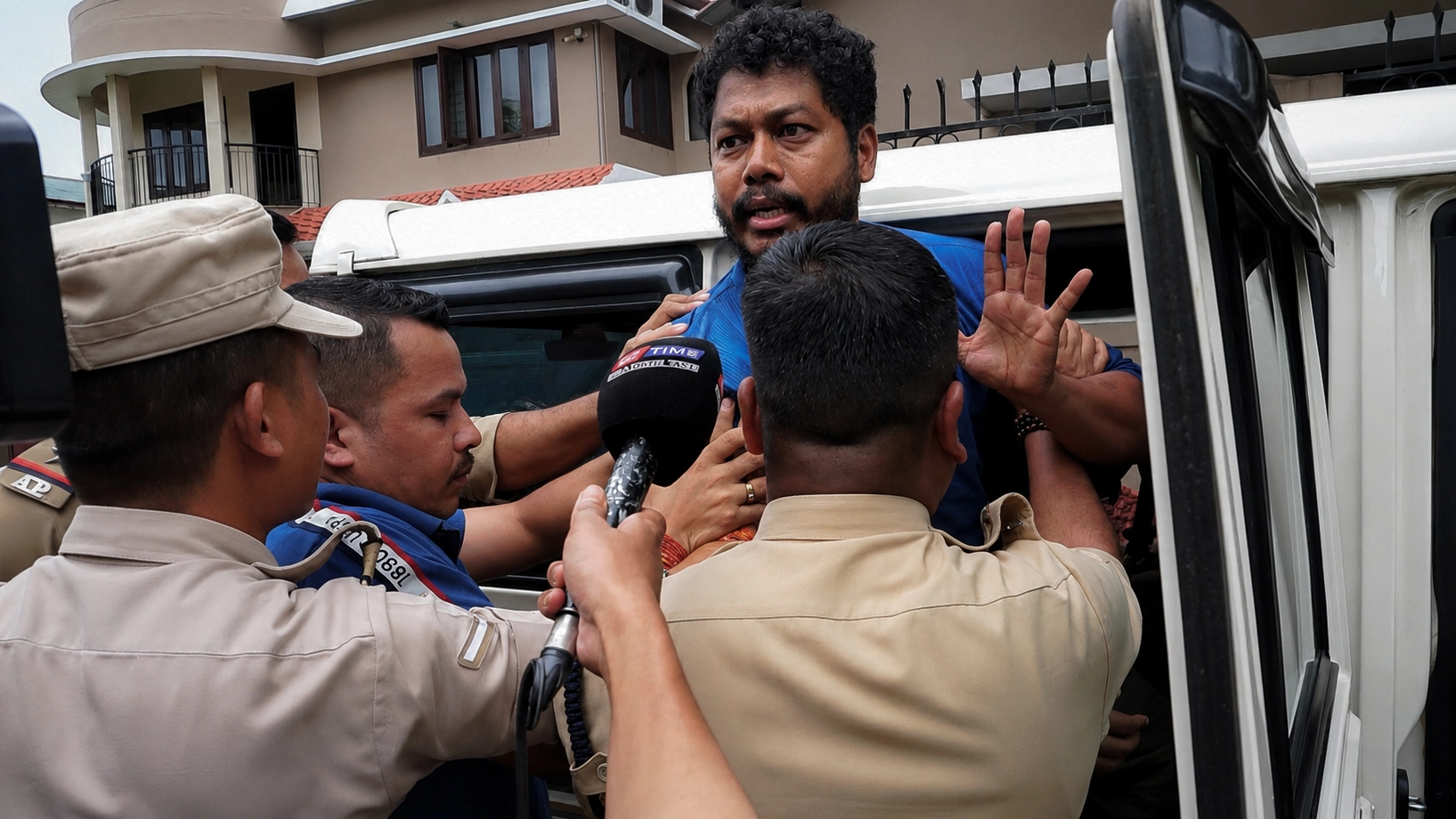
Guwahati: A day after indigenous land-rights activist Pranab Doley was granted bail in a case where police was pulled up by a sessions court for being overzealous, the state government has detained him under the National Security Act (NSA)
The 1980 Act allows the government to detain Doley without a trial or formal charges for up to 12 months.
On July 30, the Assam government in a “communication” notified Doley about his detention under an NSA provision.
The “communication” from the Assam Home and Political Department commissioner and secretary, Diganta Borah, was accessed by The Reporters’ Collective.
“It has also been reported that you have been found to be involved in various activities starting from road blockages to damage of public properties with an intent to create lawlessness for your personal and vested interests,” said the government order listing alleged instances.
The state government raised claims about “suspicious foreign transactions from doubtful sources in violation of the Foreign Contribution (Regulation) Act (FCRA) which is detrimental and inimical to the security of the state.”
The order lists out Doley’s foreign trips, saying “there is no details of air travel, food expenses, accommodation, local transportation and other personal expenses and from which source you received the money.”
Borah wrote, “It is therefore considered essential to prevent you from acting in any manner prejudicial to the security of the State or from acting in any manner prejudicial to the maintenance of Public order by detaining you under section 3(2) of the National Security Act, 1980”.
Protest Against a Dubious Hotel Project
For the past four years, Doley and indigenous families in Assam’s Golaghat district have been opposing an upcoming five-star luxury resort that is proposed to be built on the edge of the Kaziranga National Park and Tiger Reserve.
In September 2023, the state government’s Assam Tourism Development Corporation (ATDC) had inked a Memorandum of Understanding (MoU) with the Saraf group, which runs hotels using the international Hyatt brand license in India. The MOU said “an investment of Rs 100 crore” would be made by the Saraf group to build a five-star luxury resort on the edge of the Kaziranga National Park, a UNESCO World Heritage Site in the Golaghat district.
Doley, who is the convenor of the Greater Kaziranga Land and Human Rights Protection Committee (GKLHRPC), an umbrella organisation that includes residents of over 100 villages around the national park, and three other members of GKLHRPC were arrested between July 12 and 13, in connection with a gathering on June 28, which opposed the construction of the proposed hotel.
A notice from the Assam Police mentions a meeting between various groups thereafter, which the state police alleges, resulted in a violent clash with the police at the contested site.
In a statement on July 14, the GKLHRPC claimed that the charges were fabricated and that “Pranab Doley was not involved in the confrontation when the police used force to remove the gathered Adivasi families.”
“If I can’t voice my opinion for other people, what kind of democracy is this,” Doley was heard saying in a video recorded on July 12 at the time he was being detained in Guwahati.
During the Budget session in the Assam Legislative Assembly on July 15, Assam Chief Minister Sarma took issue with the protests and concerns over infrastructure projects across the state.
“There’s going to be a 5-star [resort/hotel] in Kaziranga. People should feel good, paying tourists will come. Who will get the money? The elephant mahout, jeep safari, the shopkeeper, the people…” said Sarma. “Inside Jim Corbett Park too, they’ve made a 5-star, Tata did inside Gujarat forest also, an airport inside the forest in Kenya.”
“I am shocked, the people should have requested…the leftists. Instead of the government needing to arrest them, the leftists should have taken the initiative to get a five-star hotel here,” Sarma further added.
An RTI (Right to Information Act) response from December 2024 and other documents accessed by The Collective, confirm that the Golaghat district administration, on the recommendation of the district’s Land Advisory Committee, had allotted 30 bighas of land to ATDC, which in turn handed over the land to the Saraf group. A government official in 2022 had claimed that the land committee members included state minister Atul Bora.
Meanwhile, the Saraf group also said it had gotten 10 acres of land from ATDC (which is around 30 bighas) to build a hotel. Chief Minister Sarma said it was for the group to build a five-star hotel near the national park.
The Saraf group, through a clutch of companies, runs hotels in India with the Hyatt brand, including those in Delhi, Mumbai, and Bangalore. The international hospitality chain Hyatt has its people, David Peters and Elton Tze Tung Wong, on the group company’s board. The company had nearly Rs 1,000 crore of revenue as on financial year March 2025.
In 2021, Radhe Shyam Saraf, the late patriarch of the Saraf family credited with bringing Hyatt to India, and his wife were named in the Pandora Papers which revealed a trust in the tax-haven of Belize, a country in central America. Pandora Papers were leaked documents that revealed offshore trusts and anonymous companies in tax havens owned by politicians, businessmen and celebrities.
A Saraf group-run hotel report on a May 2026 board meeting states that “the Company acquired rights over a 10-acre leased land parcel in Kaziranga, Assam, earmarked for the development of a 115-key ALILA luxury resort by Hyatt, proposed to be operational by FY2028.”
According to an “investor presentation,” the luxury resort will be developed in the proximity of the Kaziranga National Park on land leased from the Assam government for up to 99 years. It is to be made operational by 2028. Documents reviewed by The Collective do not reveal at what rate the Assam government had leased the land to the group for commercial purposes.
Since 2022, indigenous residents of Golaghat have protested and petitioned the Gauhati High Court against the project, arguing the land was forcibly acquired from them.
%20(1).webp)
It was in connection with these disputes that Doley and four other activists were arrested.
Despite Chief Minister Sarma’s repeated claim about the hotel being built under the Hyatt banner, the company, when asked about Doley’s arrest by an international non-profit, Business and Human Rights Centre, said: “While certain Hyatt subsidiaries have existing business relationships with Juniper Hotels, including a non-controlling ownership interest, Hyatt has not entered into any agreement to brand or operate the proposed hotel project at Inglay Pathar/Hathikuli near Kaziranga National Park.”
The company added, “It is among our highest priorities to respect and honor fundamental human rights, including the rights of Indigenous peoples – and Hyatt’s public Human Rights Statement affirms our commitment. We also recognize and support the importance of freedom of expression, and we are not in a position to provide commentary on Mr. Doley’s situation.”
The Reporters’ Collective sent questions to the Assam government and Hyatt and Saraf groups. The copy will be updated with their response.
Contentions Over Land Next to Kaziranga
Lands of over 20 families were taken by the Assam government, local residents claims. “We have been paying annual revenue for our land. But, in 2022, the revenue office stopped collecting land taxes which made us suspicious,” said Lokhu Gowala, a speech-impaired adivasi farmer, who was one of the first evictees.
.webp)
Srimoti Kishan, another evictee said, “Initially they told us that a piggery would come up on the land, which was followed by a proposal for an adivasi cultural centre. Then, someone told us that a big hotel would be built on our land. Some of us were opposed to these plans as this is the only plot we had.”
The residents, belonging to the adivasi tea garden communities, brought to the area during the British rule as indentured labor, have contested the government’s land classification.
According to the Bokakhat MLA Atul Bora as well as the Golaghat district administration, the project is being built on government land, on which an encroachment had been found and removed.
But a response to a RTI query to ATDC classified the entire parcel of the land as ‘government periodic patta’, which grants the holder permanent, heritable, and transferable rights over a piece of land, allowing them to legally sell, gift, or mortgage it in exchange for paying periodic land revenue under the Section 9 of the Assam Land and Revenue Regulation, 1886.
In 2024, the National Green Tribunal had also taken suo motu cognizance of the matter based on reports about the land acquisition. The case did not offer the people a chance to argue and soon the Tribunal closed the matter claiming that news reports raising concerns about the project were ‘premature’.
The residents have also alleged that several affected adivasi residents have been handed cheques worth Rs 3 lakh from Assam Chief Minister’s Relief Fund.
According to Minali Gowala, an affected victim, she was offered Rs 3 lakh in a cheque through the circle officer of Bokakhat. “These cheques have been handed out since December 2025. However, some of the families have completely refused these cheques, while others accepted the cheque not knowing what it was meant for. When someone asked the Circle Office in Bokakhat, they were told it is meant for land acquisition but there was no official communication. We refused it because we value our land and no amount of money can compensate for the losses we have suffered,” Gowala told The Collective.
On June 1, the Gauhati High Court issued notices to Assam Government as well as ATDC over a petition by 20 evicted families, who presented these land records in court. The Assam government had fenced off the land and was attempting to start construction.
Local residents said that a round of survey was conducted on June 24 by the district administration without prior notification.
“We were told another survey would be done on June 29. Instead, we found construction material dumped on our lands,” claimed Geeta Gowala.
At the time, she said, a large contingent of police was deployed and people were prevented from entering their lands.
“That led to the scuffle, in which we have been named as accused in the FIR filed by Golaghat Police leading to the arrest of the leaders who stood with us,” she alleged.
The FIR
The Assam police notice, naming 16 people including Doley, members of GKLHRPC, other civil society groups and “50 other persons”, stated that the accused “had organized a meeting regarding (an) ongoing government project”.
The police alleged that the participants had subsequently “trespassed into the site” “armed with deadly weapons,” and proceeded to “threaten the construction workers,” “attempted to damage the cement mixer” by setting it on fire and “assaulted the police personnel.”
Doley and the others arrested have been booked under multiple provisions of the Bharatiya Nyay Sanhita (BNS) that range from rioting to mischief by fire and causing hurt to obstruct public officials.
The FIR based on a complaint filed by a sub-inspector of Bokakhat police station, describes Doley as the “mastermind behind the unlawful assembly, which, in prosecution of its common object”, an allegation that GKLHRPC denies in its statement, terming the arrests as the “crackdown on an indigenous movement opposing the illegal takeover of land”.
On July 12, Assam Police showed up outside a private residence in Guwahati, where Doley was staying. There he was detained.
The police detained Doley for 18 hours without following legal procedure. Other activists and friends tried to push the police to reveal the reasons for his detention. Eventually Doley was formally arrested.
.webp)
The Collective reached out to the Golaghat Superintendent of Police. This copy will be updated with the response about whether due legal process was followed in Doley’s detention and arrest.
Doley and four others who had been arrested in connection with the case were in judicial custody. They were granted bail on July 29 by the Golaghat sessions court.
The Bail Order
While issuing bail, the Additional Sessions Judge NM Abdullah Ahmed said that the “present dispute arises from a deep-rooted anxiety regarding environmental degradation and its impact on the socio-cultural fabric of the local Tea Tribes.”
“In matters where ecological preservation intersects with indigenous survival, the standard apparatus of criminal law cannot be used to suppress local anxieties. True public order is achieved not by silencing the affected, but by listening to them,” the order mentions.
Adding, “It is also germane to mention here that in cases involving marginalised groups like the Tea Tribes, structural inequalities often prevent local communities from negotiating on equal terms with corporate or state entities. In such a scenario, treating the activists or community leaders as ‘external disruptive element’ will not yield any fruitful result.”
About the police’s account of incidents from June 28, the order mentioned the lack of video evidence to substantiate many of the police’s allegations.
On the foreign travels, Judge Ahmed noted the Doley’s lawyer’s defence that he had visited many foreign countries as an environmental activist and in that process, he might have received money for meeting travel and other expenses and that the investigating officer can conduct a “document-based investigation” “without necessitating the judicial custody of the accused”.
But, now the Assam government has imposed the National Security Act on Doley, rendering the bail infructuous.