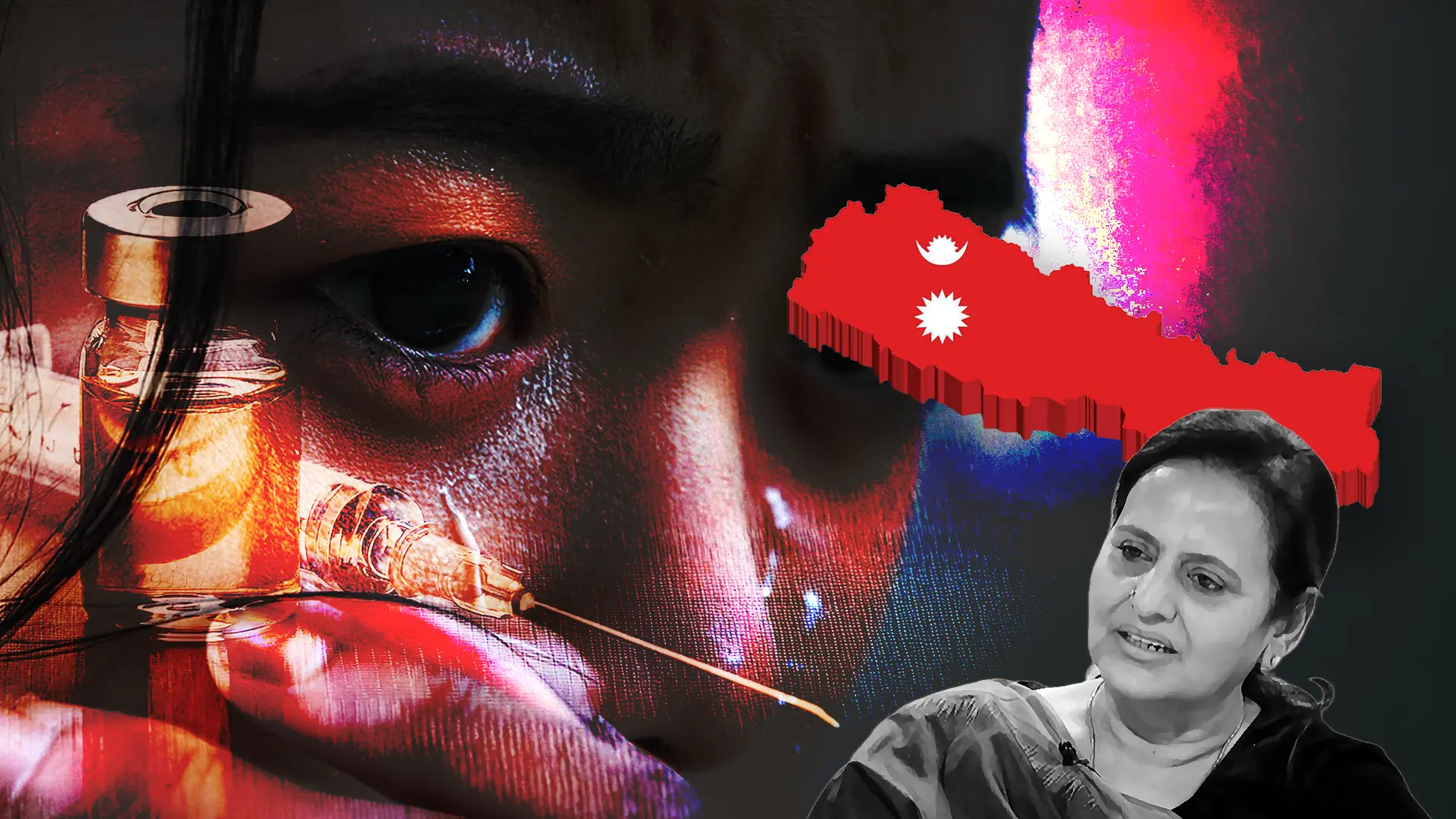


Kathmandu, Nepal: In early March 2025, Maya’s neighbour, who was an agent of a fertility clinic, lured her with promises of easy money for donating ovum. She thought it would be as simple as giving blood. The agent took her to a fertility centre in Kathmandu and introduced her to the doctors.
Doctors scanned Maya's body and drew blood to assess her ovum maturity. For fifteen straight days, the agent arranged rideshares to drive Maya from home to the clinic. Maya, using only her middle name to avoid stigma, says, "After the first (hormone) injection, I was scared. I thought that I was doing something wrong," Maya says. "I told them that I wouldn't donate any ovum. They warned that stopping would harm me because of the injections. I had no choice but to keep going."
"They gave me one, two, or even four injections every day for fifteen days straight."
In the hospital diary, doctors wrote her name as Samiksha Shrestha, but not her real name. They listed her age as 21, but she was only 17 (her birth certificate lists her date of birth as June 11, 2007). On the day of egg retrieval, they instructed her to fast for eight hours. Under anaesthesia, five doctors removed the ovum from her body. A few days later, they gave her 15,000 Nepalese Rupees (NPR) in cash.
After that, she said, she bled heavily for months. Her periods grew painful and heavy. She lost her appetite. She wanted only to lie down in a dark room.
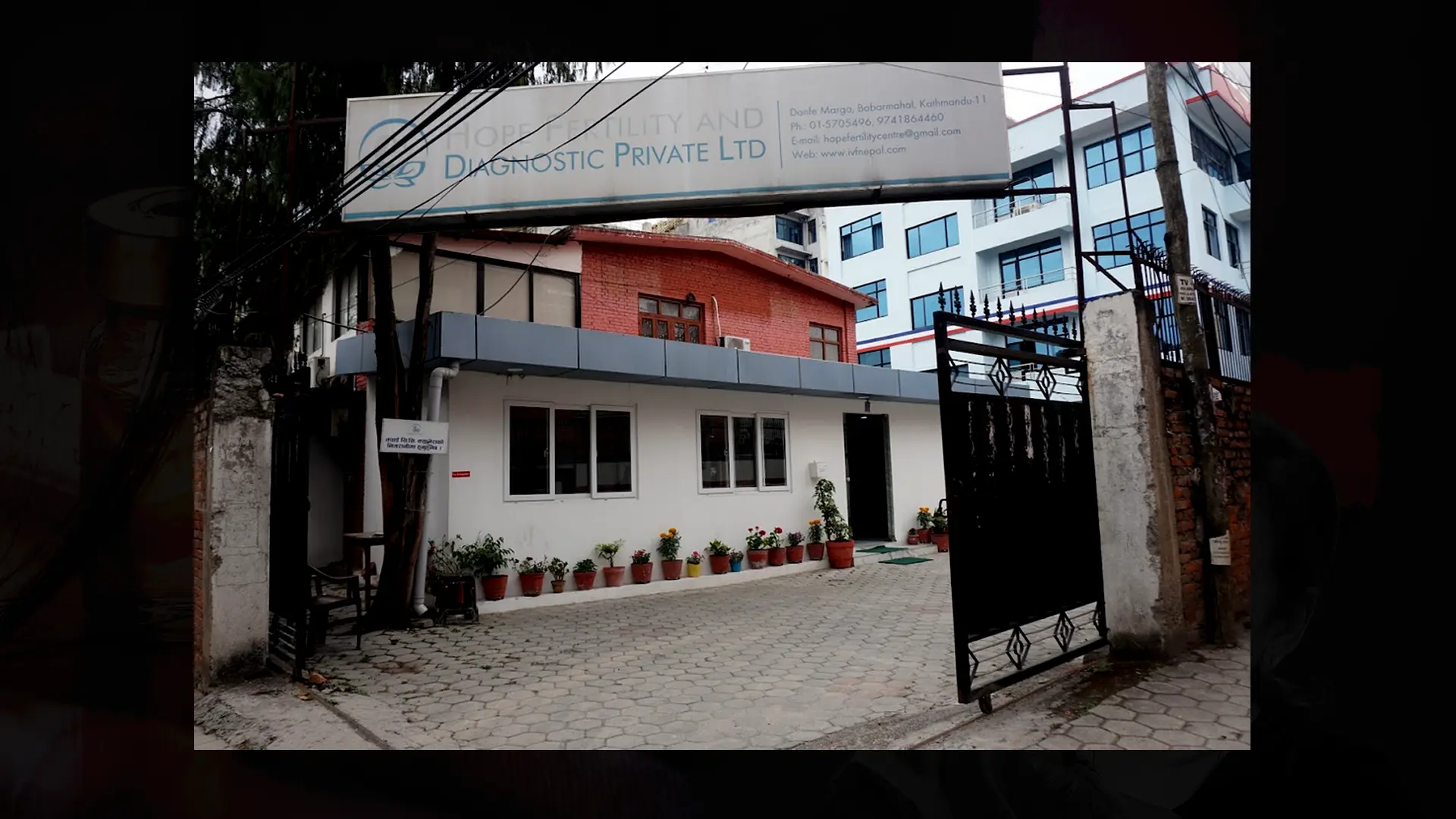
After knowing Maya's health crisis due to illegal ovum retrieval at a Kathmandu fertility clinic, Hope Fertility and Diagnostics Pvt. Ltd., her father, Lama, filed a complaint with the Central Investigation Bureau on June 30 against the doctors who used his minor daughter for egg donation without his consent. Police arrested five clinic staff members immediately for questioning. On August 18, police submitted a report to Kathmandu District Attorney’s Office charging the minor's exploitation for drug or other testing under The Act Relating to Children (2018).
The case was transferred to the CIB because, according to CIB spokesperson Shiva Kumar Shrestha, when the case was first reported to the police, they were unable to determine how to investigate it.
It was then forwarded to the Human Trafficking Investigation Bureau, which handles trafficking cases. Bureau officials stated that it did not qualify as human trafficking, so the case was referred to the CIB due to its complexity, he says
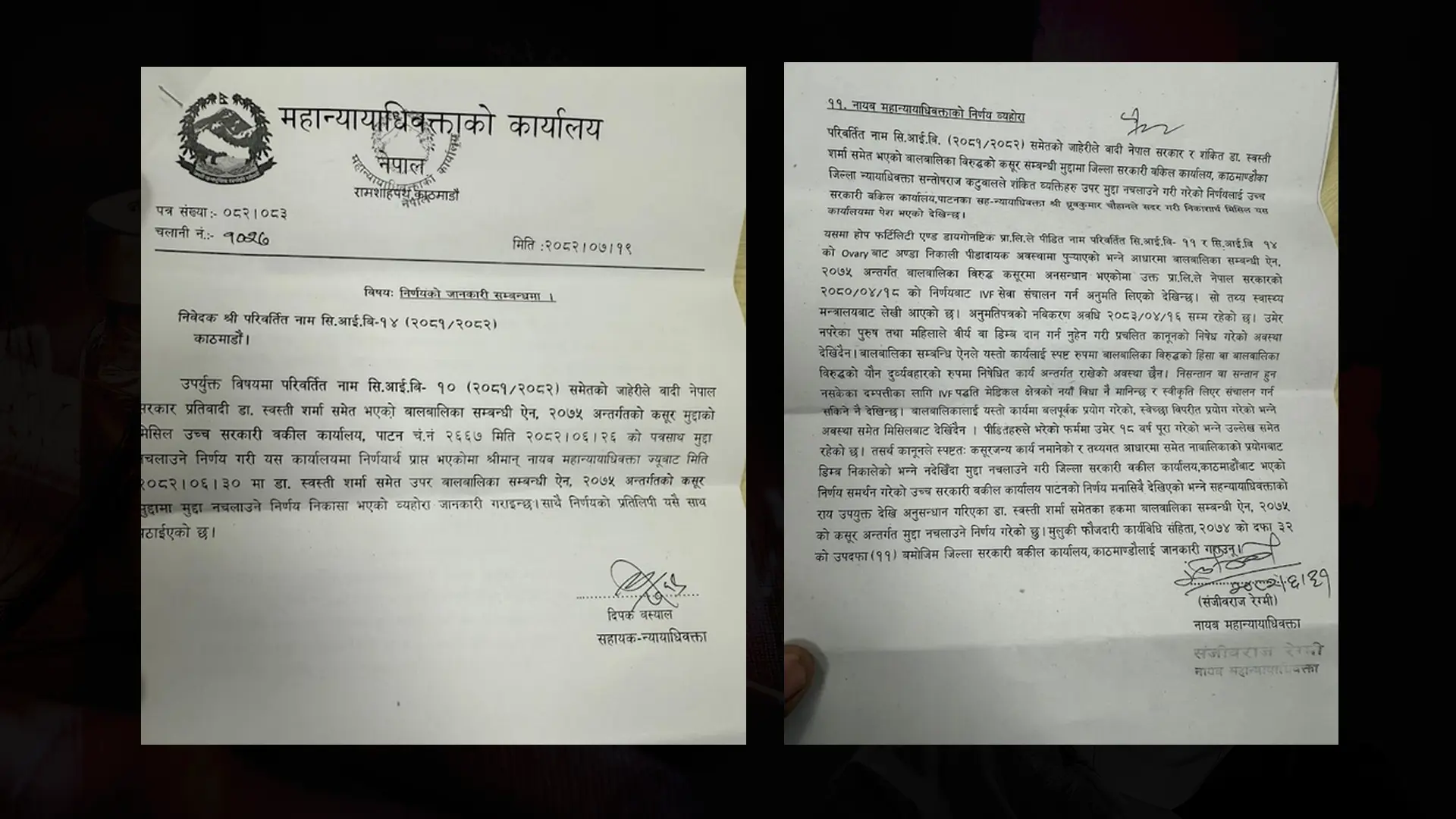
Subsequently, on November 5, the District Public Prosecutor and the Attorney General's Office dropped the case, citing no applicable law.
Under Nepal’s laws, in cases where the Nepalese Government is the plaintiff, the District Attorney has to review investigation files received from the police, take necessary action, and—upon delegation from the Attorney General—decide whether to prosecute and file the case in the relevant court. In the present case, after the files were forwarded to the Kathmandu District Attorney's Office, the Attorney General delegated authority not to prosecute. Subsequently, Associate Attorney Ramhari Sharma Kafle at the District Attorney's Office decided against prosecution.
Associate Attorney Ramhari Sharma Kafle at the District Attorney's Office, Kathmandu, says there is no law in Nepal to prosecute such a case. When asked whether unique cases require separate laws or if existing statutes could apply by identifying matching offences, Kafle replied: "We do not talk about this matter. You should go to the Attorney General's Office and ask them."
Fertility issues are a growing concern in Nepal. According to the government records, the fertility rate has dropped from 4.6 children per woman in 1996 to 2.1 in 2022. There is a surging demand for ovum, but without government guidelines, doctors face challenges, and patients stay at risk. Over 200 people are on the waiting list for egg donors at the government’s facility, Paropkar Maternity and Women's Hospital in Kathmandu, alone.
Gynaecologist and obstetrician Dr Shree Prasad Adhikari, who is the director at the Paropkar Maternity and Women’s Hospital in Kathmandu, says 50-60 women now visit the outpatient department daily for infertility treatment, up from just 10-15 a few years ago, while over 200 women await on the egg donor list.
Stimulation injections for ovum retrieval begin 10-14 days post-ovulation, targeting 7-12 ova, explains Adhikari while warning of hormonal side effects like bloating and ovarian hyperstimulation syndrome (OHSS) from injections, plus risks from anaesthesia and potential bladder or intestinal damage during the procedure. "Ovum donation is necessary, but it must be legalised with proper guidelines," Adhikari says.
{{cta-block}}
Conflict of Interest
In September 2025, following the massive protests led by Nepal's Gen Z demonstrators, former Chief Justice Sushila Karki became interim Prime Minister. She appointed Sabita Bhandari, a senior advocate who defended Nepalese cricketer Sandeep Lamichhane in his high-profile rape acquittal, as Nepal's first female Attorney General. Sabita Bhandari is a shareholder in the Hope Fertility and Diagnostics Pvt. Ltd., which is owned by her sister Swasti Sharma. The new Nepalese government led by rapper and Former mayor of Kathmandu, Balendra Shah (of the Rastriya Swatantra Party (RSP), is expected to take oath this week. Shah is all set to be the new prime minister of the country.
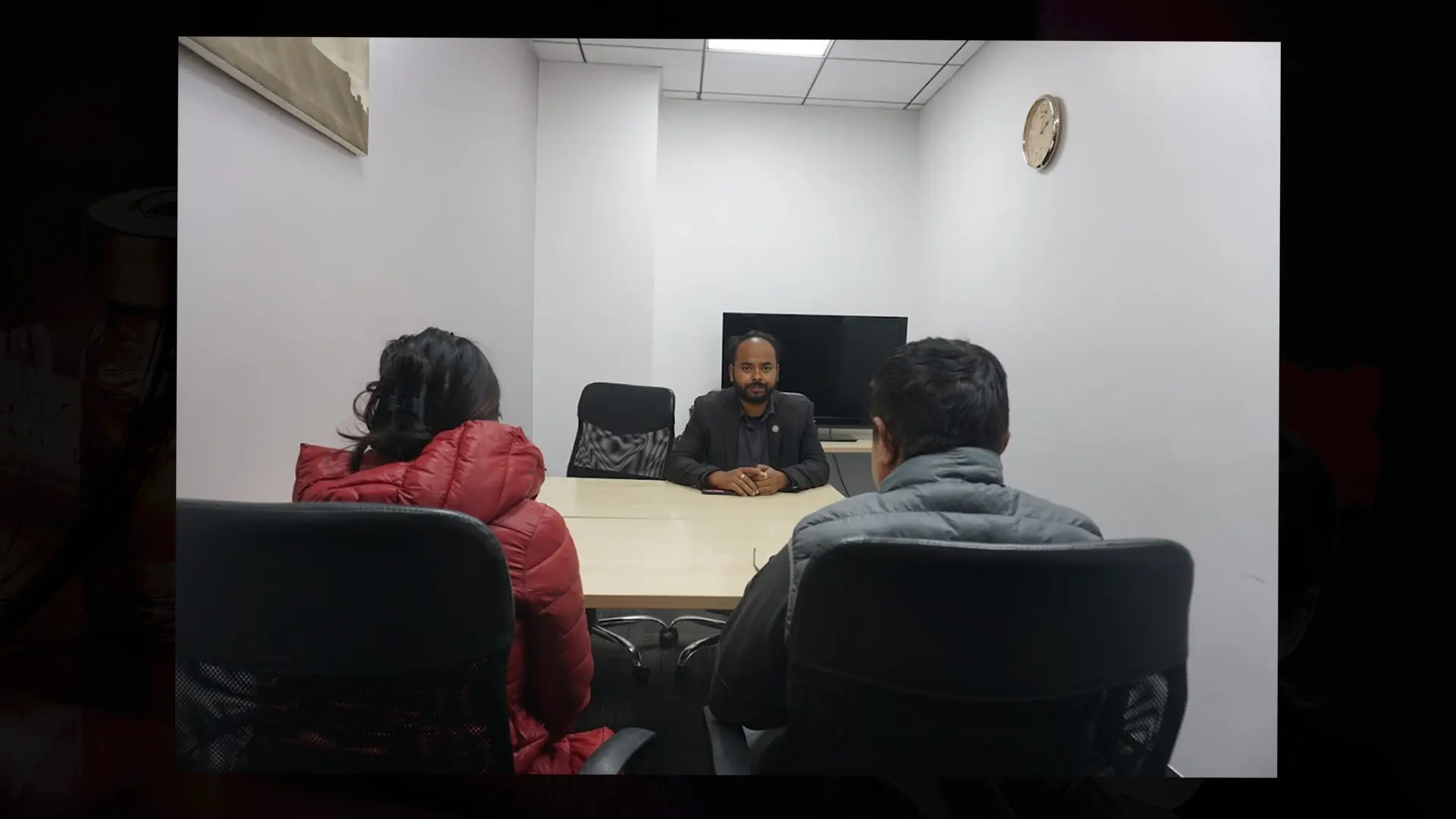
Victims, including their families, and lawyers accuse her of delaying the case to shield her shares and family ties.
A CIB report quotes Attorney General Sabita Bhandari admitting that she is the director of the clinic. According to the details with the Company Registrar's Office, there are four founders of the clinic. Swasti Sharma holds 92,000 shares valued at NPR 9.2 million, Sabita Bhandari owns 46,000 shares (23% of the clinic) worth NPR 4.6 million, Neeraj Shrestha has 31,000 shares valued at NPR 3.1 million, and Malini Chaudhary holds 31,000 shares worth NPR 3.1 million.
The police investigation alleges that seeking quick profits, the defendants exploited the poverty and ignorance of underage victims. They lured the girls with payments for egg donation, ignored risks to their physical and mental health, hid their real names, surnames, and ages by falsifying them as adults, extracted eggs from their ovaries, and sold them commercially.
The sequence of events shows that what happened was not far from the relative’s claim.
On November 19, 2025, Kathmandu's District Attorney's Office declined prosecution under the Child Welfare Act 2075. Grounds included: the IVF clinic's valid government license; no law banning minors from donating ovum or sperm; the Act's lack of explicit classification as child violence or sexual abuse; no proof of non-consensual acts; and the victim's form stating age 18 and above. Thus, no clear criminality or minor involvement was established.
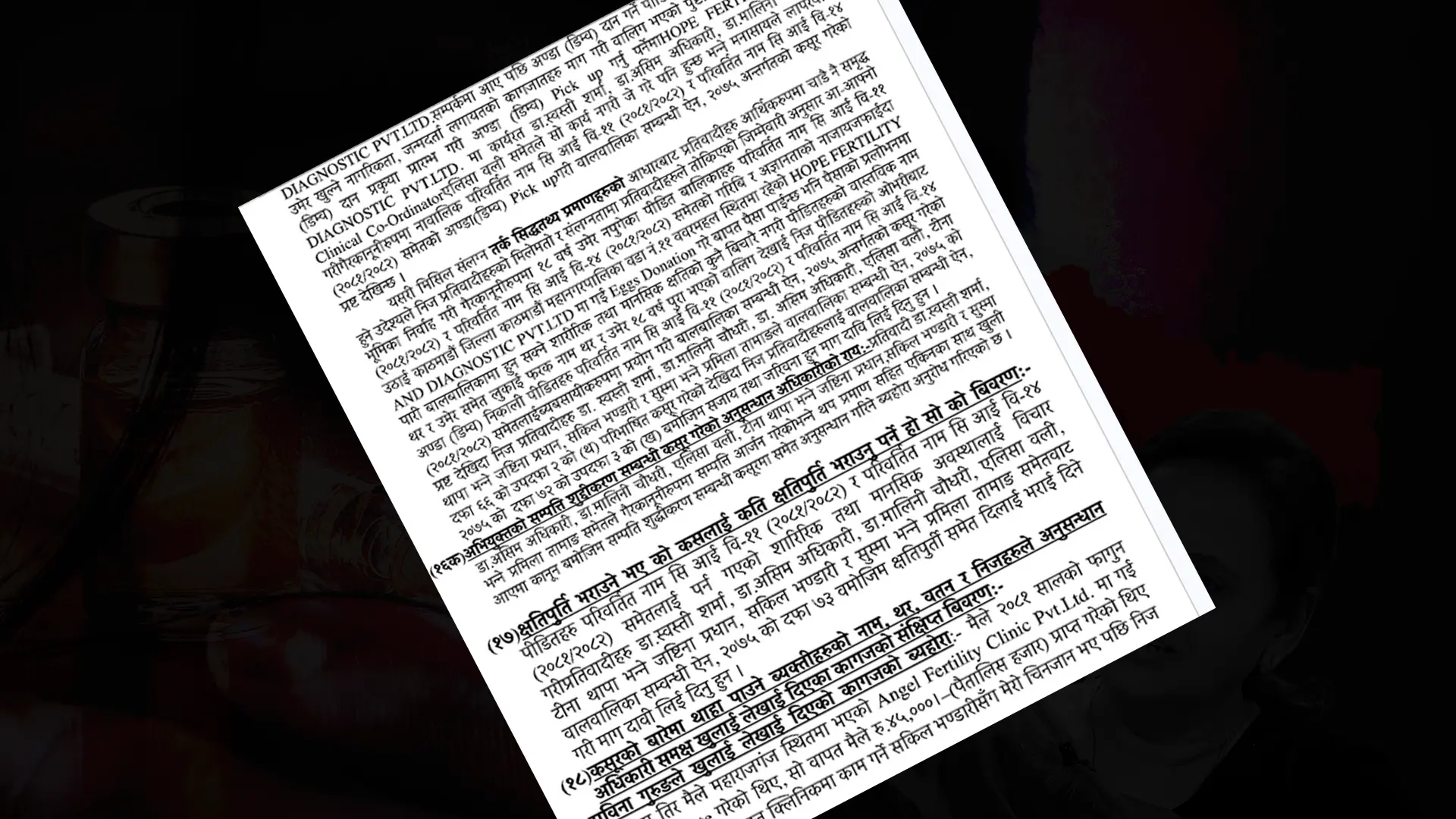
Defending their limited role, Shiva Kumar Shrestha, spokesperson for Nepal Police's Central Investigation Bureau, says, "Our role is investigation only". "Prosecutorial decisions rest with the Attorney General's Office. We can't override their choice not to prosecute. We've submitted claims based purely on evidence and facts."
Kathmandu District Attorney's Office Associate Attorney Ramhari Sharma blames the lack of a law in this case. He says, "We lack a law addressing the ovum extraction case as a crime. For an act to qualify as a crime, it must be explicitly prohibited by law. The alleged acts here are not deemed criminal by law."
However, Ankita Tripathi, a lawyer fighting this case for the victims, accuses the Attorney General of abusing her authority. "She used her position to sway the court," she says. "She stalled the case indefinitely, but I haven't given up. I'll fight until the end."
Attorney General Sabita Bhandari, who is under fire, acknowledges owning shares in the clinic. She accused the victims of lying. "The girls lied about their ages, names, and surnames," she says. "They signed documents stating they were aware of potential complications after ovum retrieval."
She says, "This is nothing but propaganda for propaganda's sake."
Hope Fertility & Diagnostic clinic's Anaesthesiologist Dr. Malini Chaudhary, accused the complainants of defrauding her and her clinic. "We take parental consent for children, but these were adults," she said. "If you seek treatment as an adult in a hospital, do they check your citizenship for age? The consent came from an adult. They've come all this way chasing money."
“After egg extraction, we follow up with each case to check for problems, but they never contacted us," says Chaudhary. "We also asked for ID cards. They always promised to bring them tomorrow, but never did."
When asked about hiring agents to bring women to the hospital for egg extraction, Chaudhary denied involving any third parties.
Dr. Ashim Adhikari, who works as a consultant at the Hope Fertility & Diagnostic clinic, insisted the girls were adults at check-up. "They were sexually active and showed no hesitation when the device was inserted into their vagina during egg retrieval," he said. "In cases where patients aren't sexually active, such procedures cause pain."
Adhikari said hormone injections are not painful. "Egg extraction hurts only when retrieving a large number of eggs, but their case involved very few. Before extraction, we discuss consent, check ID cards and dates of birth, then reconfirm consent before anaesthesia."
When asked about the hospital's policy on egg extraction, he said: "Before extraction, we discuss consent, check ID cards and dates of birth, then reconfirm consent before anaesthesia."
More Skeletons in the Cupboard
A few weeks after Maya’s ovum extraction, her 17-year-old friend Kala (her birth certificate lists her date of birth as February 14, 2008) underwent the same procedure by doctors at the clinic (Kala, using only her middle name to avoid stigma). Kala says the hospital’s agent lured her using tactics identical to those used with Maya. They recorded her name falsely as 22-year-old Pooja Acharya in hospital records. Afterwards, NPR 10,000 was deposited in her friend’s bank account as payment, as she doesn’t have her own bank account.
When Kala's mother, Tamang, went to the clinic to ask why her minor daughter was used without the parents’ permission, the operator retorted that they had paid Kala for the ovum.
Tamang says they threatened us and said that no matter where we go, no one will give us justice.
The clinic and the Attorney General continue to claim that there is no crime. “We did nothing wrong. We told them that no matter which agency you approach, you won't get any resolution because we committed no offence," says Attorney General Sabita Bhandari.
Currently, the case is in the Supreme court.
Cover Up and Legal Battle
On September 2, 2025, Nepal’s Ministry of Health and Population issued standards for infertility management services. These standards aim to provide easy infertility identification, prevention, and treatment to target groups, requiring donors to be 20-35 years old and limiting donations to no more than six times.
Ankita Tripathi, Nirab Gyawali, and Dhruba Bhandari, who represent the girls (victims), dismissed the ministry’s standards, calling it a blatant attempt to undermine the case.
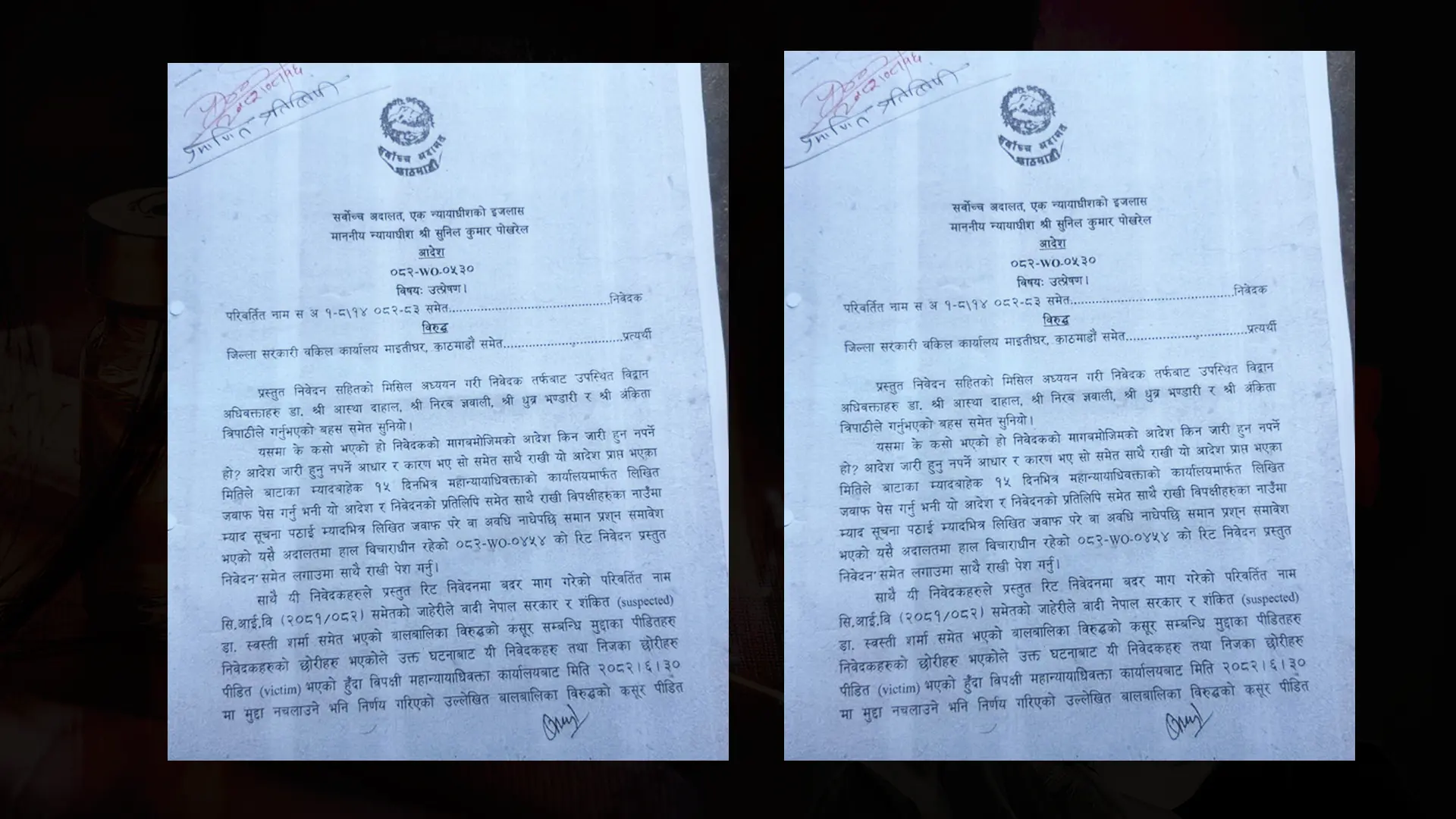
Following the Attorney General's Office decision not to prosecute, they filed a writ petition in the Supreme Court on November 16, challenging the refusal to prosecute the fertility centre operator in the ovum extraction case. In this case, the District Government Attorney's Office, High Court, and Attorney General's Office had opted against pursuing the case. The Supreme Court issued a show cause order on December 30, expediting the hearing process.
Gyawali says the new standards are nothing but “an attempt to dismiss the case by claiming pre-existing incidents can't be prosecuted".
Dhruba Bhandari echoes similar views and says, "The ministry issued these standards overnight. By doing so, it undermined this case's sensitivity. This standard emerged from lobbying by vested interests." He explained that laws are not retrospective and, in the context of this case, new laws cannot affect cases that occurred before they were enacted.
He says the case shows clear elements of organised crime as the clinic targeted girls via social media (also mentioned in the CIB report), deceived them with false promises, arranged transport through others, administered 10 or 12 injections, conducted X-rays and ECGs, and manipulated them for money. “Making minors move without parental consent amounts to kidnapping,” Dhurba says.
Article 211, Sub-section 2(b) of the National Penal (Code) Act 2017 states that forcibly taking a child to any place without the consent of their parents or guardian constitutes kidnapping and physical restraint. This offence carries a punishment of 7 to 10 years' imprisonment and a fine of NPR 70,000-100,000. Sub-section (c) of Section 2 of Article 219 also states that inserting any object other than a penis into the vagina is considered rape. Punishment varies by circumstances and the victim's age.
In the present case, the girls are over 16 but under 18 years old, which can lead to 10 -12 years' imprisonment and a fine of up to NPR 500,000 for the offender.
"This is a grave offence, yet treated too lightly. We have rape laws, child protection laws, and anti-kidnapping laws," says Dhurba Bhandari. "Aren't those sufficient?" he asks.
Dr Saroj Sharma, the head of the Quality and Monitoring Branch at the Ministry of Health and Population, says, "We prioritised the standards after this case emerged, though release was a mere coincidence.”
“Implementation is on hold due to the ongoing court case. The ministry is addressing unclear issues in the standards,” she says.
Meanwhile, Attorney General Sabita Bhandari says she has been accused of influencing the court. "If I could influence the court, could I not also influence the police and the new junior lawyer?" she asks.
“I have advanced this far by upholding integrity. They are attacking my integrity. If we'd done anything wrong, others would have sued us by now. The fact that the clinic is still open proves our innocence”.
While legal experts weigh in on whether the clinic was in the wrong or not, the families of Maya and Kala wait for justice for their daughters.
Maya's father, Lama, says, "When our own country denies us justice, where do we turn? We're battling so that no other child suffers like ours. We demand justice and accountability. You can't play with a poor child's body like a toy just because you're in the position to administer the law."
Kala’s mother, Tamang, laments people like us do not matter for law.
Nabin Kumar Shrestha, lawyer at the Nepal-based Forum for Women Law and Development (FWLD), warns that these girls were lured with false promises and exploited through ovum extraction, underscoring a grave social justice failure. "This case demands the harshest penalties to uphold the rights of vulnerable minors from marginalised communities," he said.
Shrestha emphasised that although Nepal lacks specific ovum trade laws, this cannot protect perpetrators and prosecutions must proceed under the Children's Act, rape provisions, and human trafficking statutes.
Shrestha said the Attorney General's case withdrawal exploits legal loopholes, disproportionately harming poor and powerless girls, and called for robust regulations to prevent future impunity while safeguarding reproductive justice for all.
In December 2025, the Supreme Court issued a show cause order in this case, but no hearing has taken place since then.