.avif)
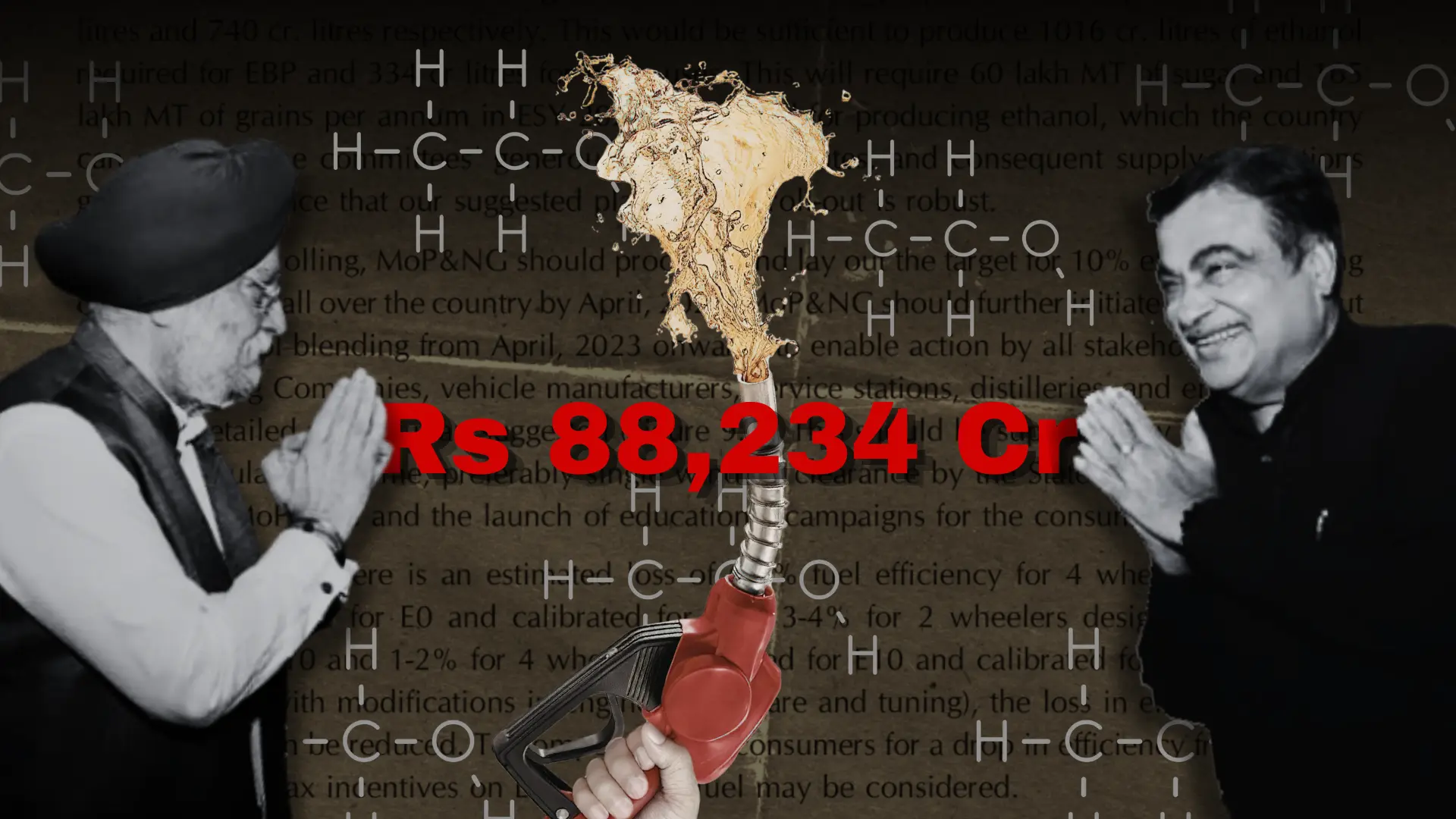


New Delhi: Nearly two months after the Indian government celebrated the milestone of achieving 20 percent ethanol blending in petrol, Union Minister of Petroleum and Natural Gas Hardeep Singh Puri addressed a conference in Delhi. He rubbished claims that vehicles running on blended petroleum were burning more fuel and/or facing engine damage.
Puri told the audience of energy experts that these stories were “BS (bullshit)” in those exact words.
“All the stories you hear about biofuels being harmful for engines, there’s a load of BS – B capital, S capital.. (in them),” he said.
He went on, “I can give you 21 reasons why [fuel] efficiency of a car can go down by one or two percent.” Puri claimed that running cars on congested roads of Delhi or Gurugram was a more likely reason for burning more fuel than running it on 20 percent ethanol blended or E20 petrol.
Using the Union government’s own data, The Reporters’ Collective fact-checked Puri. Our analysis of motor spirit consumption data and vehicular traffic growth shows that ever since ethanol blending gained pace, consumers have had to shell out approximately Rs 88,234 crore more in the past three years (between 1 April 2023 and 31 March 2026) to cover for the loss in mileage of ethanol blended fuel. Motor spirit refers to all petrol and its blended derivatives used to run vehicles.
There is a recurring annual cost that Indian consumers will have to continue bearing in future and the financial burden on them will increase if the government increases the percentage of ethanol mixed into petrol.
The reason for this fall in mileage is simple science that the government did acknowledge in its reports and then tried to hide in rhetoric: Ethanol does not provide the same energy as petrol upon burning. It is about 33% less efficient.
While the government has saved some on its crude oil import bill by mixing ethanol, the cost of this shift is also being borne directly by consumers at scales that the government has not acknowledged or quantified and subsequently rubbished as “bullshit”.
The consumer cannot escape this additional cost even by shifting to the zero ethanol fuel because today if you want to switch, the government has fixed the cost of that at Rs 66-68 per litre (on current Delhi rate) higher than the blended petrol. In Delhi, while ethanol-blended petrol costs about Rs 102, pure petrol is priced around Rs 167-170.
{{cta-block}}
The Great Ethanol Experiment
Ethanol, an alcohol produced from sugarcane and food grain based raw materials, was introduced in India nearly 23 years ago as a bio-fuel alternative to petrol used in motor transport.
Launched in January 2003, the government’s Ethanol Blending Programme initially aimed to blend five percent ethanol into petrol supplied in nine states and four Union Territories. However, until 2013-14, the actual ethanol blending remained negligible, between 0.1 percent and 1.5 percent, well below the government’s initial target.
The program’s trajectory got a boost after the BJP came into power. In April 2019, ethanol-blended petrol was rolled out nationwide (with a few exceptions), with blending percentages rising sharply in the last three years, to 20 percent in July last year.

In the past year, Indian motorists began to complain of a sharp increase in their fuel bills, as they purchased more motor spirit for the same distance.
A survey of over 44,000 urban petrol vehicle owners (pre-2023) conducted by the community platform LocalCircles found that the majority observed that since early 2025, running vehicles on E20 fuel has reduced mileage by 15-20%. Minister of Road, Transport and Highways Nitin Gadkari maintains that individual motorists can’t assess such a decline. Yet thousands of surveyed owners reported dropping fuel efficiency on the higher blended fuel, with this sentiment growing stronger with each passing month.
India currently imports nearly 88 percent crude oil from abroad. The hope was, besides other advantages, mixing ethanol would reduce the government’s fuel import bill.
From its introduction in 2003 until 2014, ethanol blending was nearly negligible. In June 2018, the government notified its National Policy on Biofuels and set the goal to blend 20 percent ethanol into motor spirit by 2030. A report by Niti Aayog published three years later, claimed that India would save nearly Rs 30,000 crore in its oil import bill once E20 blending is achieved.
In July 2025, India achieved its target of 20 percent ethanol blending, five years ahead of schedule. For the 2025-2026 financial year, an average of 19.9 percent ethanol was blended into motor spirit. We calculated this using the monthly ethanol blending percentages published by the Petroleum ministry’s Petroleum Planning Analysis Cell (PPAC).
The 2021 Niti Aayog report detailing the roadmap for ethanol blending admitted one key concern union ministers Hardeep Singh Puri and Nitin Gadkari tried to play down as India accelerated ethanol blending into petrol.
Gadkari has been a vocal supporter of ethanol blending since at least the early 2000s. His ministry changed vehicular standards for the adoption of ethanol blending. None of this, however, was possible if the Petroleum ministry, with Puri at its helm, helped push blending to 20 percent, with the Union cabinet on board. The two remain ardent defenders of the ethanol blending policy.
To write the 2021 report, the Aayog consulted several ministries and industry associations. They acknowledged that running cars on E20 fuel would result in a mileage penalty. This means that motorists would need to burn more fuel to cover the same distance.
“When using E20, there is an estimated loss of 6-7% fuel efficiency for 4 wheelers which are originally designed for E0 and calibrated for E10, 3-4% for 2 wheelers designed for E0 and calibrated for E10 and 1-2% for 4 wheelers designed for E10 and calibrated for E20,” the report observed.

The government went ahead regardless of this red-flag. To offset the cost to consumers from low mileage the government could have reduced the price of E20 fuel for vehicles. It didn’t do so.
When complaints from consumers rose after the government rapidly increased ethanol blending from 10 to 20 percent within just three years, Union minister Gadkari was quick to dismiss the loss in mileage as minor.
In an interview with the Times of India in July 2026, he maintained that the mileage loss of E20 petrol would be minor due to the lower calorific value of ethanol compared to petrol. “In city traffic in Delhi or Mumbai, you will not see any major change. There may be some loss when you are driving at high speed on the Delhi-Mumbai Expressway,” Gadkari said.
The same month, on July 20, the Union minister Puri claimed that “extensive laboratory studies and field trials” establish that there is no significant variation in performance of vehicles or abnormal wear and tear due to E20 fuel. This was in response to a parliamentary question asked by parliamentarian John Brittas in the Rajya Sabha.
However, the Union Petroleum ministry did not publicly release the official reports of these purported studies and trials.
We asked the ministry to share the reports for these trials in our questionnaire, they did not reply at the time of publication.
The Collective decided to carry out an analysis of how much excess petrol bills consumers had run up in the three financial years since ethanol blending was ramped up by the government.
The E20 Cost to Citizens
Since the government did not provide a clear answer on the loss of fuel efficiency from running vehicles on E20 blended fuel, The Collective used a simple calorific value conversion between ethanol and pure petrol to calculate the loss in mileage for cars and two-wheelers running on E20 petrol.
Burning a single litre of ethanol gives 33 percent less energy than burning a single litre of petrol. So if one blends 20 percent ethanol into motor spirit, we calculated, it will give 6.7 percent less energy than pure petrol. An expert in the automobile industry who has worked on ethanol blending also validated this conversion.
On this basis we calculated the projected consumption of motor spirit for the all financial years since April 2023, the starting point of our analysis, from when blending ramped up from E10 to E20.
In FY2025-26, India burned 42.6 million metric tonnes (MMT) of motor spirit which had nearly 20 percent blended petrol. If motor spirit burned was just pure petrol, Indians would have only needed 39.76 million metric tonnes. So, for FY2025-26, India burned 2.83 MMT of motor spirit in excess.
In the last three fiscal years, India gradually increased ethanol blending from 11.8 to 20 percent. Since ethanol delivers about 33 percent less energy than pure petrol, this higher blending required the motorists in India to burn an additional 6.57 million metric tonnes of fuel compared to what would have been needed if pure petrol had been used. Over these three years, the value of this excess fuel amounted to an estimated Rs 88,234 crore.
Questions were sent to the Petroleum ministry and to the Transport ministry. The ministries had not replied till the time of publication.
.webp)
To calculate the cost of the additional fuel consumed we considered a scenario where Indians were not forced to buy excessively priced unblended petrol and could choose to buy it at the same price as blended fuel, at the prevailing petrol prices in Delhi for that time period. We tilted towards this conservative route of calculation though at current prices of pure petrol the motorists’ bills would skyrocket much higher.
In India, the price of petrol has remained the same even after blending. In the United States, which is the largest producer of ethanol in the world, ethanol blended fuel is subsidised in comparison to unblended petrol.
On this basis, for the amount of excess fuel consumed Indians were forced to foot an additional bill of Rs 37,843 crore in the FY2025-26 alone, and Rs 88,234 crore across three fiscal years.
We also compared the growth in motor spirit consumption with the annual growth in the total number of vehicles plying on the road. The government, however, does not provide this data. For this, we used a study conducted by the Council on Energy, Environment and Water (CEEW), a New Delhi-based think tank, to extrapolate the number of vehicles on the road each year.
CEEW uses data on vehicular ownership to arrive, along with GDP and population projections, to estimate the total number of vehicles active on roads in 2023. Building on this study, we projected growth in net number of vehicles across financial years, and compared it to the growth in motor spirit or blended petrol.
This projection revealed a trend. In the years when ethanol blending expanded across the country, with the Union government pushing for 20 percent ethanol blend, the motor spirit consumption outpaced the growth in the number of vehicles on the road. This means that with each passing year, cars were consuming more and more fuel, suggesting the ‘mileage penalty’ of ethanol.
While ethanol blending increased fuel consumption in vehicles, factors such as road network expansion – with vehicles travelling longer distances – and increase in congestion in urban centres would have raised consumption as well.
What is clear from this analysis, however, is that over the last six years, the average ethanol blend in petrol has increased from around five to 20 percent, and fuel consumption has always grown faster than the number of vehicles.
In comparison, if Indians had access to unblended petrol, the rising consumption of fuel would have been trimmed. Instead, they ended up paying an estimated Rs 88,234 crore extra in the last three years.
This is the cost of the mileage penalty that ministers Hardeep Singh Puri and Nitin Gadkari deem as ‘insignificant’ or ‘bullshit’. Even as Indian motorists spend thousands for crores extra out of pocket to drive down the road laid in the government’s ethanol-fueled dream.
In our calculations, we have tended to stick to conservative scenarios while using the limited data available in public. The one factor that could potentially show a lower impact on the motorists’ bills is the annual growth in vehicle-kilometres that Indians travel on the road. Some studies suggest this is about three percent annually for all vehicles. But, the government does not make public the data needed to factor this in while calculating the cost to citizens.
Another factor that Puri made an exaggerated point of is the slowing down of traffic, particularly in cities, as vehicles grow on road. Traffic growth certainly reduces mileage. By how much? Rather little compared to the loss due to introduction of E20. The exact figures, potentially, sit locked in government files while the ministers bat it out in public.
Last heard, Gadkari has won the right to sue social media companies like Google and Meta to pull entities or pages spreading “defamatory” content on ethanol blending.