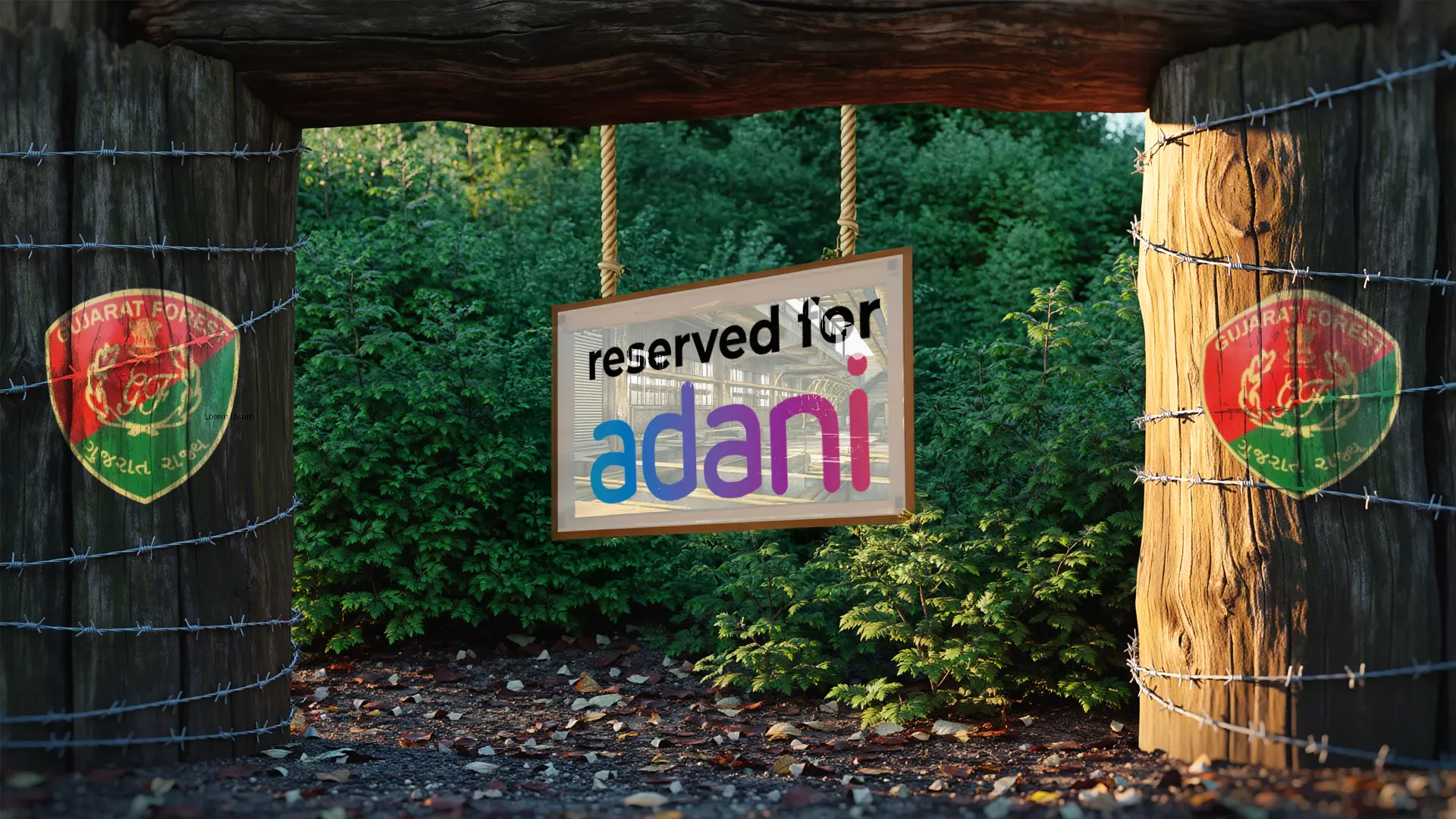


New Delhi: The BJP-led Gujarat government asked the Union government to unlock many parcels of forest land that had been reserved for afforestation under the Green Credit Programme. It said the Adani group had ‘demanded’ four of these forest parcels for its projects.
The Union government’s designated expert body overseeing the Green Credit Programme hesitated. It noted that allowing the deforestation of degraded forest parcels instead of earmarking them to make the forest denser and healthier under the green initiative was inherently "contradictory in nature."
The Gujarat government subsequently submitted a revised justification. It informed the Union government in a fresh plea that no one wanted to plant forests on these and other patches, so they should all be removed from the programme the Modi government had launched with much fanfare in October 2023.
The Union government obliged. Bypassing its existing rules, it removed the four parcels totalling 63.44 hectares—originally requested for the Adani Group—along with several others from the Green Credit Programme.
When The Reporters’ Collective mailed queries to the Gujarat government, it denied requesting the Union government to remove forest parcels for the Adani group. We shared a copy of their records, revealing that it had originally done so. We did not receive a response.
Initially, the Adani Group responded to our queries by asking for details of the parcels. We shared all the details from the Gujarat government’s records in our possession, and cited in the reportage, including geographical coordinates. After repeated reminders, the company then said it could not comment unless the project details were specified.
We could not determine whether the Gujarat government had formally received a proposal from the Adani Group to clear the forests.
{{cta-block}}
The Green(wash) Credit Programme
The Indian government's narrative on the health of the nation's forests has long been questionable. While official reports tout steady annual increases in forest cover, researchers contend that these figures are inflated by conflating plantations with natural forests.
In October, an assessment by the Food and Agriculture Organisation(FAO) ranked India 9th in terms of total forest area and 3rd in terms of annual forest area gain.
India’s environment minister Bhupender Yadav credited the Modi government’s “policies for protection and enhancement of the forest and massive plantation efforts by State Governments” for the feat.
With fuzzy statistics, the complete picture is hard to stitch together. But, the government’s own data shows that rich forests are degrading, and every year large patches of existing forests are being cleared for industries, mining and infrastructure projects. Between 2014-15 to 2023-24, the Union government approved cutting down 1.74 lakh hectares of forests for mining, infrastructure and other projects, an area larger than the size of Delhi.
Against this backdrop, in a bid to bolster its green credentials ahead of world leaders convening at the UN Climate Conference in December 2023, Prime Minister Narendra Modi unveiled the Global Green Credit Initiative. The announcement rang hollow. The Initiative was a stunt, reselling a domestic idea, without the details in place, for an international audience. It was mimicking the Green Credit Programme that Modi’s government had launched two months before, in October.
Under the program, the Union government promotes tree planting on degraded forestlands to generate green credits, which companies can use to meet their environmental obligations. For instance, to obtain permits for clearing forests for projects, firms must afforest an equivalent area of non-forest land or twice the area of degraded forest land—a process known as compensatory afforestation. Now, they could instead fund such plantations or buy credits from others who have already planted.
The Green Credit Programme requires states to identify degraded forest lands that can be turned greener and ensure that these patches are “free from all encumbrances” before offering them to the Union government’s forest land bank for the scheme. The parcels are then offered to corporates that require undertaking environmentally beneficial activities as part of their legal requirements or corporate social responsibility.
A previous investigation by The Reporters’ Collective had revealed how the scheme, from the start, has been a mix of hype and greenwashing.
Enter Adani
Regardless of how patchy the scheme’s rollout and details were, the Union government set the rules in place in February 2024 and asked states to identify forestland parcels for the scheme. These parcels would be part of a land bank, and entities would fund growing trees or other eco-restoration activities on them to earn credits. Many states did so. Gujarat was the first to.
After all, the original idea for such a scheme had come from the Gujarat government just when Narendra Modi was upgrading from the state’s chief minister to be elected India’s Prime Minister.
But, in just a few months, Gujarat would turn turtle on its idea, show documents accessed through the Right to Information Act.
In July 2024, the Gujarat forest department wrote to the Director of the Green Credit Cell at the Indian Council of Forestry Research and Education (ICFRE), the body supervising the Green Credit Programme. It requested ICFRE to delete 13 forestland parcels from the land bank of the programme in Gujarat.
The state forest department said because of "unforeseen circumstances, we are unable to continue below mentioned land parcels for the upcoming plantation under the Green Credit Programme.”
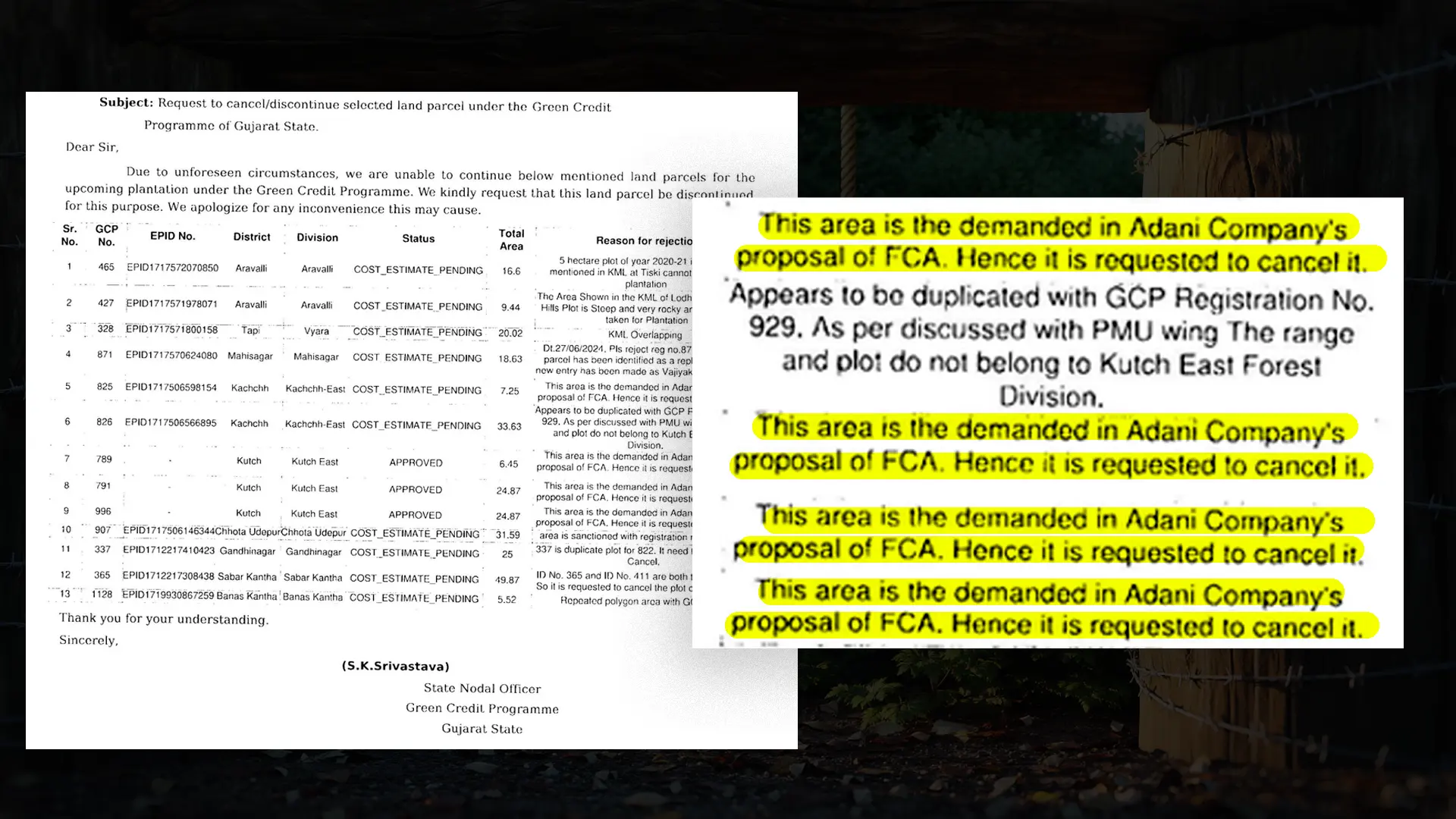
A table was attached listing these 13 parcels and the reasons for deleting them from the greening scheme. Some parcels were suddenly found to be “steep and very rocky”, some were found to be “duplicate” entries.
And against four, it was mentioned, “demanded in Adani Company’s proposal of FCA. Hence, it is requested to cancel it.”
FCA is the abbreviation for the Forest Conservation Act, 1980. It was recently amended and rechristened by the Modi government to Van (Sanrakshan Evam Samvardhan) Adhiniyam, 1980. It's under this law that the states and the Centre permit handing over forestlands to industries to clear and use for their projects.
This is what the Gujarat government meant by saying the four land parcels were 'demanded' by an Adani company for FCA. The Adani group had asked the state that those parcels be handed over to their company.
The Gujarat government’s request kick-started hectic parleys within the ICFRE, records show.
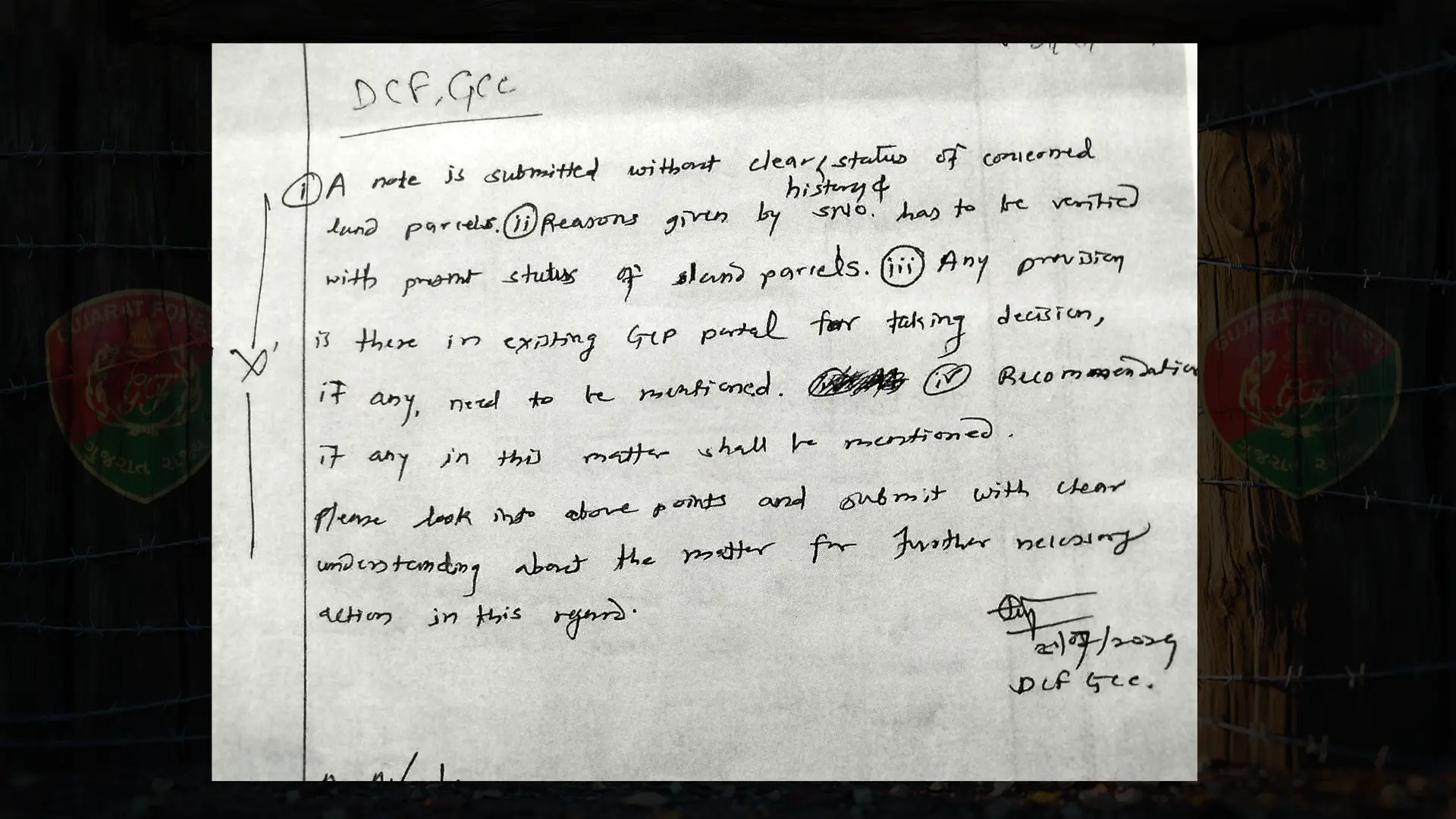
In the same month, an ICFRE official noted that the request had been submitted without a “clear status of land parcels”. He noted that provisions in the existing Green Credit Programme portal for delisting forestlands needed to be mentioned before taking a decision. He tasked officials to fetch more details on the forests that Gujarat was now keen to delist.
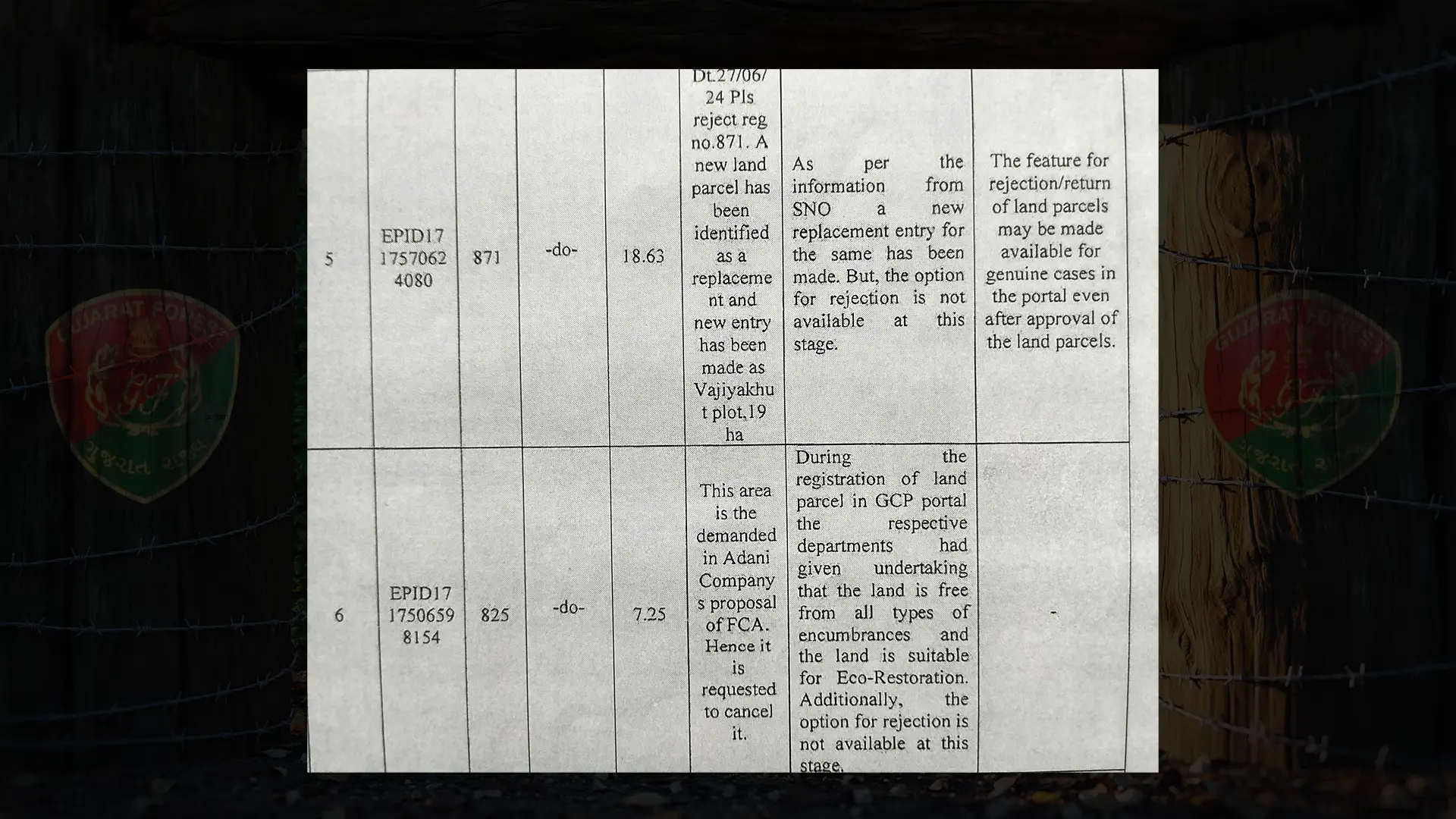
By August 2024, ICFRE had made a more detailed assessment. It confirmed that the Gujarat government wanted four forest patches reserved for the Adani group to chop down.
It put the forest officials in a pickle. The ICFRE officials did not address these four cases specifically. The column to write the recommendation in favour of or against the deletion of these patches was left blank.
They did remark that Gujarat had committed on record that the land was free of any encumbrances and suitable for eco-restoration when listing it for the scheme. In polite bureaucratic language, the ICFRE was blaming the Gujarat government for suddenly discovering Adani group’s interests in the land the state had earmarked earlier for afforestation. ICFRE noted that “the option of rejection is not available at this stage”.
For the land parcels that did not involve the Adani group, an ICFRE official recorded that internal systems could be revised to provide the option “for rejection/return of land parcels” for “genuine cases”. Another one said the Gujarat government should be told not to make such mistakes in the future.
Its records show that some central government companies had shown interest in greening one of four parcels Gujarat now wanted freed for the Adani group.
ICFRE’s highest official, the Director General, commented that in the case of land parcels 'demanded' by Adani, it was a policy issue for which directions from the environment ministry were needed. It needed clarity whether land parcels that had been listed to be improved upon under the Green Credit land bank could instead be selected by companies under FCA to be chopped down, since the two processes were “contradictory in nature”.
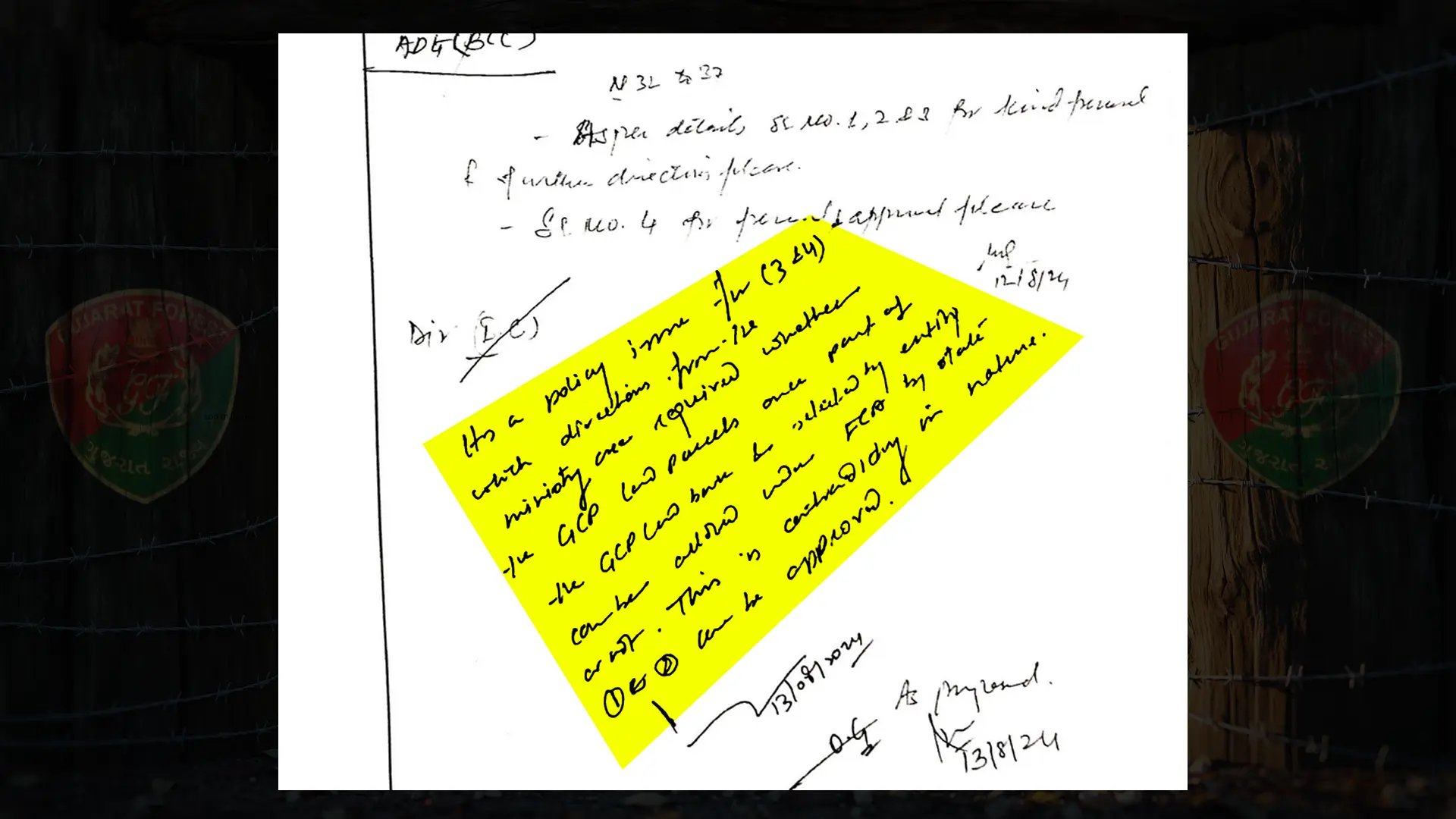
In September 2024, ICFRE wrote to the ministry about the forest patches Gujarat wanted reserved for the Adani group. It said the “situation presents a challenge as these land parcels were initially registered under the Green Credit Programme”. It said that their "subsequent identification” for forest clearance permits “raises concerns about procedural overlap and management of such cases”.

In return, the environment ministry told the ICFRE that the two mechanisms were indeed "mutually exclusive” and independent of each other. The ministry’s mail did not provide clear instructions to ICFRE.
Naming the Adani group explicitly had made the issue a hot potato. It was stuck as a ‘policy issue’.
In December 2024, the Gujarat government came up with another rationale to get the forest parcels free for the group. This time around, it said all forest parcels that it had earlier offered for greening and were yet to get any offer for greening should be withdrawn entirely from the Green Credit Scheme. This, without saying as much, included the forestlands 'demanded' by the Adani group. On paper now, the reason for chopping down these forests did not mention the corporate by name. In all, 81% of the land it had originally offered for plantations in 2024-25 under the programme was to be removed, Gujarat said.

Records reveal, this time the Union government acceded to Gujarat’s demand and “withdrew” the lands from its prestigious and much-hyped programme.
The Four Parcels
While the Gujarat and ICFRE official correspondence does not mention which projects the Adani group wanted the forestlands for, we tried to identify them independently.
All four land parcels lie in the Kachch East division of the Kachch district.
The reporter asked ICFRE for the geographical coordinates of the land parcels and located them on Google Earth to find what Adani Projects might be running close to these areas.
Two of these land parcels are in the Mundra forest range. One of these two is located within 200 metres of Adani Power Limited’s complex, which includes its Mundra power plant.
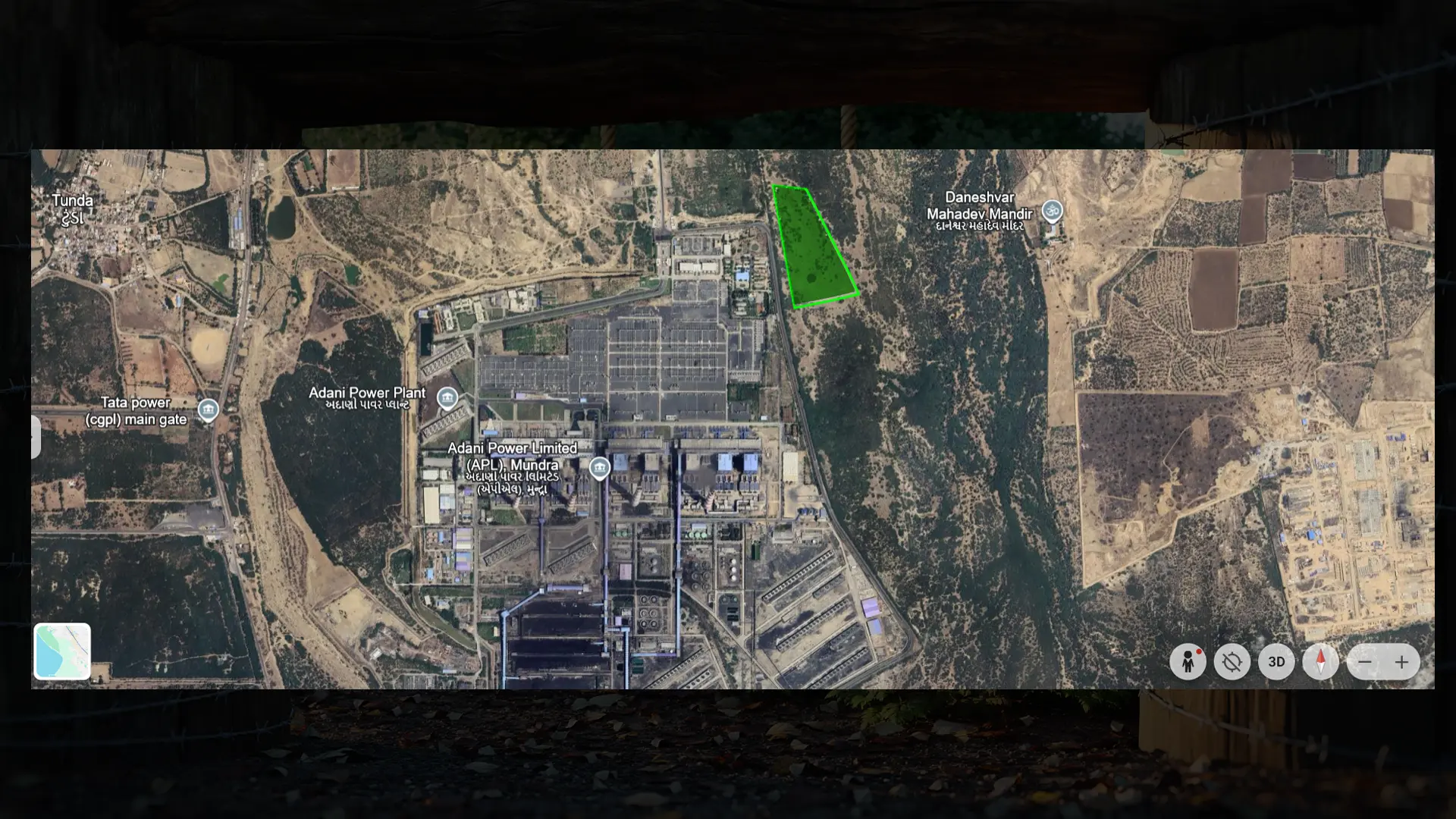
The second one is around 18 km from the Adani Power Limited complex and about 27 km from Adani’s Mundra port.
The other two land parcels are in the Bhuj South range. We could not identify any Adani projects running in their vicinity.
Private parties submit their proposals for chopping down forests to the state, which in turn forwards it to the Union government. The Union government’s Parivesh portal displays these proposals with details of the land being asked for. We tried to investigate if the Adani group’s proposals for these four land parcels were on the Parivesh portal. We could not trace them, suggesting the proposals, formally, are sitting with Gujarat for now.
We called S K Srivastava, Gujarat’s nodal officer for the Green Credit Programme, asking about the deletion of land parcels.
He insisted Gujarat had withdrawn the forestlands from the programme because it had not found any takers for the afforestation drive.
“Last year, no one was very clear what target would come for plantation. We internally had decided that we would be doing 5,000 hectares... But only around 975 hectares were actually funded by some agency or other.”
When we pointed out that the Gujarat government had asked four parcels to be deleted specifically for the Adani group to chop down, Srivastava said he did not know the details.
He said, “I will not be able to tell you since I really do not have that kind of detail.” He added, “The reason for removal from the land bank of the programme is different. It is not because someone asked for it.”
This statement contradicts the Gujarat government’s records, which explicitly mention the Adani group’s 'demand' for the lands.
In response to our first set of queries, the Gujarat government outrightly denied sending any request to ICFRE for cancelling land parcels to help the Adani group.
Gujarat’s response read, “In July 2024, no request was made by the SNO (state nodal officer of the Green Credit Programme) to remove any land parcels from the Green Credit Programme.” It added that since land parcels were funded “under State Government schemes, they were removed from GCP land bank to avoid duplication of funding or future financial complications.”
Official records of the environment ministry and ICFRE nail Gujarat government’s lie.
The environment ministry’s internal notes explicitly state that the Gujarat government requested cancellation of land parcels and “indicated that these parcels are part of Adani Company’s proposal under FCA”.
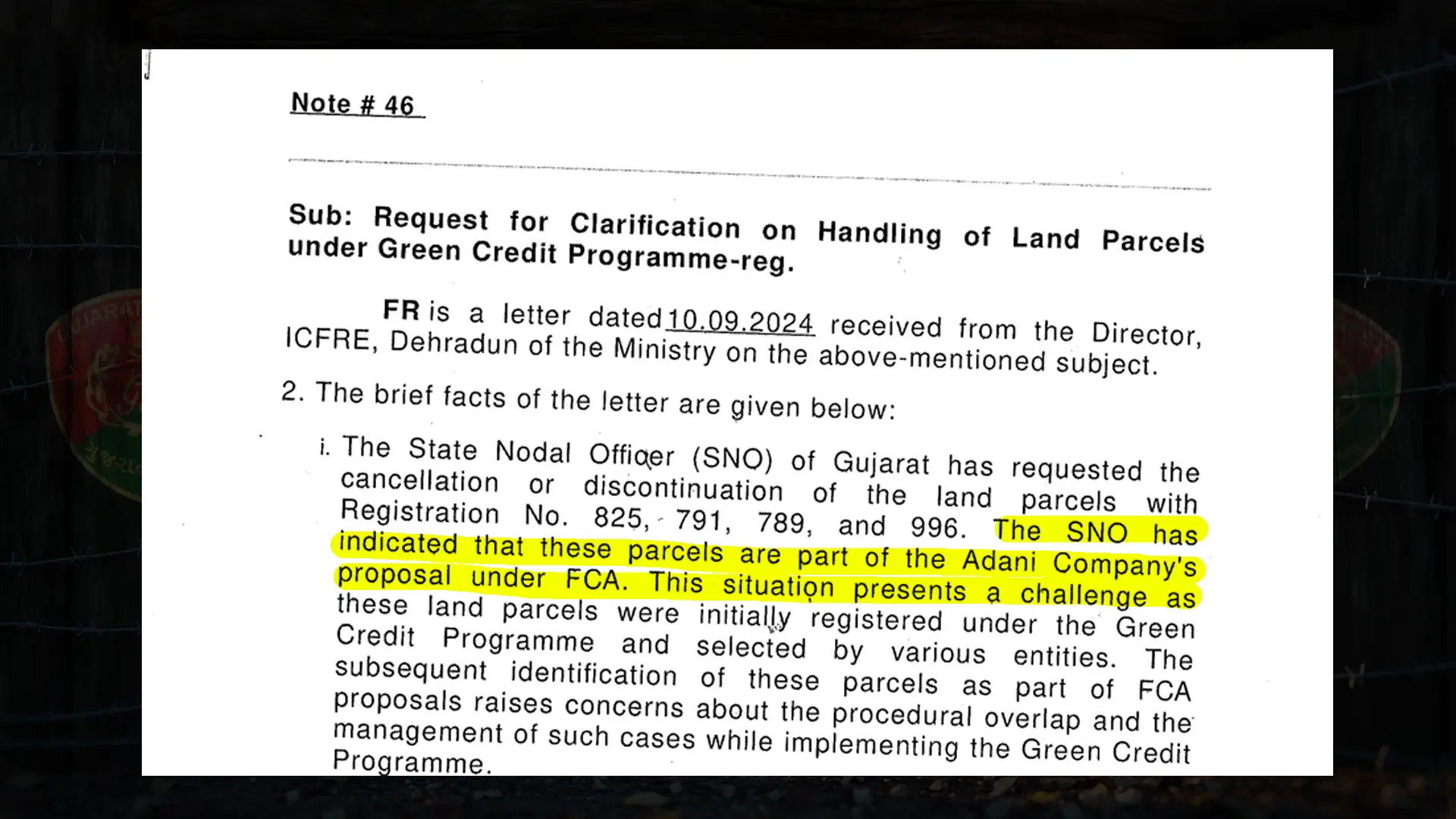
To give Gujarat another chance, we shared the record accessed by us under the Right To Information Act, which showed the state had asked for four forest parcels specifically for the Adani group. Gujarat did not reply.
We contacted ICFRE as well during the reporting of this story. The ICFRE’s public information officer said, since the information we were asking pertained to ‘a third party’, he would not be able to disclose it.
Separately responding to an RTI application, the agency said that because it is not involved in the forest clearance process, the information on the specific company proposals was not available to it.
We emailed detailed queries to ICFRE and the Union governments upon completion of our reportage. None of them had responded till the time of publication.
Consequently, we were unable to ascertain whether the Adani group had formally sent proposals for clearing the forests on the four land parcels or not.
Adani Group’s Response
We engaged with the Adani group repeatedly over two weeks to solicit a response to the reportage. The correspondence took place over emails, phone calls and WhatsApp messages.
We first emailed queries to the Adani group. Among other things, we requested the company to share details of the projects for which the Gujarat government had tried to sequester the forest parcels out of the Green Credit Programme.
Mitul Thakkar, Associate Vice President, Corporate Brand Custodian at Adani Group, told us on a phone call that he had made inquiries within the group companies and was unable to identify any matching proposals for deforestation in the specific district.
On email, he turned our query around on us and asked us to share “the specific project/company and the location.”
The Gujarat government had not named the specific projects and the group companies in its missives to the Union government. It had shared the geographical coordinates of the land parcels.
We shared those with Thakkar. The company did not reply for nine days despite repeated reminders.
Thirteen days after we first mailed them, and nine days after we sent them geographical coordinates, on our last reminder, Thakkar replied on WhatsApp to say, “details for specific projects and companies still awaited, as requested.”
We reiterated that The Reporters’ Collective had already shared all details available in the Gujarat government’s documents, which we planned to report on. To this, Thakkar responded for the company to say, “We are unable to provide comments unless you specify the projects mentioned in the said document, which did not originate from our end, as previously requested.”
All correspondence with the Adani group, the state government, the Union government and the ICFRE, alongside the documents reviewed by us for the story, are being made public.
Documents accessed for the story.
Correspondence with the Adani Group, Gujarat government, ICFRE and environment ministry.
Gujarat government's response after publication and our statement.




.avif)