
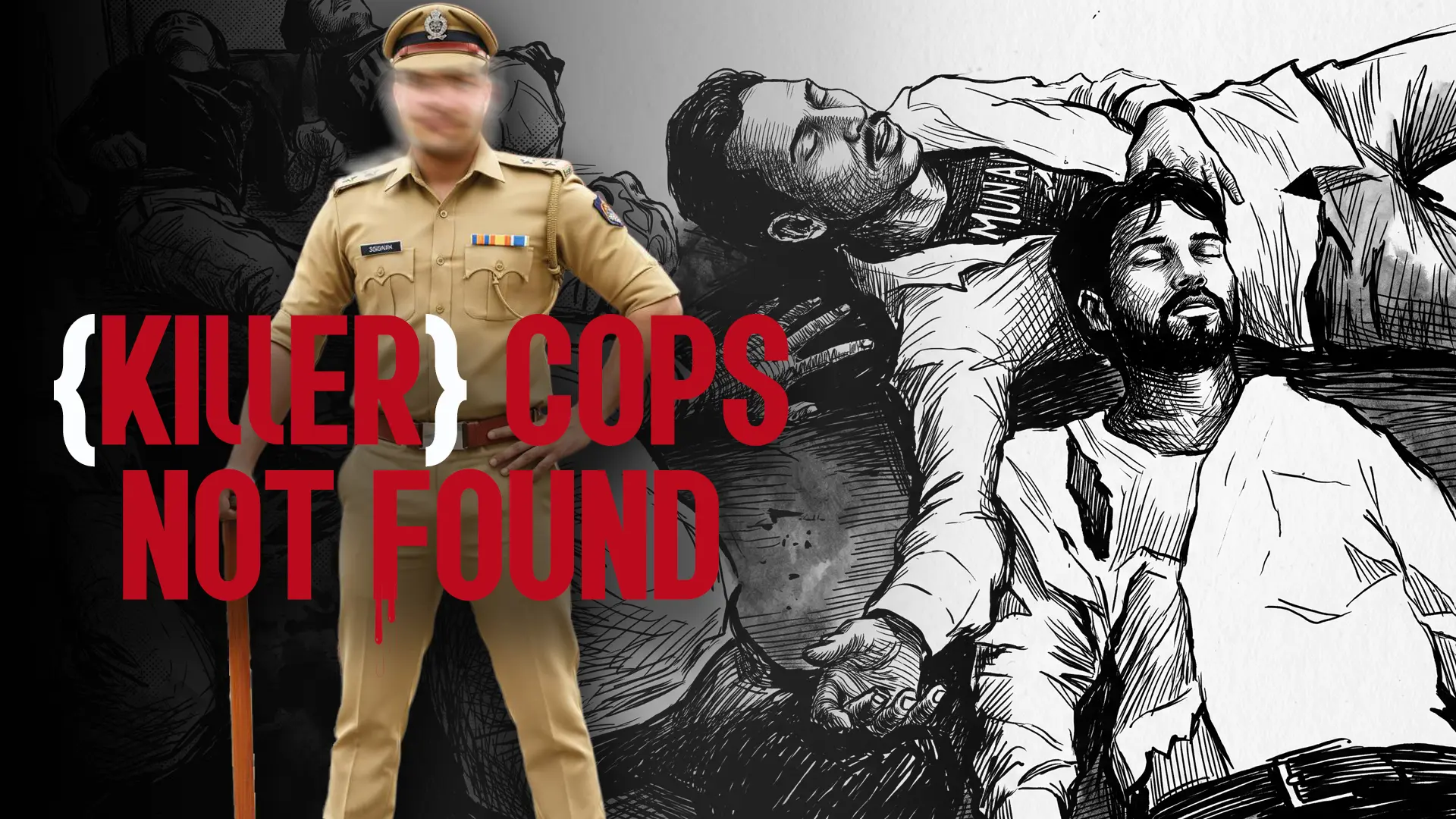


New Delhi: After nearly two years of investigation, the Central Bureau of Investigation (CBI) has failed to identify all the policemen who bludgeoned 23-year-old Faizan to death. The cops had forced him to sing the national anthem as he lay injured on the roadside during the 2020 Delhi violence.
The brutal assault on Faizan, and four others, by a group of policemen near the Maujpur area of northeast Delhi was caught on camera and widely shared on social media.
After being beaten, Faizan was held in police custody for one day. He was released in a severely injured state and died the following day.
In its investigation earlier, Delhi Police, which reports to the Union home ministry, was unable to identify even a single policeman who had beaten Faizan to death. Castigating the police, the court had tasked the CBI with finding the policemen, whose job was to quell the riots, but who instead killed a citizen in cold blood.
The CBI too has failed. It has zeroed in on only two low-ranking officials, head constable Ravinder Kumar and constable Pawan Yadav, that the Delhi Police investigation had already identified as suspects. While CBI concluded that “due to this severe beating Faizan died of the injuries,” they stop short of charging the two cops for murder. They have instead been charged for culpable homicide not amounting to murder (section 304 (II)) and violent acts committed by a group (section 34), and for causing serious injuries (sections 323 and 325).
The Reporters’ Collective accessed the final report of the CBI chargesheet filed on 5 February. The document reveals how the CBI found that the Delhi Police had done little to identify the killers in its ranks. The Delhi Police had even claimed in court that it didn’t have the duty roster of the cops deployed at the crime scene that day. The CBI used the very same roster to find the two accused.
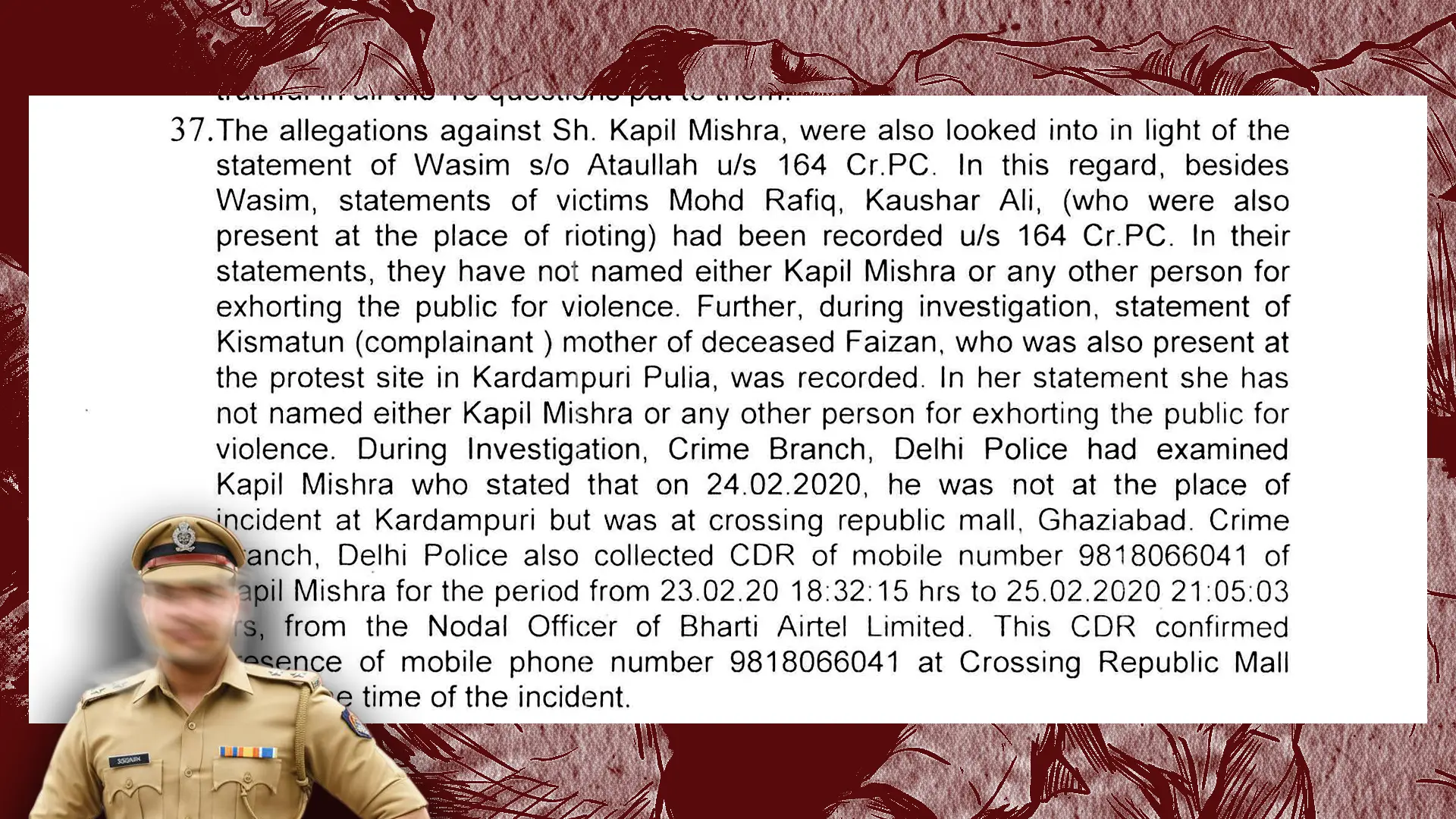
The report also shows the CBI’s approach, which failed to identify Faizan’s killers, who likely continue to serve in Delhi Police today. The chargesheet also mentions Kapil Mishra, a BJP leader and cabinet minister in the Delhi government, clearing his role in “exhorting the public for violence.”
{{cta-block}}
The Duty Roster Delhi Police Said It Never Had
On the evening of 23 February 2020, communal violence tore through northeast Delhi. Violent mobs went around killing and setting houses on fire, targeting Muslims sitting in protest against the Citizenship (Amendment) Act (CAA). Hours earlier, Mishra had stood at Maujpur Chowk, barely a kilometre away from where Faizan would be beaten, giving anti-CAA protestors a three-day ultimatum to clear the roads. Videos of his remarks were widely shared on social media. More than 50 people, most of them Muslims, were killed in the violence.
Violence intensified the next day. That afternoon, Faizan, who worked at a meat shop, left his home in Kardampuri to look for his mother, who was a regular at the nearby protest site, one of the many such anti-CAA protest sites in Delhi. He never made it back home.
Faizan, in his dying declaration, said that when he reached the site, police officers “grabbed him from his neck and dragged him” to the main road near the Kardampuri Mohalla clinic. Eight to ten officers then beat him with cane batons, kicked him, and stomped on him with boots, he said in the declaration.
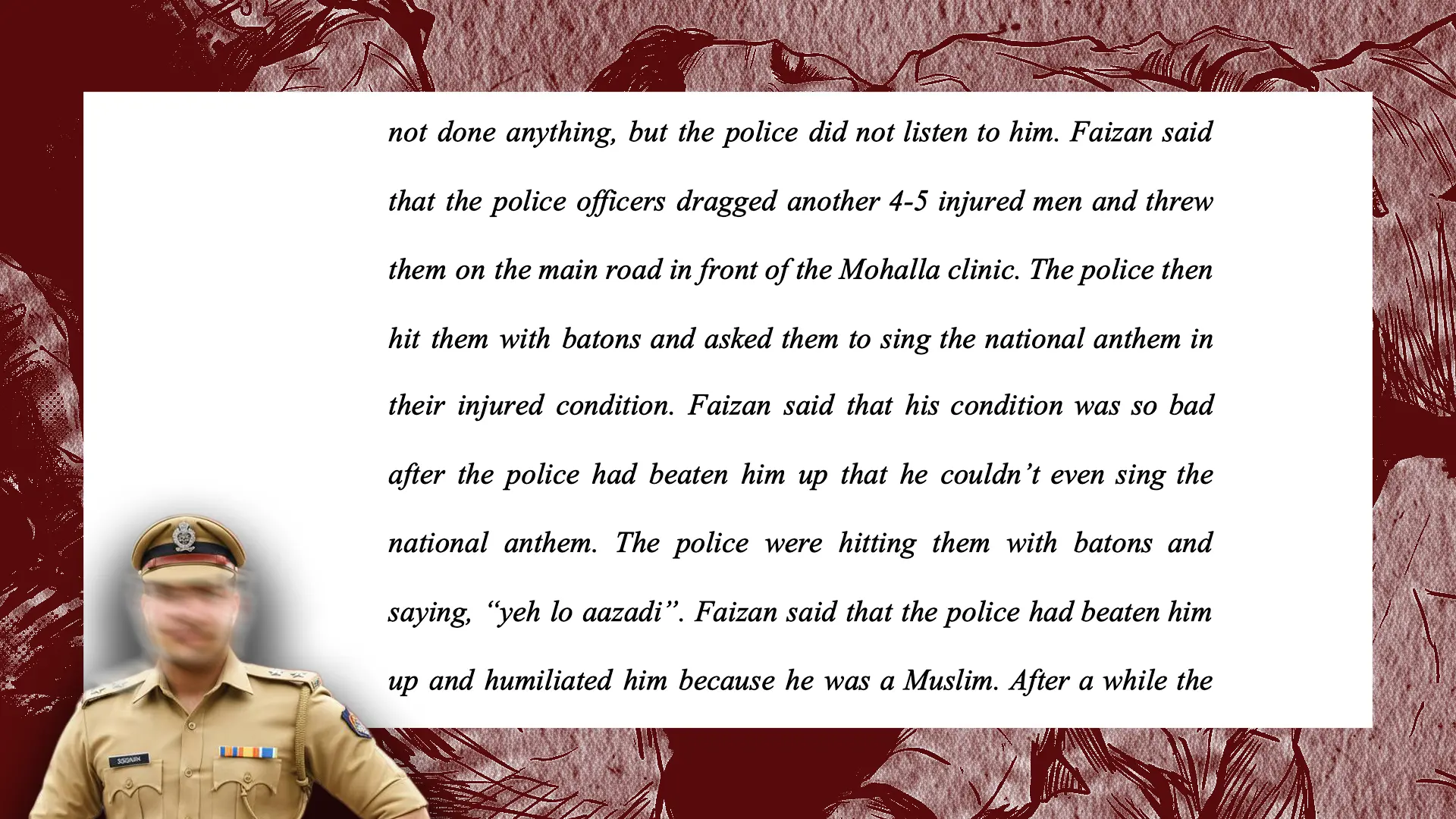
Videos of the assault, widely shared on social media, corroborate what he told his mother before he died. They show a group of cops, all helmeted except one, dragging the five injured on the side of the road, then taking turns to strike them. In another video, shot close up, cops force Faizan and others to sing the national anthem as they lay bleeding on the road. The cops can be heard saying, “yeh lo azaadi (here’s your freedom),” mocking them as they mercilessly beat them. In his declaration, Faizan told his mother that the police had beaten and humiliated him because he was a Muslim.
From one of the videos published by Newslaundry on 3 March 2020 – also mentioned in the chargesheet – at least nine policemen can be seen circling the five injured, some of them kicking and hitting them. The CBI, however, failed to track down the other seven seen in the video.
In another video, which corroborates what Faizan told his mother before he died, he can be seen lying outside the Mohalla clinic when a helmeted cop walked towards him and started beating him with a lathi. One by one, five more helmeted cops followed, taking turns to beat him up, repeatedly striking his head with their lathis.
He said that he requested the police to let him go and told them that he had not done anything, but they did not listen.
Delhi Police’s Special Investigation Team (SIT) spent over four years trying to find the policemen without charging a single cop for murder.
In its explanation to the Delhi High Court, the SIT claimed it could not trace the cops using the duty list because of the scale of the violence, where “police contingents [were] requisitioned from police stations and other outfits all over Delhi and the policemen on duty were not necessarily from the local police station.” They argued that they “do not have [the] duty-list of the policemen who were deployed at the particular spot on the date of the incident.” The high court was not persuaded.

On 23 July 2024, it handed over the case to the CBI, describing the Delhi Police investigation as “tardy, sketchy, and conveniently sparing of the persons who are suspected to be involved in brutally assaulting” Faizan.
When the CBI took over, Delhi Police’s claim turned out to be a lie. The duty roster existed. The CBI used the very same roster to identify two cops – head constable Ravinder Kumar and constable Pawan Yadav, the same suspects the Delhi Police SIT identified in its investigation.
The CBI found that the cops of the V&T company of the 7th battalion of Delhi Armed Police were deployed near the crime scene on that day. As they probed further, a fellow officer, Sub-Inspector Suchendra, picked out Kumar from an assault video. They also found that Yadav was accompanying Kumar that day.

Voice analysis matched both men to the “yeh lo azaadi” slurs audible in the video footage. Kumar’s face was also matched forensically to the video. In lie detector tests, both were found to be “deceptive” in their responses.
But the CBI stopped at them. The agency claimed “many officials of these companies were examined” but it yielded no results.
The Reporters’ Collective sent questions to the CBI asking why it failed to identify at least seven other cops visible in a video, cited in its own chargesheet, surrounding Faizan and the four others injured. Calls to the spokesperson went unanswered. CBI hasn’t responded. This story will be updated if and when it does.
Who unplugged the CCTVs?
Three hours after the assault, at about 8 pm, a group of cops took all five injured in a police gypsy to the nearby Guru Tegh Bahadur Hospital in Dilshad Garden.
Faizan’s first medico-legal certificate noted that his scalp had an open wound, his legs were swollen with scraping marks, and his shoulders were bruised as well. He was referred to neurosurgery and orthopaedics for further treatment. While the high court pointed out that Faizan wasn’t taken to a neurosurgeon despite a referral, the CBI chargesheet claims that he was examined by both an orthopaedic doctor and a neurosurgeon, apart from receiving a basic first aid treatment.
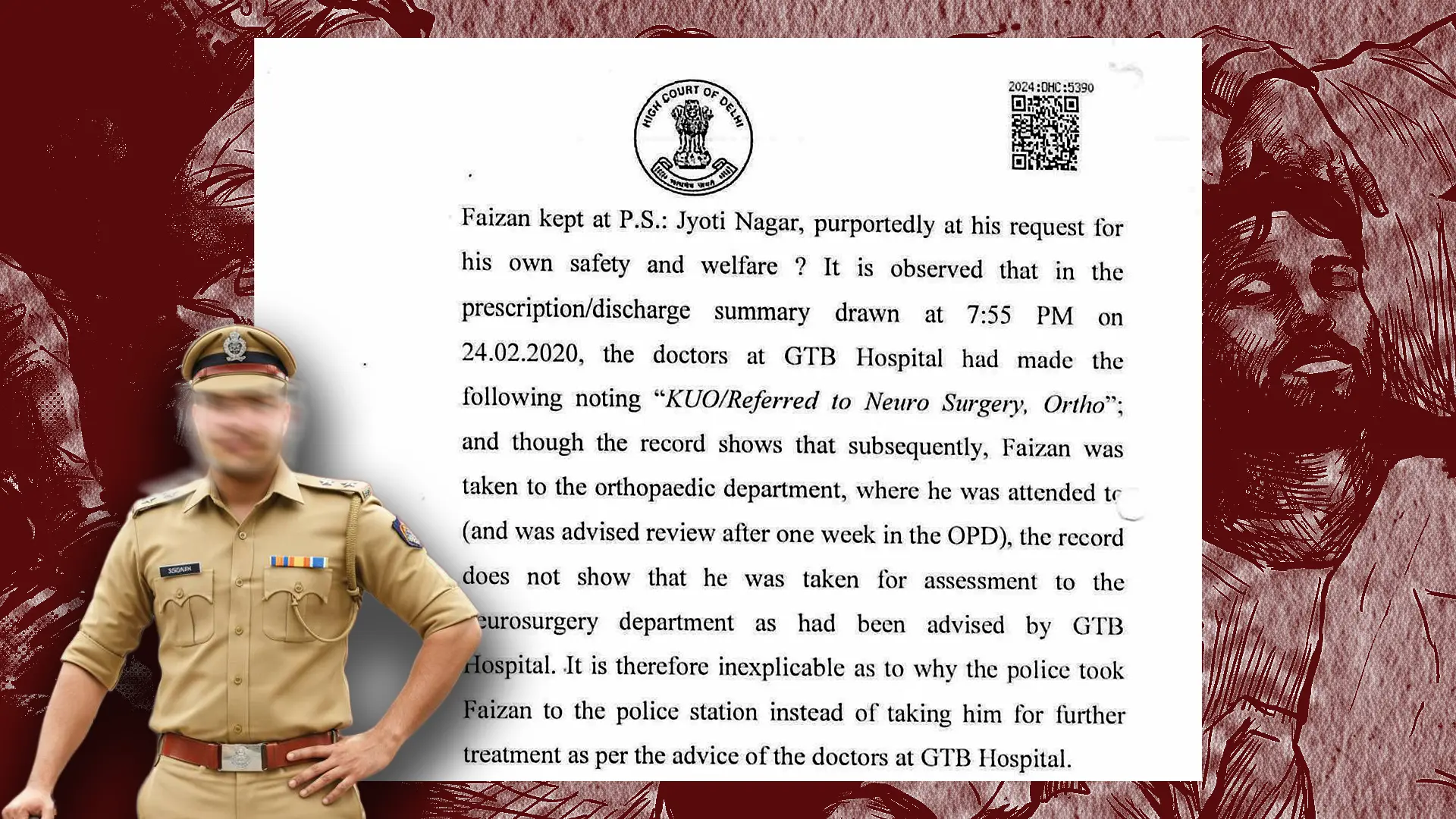
Faizan said in his declaration that “no doctor spoke to him and all the medical inquiry and treatment were carried out by the doctors on the instructions of the police.”
One piece of evidence that could have established what happened to Faizan inside the police station was the footage of CCTV cameras installed inside the station. The Delhi Police’s SIT had claimed that “the entire CCTV system at the station had malfunctioned” the night Faizan was in its custody.
After first aid, Faizan and two others, of the five injured, were brought to Jyoti Nagar police station the same night at around 10 pm. The official record recounted in the chargesheet, a general diary entry by Sub Inspector Dinesh, states that the three came willingly, unwilling to go home given the tense situation outside.

The high court had found this hard to believe. It observed that if Faizan had gone to the station for his own safety, as the police claimed, why had he not called his family or told the police about his place of residence. If Delhi Police’s version is to be believed, Faizan, who had just been brutally beaten by the same cops, leaving him with a severe head injury, decided to trust his life to them and seek shelter at the station.
Faizan’s mother Kismatun’s account is different. In her petition, she alleged that upon learning that Faizan was at the police station, she went there the same night with her other son Nadeem. Two policemen stopped them from entering the station’s premises.
She returned the next morning at 8 am, alleging that Faizan was still not released. It was only later that night, nearly 30 hours after the assault, that he was let go. He came out in a “severely injured condition,” Kismatun said in her petition, wearing clothes “soaked in blood,” his trousers “torn”, and barely able to walk. The next morning, on 26 February, his family took him to Lok Nayak Hospital as his condition deteriorated. Later that night, Faizan succumbed to his injuries.
From just three injuries listed in his first medical examination, before he was taken to the police station, the post-mortem report – cited in the chargesheet – showed Faizan’s injuries had increased to 20. The report noted the cause of his death as “cerebral injury associated with blunt injuries over the body.” These injuries included wounds on his elbows, knees, fingers, and the back of his abdomen, and multiple contusions all over his body. All injuries, the report stated, were “ante-mortem,” meaning they occurred before his death, over two to three days.
When the CBI went to examine the CCTV footage, to investigate the allegations of custodial torture, it found that the CCTV system was “not working” on the day of the crime. It reviewed a third-party engineer’s report who had visited the station to fix it 10 days later. The engineer noted that the recording unit’s “power cables were not connected.”
The Delhi Police SIT had claimed the CCTV system had malfunctioned the day Faizan alleges he suffered custodial torture. The CBI found that the system itself was unplugged, acknowledging this was likely “an act of damaging the CCTV cameras.”
It conducted forensic tests on just five cops of the Jyoti Nagar police station, questioning SHO Shailender Tomar, Sub Inspector Dinesh Kumar, Assistant Sub Inspector Naresh Kumar, Head Constable Anirudh, and Constable Rakesh Kumar for their involvement.
The investigation into the tampering of the only evidence of custodial torture stopped there. So did the investigation into the custodial torture itself. And into who else beat Faizan to death.
The case is being heard at the Rouse Avenue Court, a district sessions court in Delhi. At the last hearing on April 18, Kismatun sought the framing of an additional murder charge against the two cops, citing the “heinous nature and severity of the assault on Faizan.” The court will next take up the matter on May 19.