.avif)
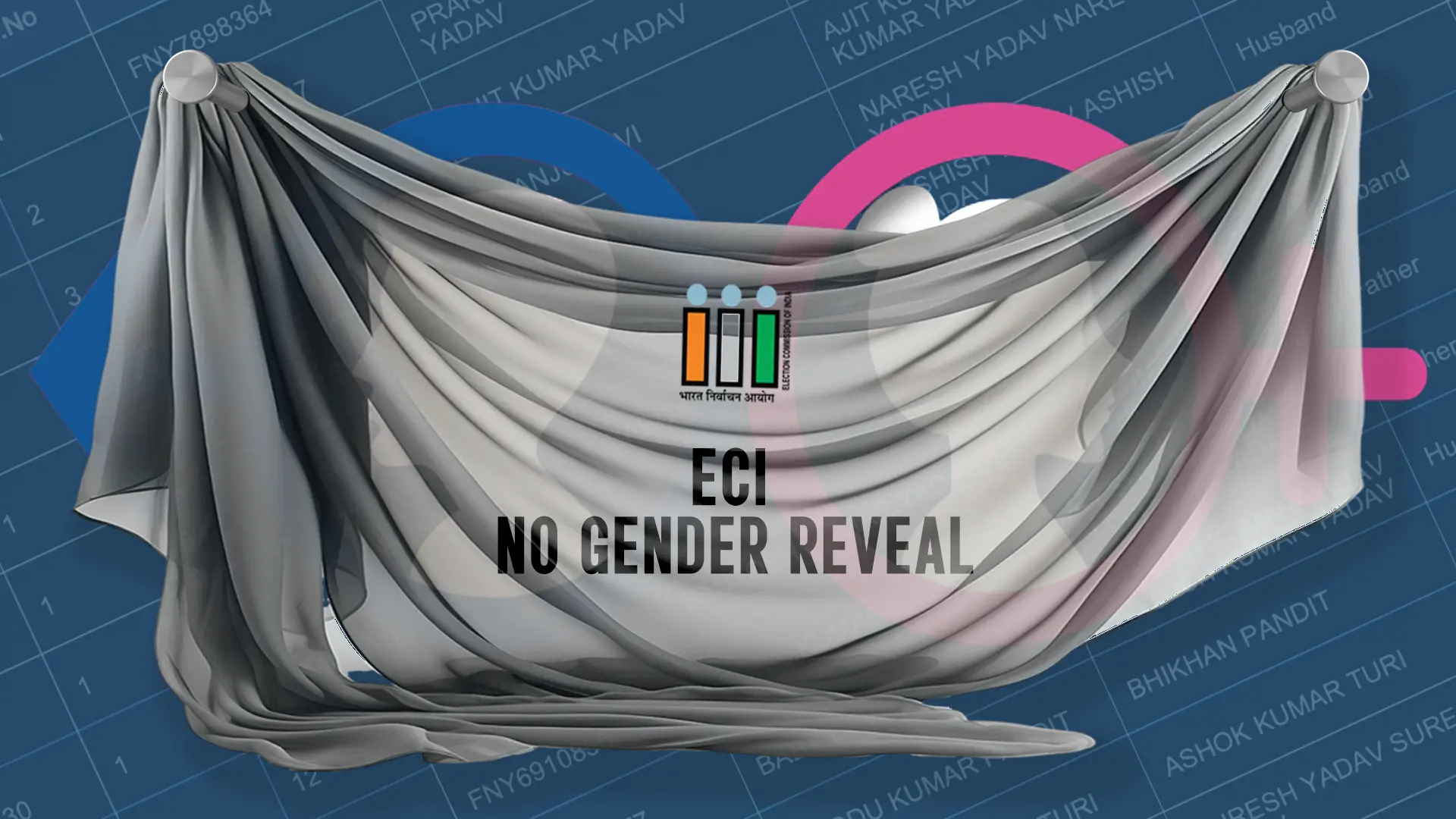


New Delhi: The Election Commission of India (ECI) has stopped disclosing the gender of voters that are being marked suspicious in the first round of scrutiny under the ongoing phase of Special Intensive Revision (SIR).
This will prevent the kind of analysis by civil society watchdogs and journalists, who had previously shown a disproportionate impact of SIR on women in the previous two phases of the voter roll revision in 13 states and Union Territories (UT). Such analysis had shown another layer of discrimination that ECI’s voter roll revision processes was causing.
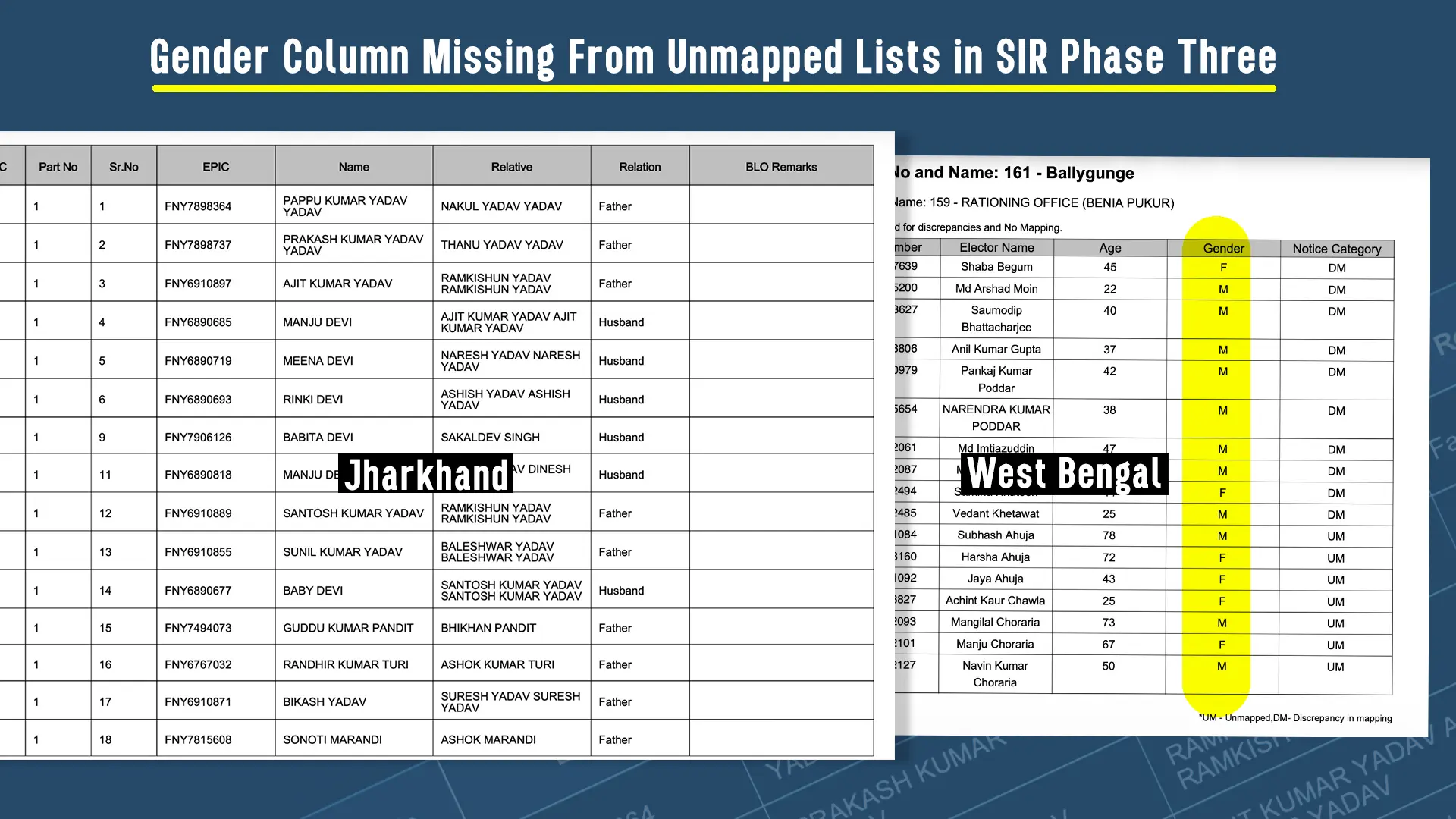
The Reporters’ Collective contacted officials and reviewed suspect voter lists in six of the 19 states and UTs currently undergoing SIR. In all the six states, Odisha, Jharkhand, Haryana, Uttarakhand, Telangana, and Andhra Pradesh, the ECI has not disclosed the gender of voters in these lists.
We also sent questions to the Election Commission of India as well as the Chief Electoral Officer of Jharkhand, both did not reply by the time of publication.
In the state of Jharkhand, the Kolkata-based public policy and research organisation Sabar Institute found a way to partly breach this additional opaque wall that the ECI has recently built to hide information on the voter roll database.
Sabar Institute identified some names that are uniquely used only by women in Jharkhand state. It then digitised the records of who had been marked as doubtful and ran the check on this database to identify if women had been put to test more than others by the ECI’s methods.
They did the exercise for five assembly constituencies of Jharkhand. Analysis of the names revealed that women, Muslims, and SC and ST voters make up the majority of voters marked as ‘unmapped’ in these constituencies.
Sabar Institute conducted a surname analysis of the flagged voters, looking specifically for gendered titles and surnames, such as Bibi, Khatun, Devi, Kumari, or Bewa, that are exclusively used by women. They found that the proportion of women marked suspicious out of the total in these five constituencies ranged from 25 percent to as high as 47.8 percent.
ECI Keeps Evading, Sabar Keeps Digging
During the ongoing revision, the ECI was mandated by the Supreme Court to publicly release the lists of voters who were deleted or flagged for additional checks. According to the court’s directives, which were reiterated in its final judgment on May 27, the ECI must disclose the reason for exclusion alongside each voter’s name and Electors Photo Identity Card (EPIC) number.
Along with these mandated disclosures, the commission also maintained the practice of disclosing the voters’ gender within these lists. This practice remained constant across all the 13 states and UTs that have conducted SIR in the past year.
Political analysts have used disclosures to establish that women have been disproportionately affected from the exercise. Their exclusion rates outpace the region’s gender ratios in several states, including Bihar and West Bengal. ECI has been panned by political parties and civil society for this trend during the first and second phase of the revision.
Sabar Institute and The Collective found that the ECI had dropped disclosing the gender of suspect voters.
Jharkhand, where SIR is being conducted in the third phase along with 18 other states and UTs, was one of the first states to release the lists of unmapped voters. These are flagged voters who have not sufficiently established their links to the 2003 list, either independently or through relatives.
Unmapped voters was a new category of flagged voters that was introduced during the second phase of SIR which commenced in 12 states and UTs from October 2025.
Voters unable to establish a link to the 2003 voter rolls of the previous SIR were required to submit additional documents to prove their citizenship.
Earlier this year in West Bengal, this new categorisation of suspect voters triggered widespread panic, forcing lakhs of flagged citizens to rush to overburdened hearing centres to prove their citizenship and remain on the voter rolls.
SIR exercises in the five Jharkhand assembly constituencies, namely Rajmahal, Pakur, Shikaripara, Dumka, and Barhait, started on June 30. Barhait is the home constituency of the Jharkhand Mukti Morcha (JMM) leader and state’s current chief minister, Hemant Soren. All five seats were won by JMM or the Indian National Congress in the previous assembly election with a significant margin.
.webp)
In Sabar Institute’s analysis, they found that in three out of the five assembly constituencies (Rajmahal, Pakur, and Dumka), voters with exclusively female titles make up more than a quarter of those flagged as unmapped.
In Rajmahal, this segment is the highest, with over 47.8 percent bearing exclusively female titles. In Pakur, 45.3 percent of voters bore female only titles. In Dumka, the proportion was 25 percent. Across all five assembly constituencies, voters with female-exclusive titles far outweigh those with titles exclusive to men.
Shikaripara, Dumka and Barhait are ST-reserved seats. Predictably, tribal surnames make up the plurality of voters flagged in these constituencies. In Shikaripara, this number is the highest, where the top five surnames flagged for being unmapped are exclusively tribal. Surnames like Murmu, Soren, Hembrom, Marandi and Tudu make up more than 37 percent of unmapped voters.
Hemant Soren’s assembly seat of Barhait sees four of its top five flagged surnames coming from the ST community, accounting for a quarter of all unmapped voters.
Sabar Institute compiled a list of the top 50 surnames of voters who are unmapped across the five constituencies. In each case, these 50 names make up 80–90 percent of the voters who have been flagged on this list.
Most of these names belong to individuals from SC, ST, or Muslim communities. Female titles significantly outnumber male titles on these lists. Upper-caste Hindu surnames constitute only a tiny proportion of the top 50 red-flagged entries.
Identifying individuals with female only titles does not give the universal set of female voters on the list. Women bearing gender neutral surnames will also be on the list of unmapped voters indicating that women likely make up the majority of voters who have been flagged during SIR.
Yet, by omitting this simple disclosure in the final phase, the ECI has hidden the true impact of the voter roll revision on women and gender minorities forever.