COD: Cannabis on Delivery


Hyderabad and New Delhi
[dropcap]D[/dropcap]o you have headaches and anxiety?” the doctor asked. “Oh, so then that’s probably because you’re having work stress, overthinking, and not able to sleep, right? Then you can take this,” he said.
In under a minute, the ayurvedic doctor, who gave only his first name, prescribed not an over-the-counter medicine, but cannabis gummies, chewable candies infused with cannabis.
The company Cannavedic India that sold the potent gummies, branded on its website as Canna Relax RAW - Ayurvedic Vijaya Candy, connected this reporter to its ayurvedic doctor. Its website promised a pack of gummies worth Rs 999, each with 30 mg of cannabis, after consultation.
In practice, all it really took was a few messages on WhatsApp and then this perfunctory consultation. The Reporters’ Collective was soon delivered a pack of gummies, infused with cannabis, a narcotic drug.
The cannabis plant, often referred to as bhang, ganja or marijuana, contains hundreds of cannabinoids, compounds that affect how the body feels and functions. The two most important are Cannabidiol or CBD, which helps with anxiety, pain, and sleep, and Tetrahydrocannabinol, or THC, a psychoactive and psychotropic chemical that is intoxicating and an addictive narcotic.
Cannabis is the most widely used addictive drug in the world, according to the United Nations Office on Drugs and Crime. A 2018 Union government survey estimated that cannabis users in India rose from 87 lakh in 2004 to 3.1 crore in 2018.
To comply with the 1961 UN drug convention, a treaty to control production, trade, and medical use of narcotic drugs globally, India passed the Narcotic Drugs and Psychotropic Substances (NDPS) Act in 1985. Cannabis was declared a “controlled” substance. But it came with an exception.
The consumption of cannabis flower buds and resin was banned. However, government rules allowed the sale of cannabis seeds, leaves, stems, stalks, and roots for traditional medicinal and research use.
This left a regulatory loophole. Ayurvedic doctors could prescribe cannabis products for medical use with no cap on psychotropic THC content in it, and companies could sell them as ayurvedic medicine.
In India, cannabis prescribed for medical purposes falls under a system overseen by the Ministry of Ayurveda, Yoga and Naturopathy, Unani, Siddha and Homoeopathy (Ayush), which calls it Vijaya.
Companies looking to turn the ‘traditional’ drug into a lucrative, upmarket product have latched onto this loophole. Their products, labelled “Ayurvedic,” bypass the strict regulations that oversee pharmaceutical products prescribed under modern medicine.
The government tightly controls other addictive drugs such as morphine and codeine through dedicated schedules and pharmacy-level oversight. Cannabis or vijaya, sold freely as flavoured gummies under an ayurvedic label, faces none of these controls. Regulatory gaps, The Collective found, have allowed companies to put a psychotropic narcotic on doorsteps nationwide. And all it requires is a single phone call.
Companies are required to sell their THC-loaded cannabis products only after a prescription by an ayurvedic doctor, including by dubious doctors whose credentials and conflicts of interests are not always verifiable. The ‘safeguard’ of a prescription has failed in large parts, The Collective found.
This dangerous trade of cannabis products is licensed and run by the Union government, particularly the Ministry of Ayush. Their multiple standards, regulations and inspection regimes have adequate built-in loopholes which both unscrupulous and scrupulous corporates use to ‘legally’ flood the market with a narcotic, one that many young buyers are using for ‘recreational purposes’, a euphemism for getting ‘high’.
.webp)
Many companies have hired their own Ayush doctors to issue the mandatory prescription online without batting an eyelid. At times, it can be availed without the need to see a doctor in person. You just say you have headaches. The doctor agrees with you and says yes, you need the high THC-loaded gummies. And that’s it: you are now ready to receive a psychoactive, psychotropic product delivered to your address. For your ‘wellness’.
This is exactly how this reporter got 100 mg of THC delivered in the form of five gummies. We asked Cannavedic India how it was so easy for anyone to get a prescription online. The company declined to comment citing confidentiality.
{{cta-block}}
A Thriving Market
Due to poor regulatory oversight, companies have a free run. The government requires mandatory prescriptions, but the real challenge is tracking whether the prescriptions, or the doctors issuing them, are genuine. Label a product ayurvedic, and a narcotic chemical that would otherwise be illegal becomes a legal product for sale. The result: a Schedule E(1) substance, the official classification for poisonous substances, sold online to anyone who can spend a minute on a call and has the money to splurge.
With government bodies, particularly the Ayush ministry, turning a blind eye, the business has flourished. Websites selling these cannabis products have multiplied, often marketed discreetly through social media.

“Cannabis gummies serve as a convenient, enjoyable option for recreational and medicinal cannabis consumption,” one company, Trost, says openly, advertising gummies in cola and berry flavours. Another e-commerce platform names cannabis strains outright, liberally using cannabis imagery and cultural nomenclature.
As of May 2026, India has 83 cannabis health-tech companies, of which seven have collectively raised $16.4 million (Rs 156 crores) in funding, according to startup tracking data firm Tracxn. The entire cannabis product market in India, including hemp products, was estimated at $1.3 billion (Rs 12,350 crores) in 2024, projected to reach $4.7 billion (nearly Rs 44,750 crores) in 2032.
A market expected to nearly quadruple in eight years would, if taken at face value, mean an epidemic of conditions needing ayurvedic cannabis treatment, a paradigm shift in Indian medicine. At Rs 999 a pack, this is a product for those who can afford it. The most plausible explanation for that growth is not medicine. It is cannabis dependence.
“The science shows that cannabis is effective for problems like chronic pain,” said Benzir Hussain, a psychiatrist and an office-bearer of the Indian Medical Association’s Kochi chapter. “And the industry is aware that it is being used in medicines in a legalised, controlled form. But the problem is that in a country like India, we’re not able to control our drugs, let alone potentially psychotropic drugs.”
There are real-life consequences of such unregulated sale of cannabis. Hussain has recently seen a patient who was consuming cannabis products on an ayurvedic doctor’s prescription, but found them ineffective, and allegedly returned to using them purely for recreational purposes, ending up with complicated neurological issues when combined with his psychiatric medicines. Another patient allegedly used cannabis oil for sleep but, Hussain claimed, it caused psychotic issues.
THC, the ingredient in cannabis that gets people “high”, acts on the consumer’s brain. In the short term, alongside relaxation and euphoria, it can also trigger anxiety, poor coordination, a racing heart and elevated blood pressure, sometimes raising the risk of a heart attack right after use. Over time, heavy use has been linked to breathing problems, chances of stroke, irregular heartbeat, and, particularly among teenagers, memory impairment, dependence, and even psychosis.
.webp)
Yash Kotak, co-founder and chief marketing officer of BOHECO, short for the Bombay Hemp Company, traced the industry trends. Cannabis products in 2019-20 came as tinctures, topical applications and oils. The next generation came as capsules and balms.
“In the last 18-24 months, there have been a lot of new-age form factors like gummies, soft capsules, and mints,” said Kotak. “And gummies technically fall under ‘mridu vati’ in Ayurveda, sweet tablets. This is what allows them to be a licensed form factor.”
But Remya Krishnan, an ayurvedic doctor and founder of Science Based and Evidence Based Ayurveda (SBEBA), disputes this, saying there is no concept of ‘mridu vati’ in classical Ayurveda texts.
Mridu, in Ayurveda texts, means soft. The distinction matters because marketing it with this ayurvedic classification gives these products more legitimacy. A sweet, chewable gummy reads as harmless, closer to a candy treat than a medicine. That is precisely what makes it an easy sell, and even easier for a buyer to underestimate.
“Many things are now being marketed under the claim that they are all Ayush-licensed,” said Krishnan.
On the more euphemistic end of this spectrum is a syringe, loaded with cannabis oil and symbolism.
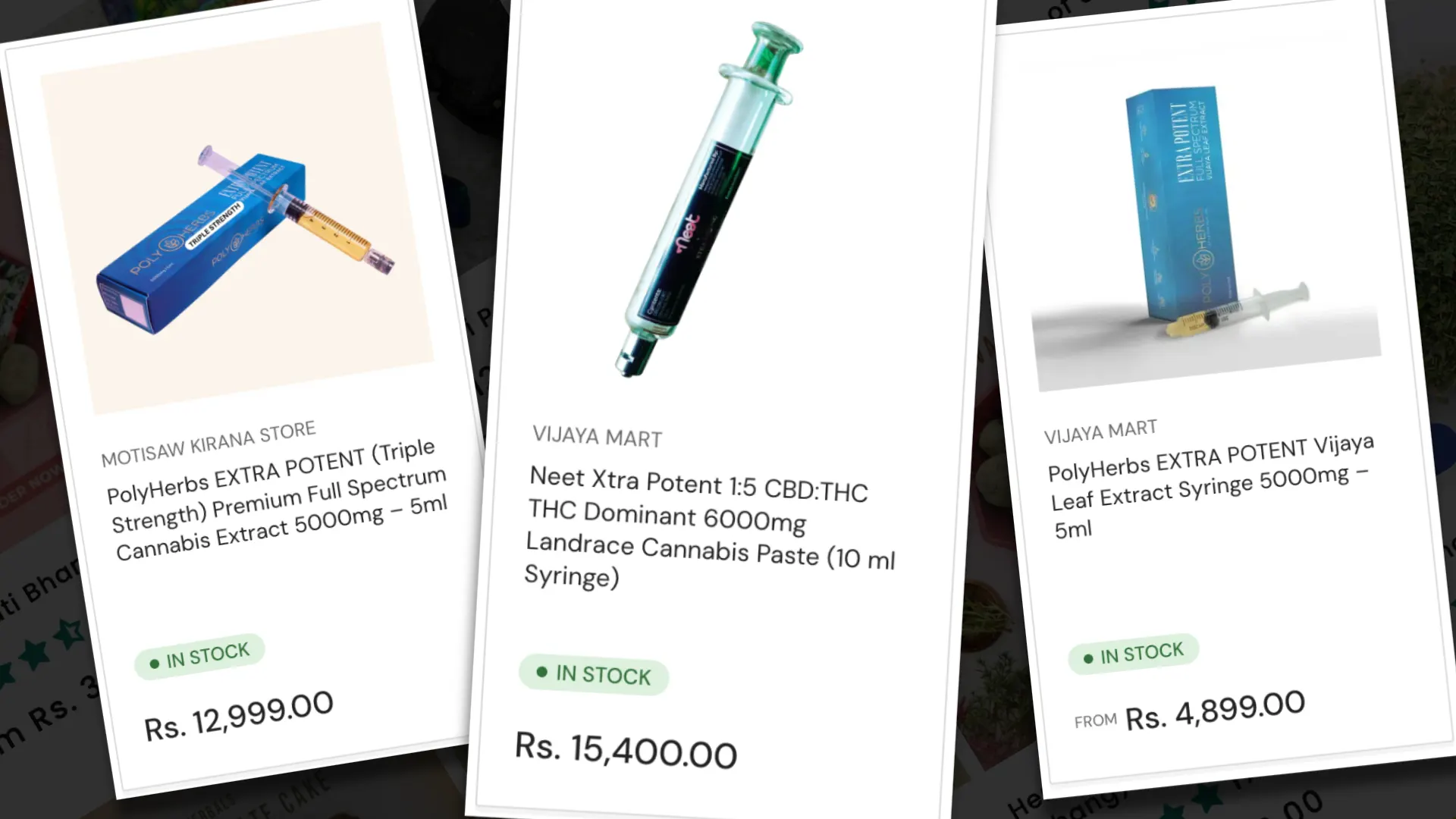
A slew of companies are selling such products by mislabelling them, in clear violation of the mandate that cannabis products be used for medicine and scientific research. Some products feature the cannabis leaf on packaging, like the one purchased by The Collective; others run product advertisements showing young people partying.
It blurs the line between recreational and medicinal, drawing associations that aren’t strictly medicinal — like selling cannabis extract in a syringe raises associations for those experienced in consuming narcotics. In some cases, bhaang “leaves” are advertised. Such advertising is also illegal under the 1954 Drugs and Magic Remedies (Objectionable Advertisements) Act.
“Advertising remains subject to the [Drugs and Magic Remedies] Act and misleading claims may attract regulatory action,” said lawyer Biplab Lenin of Cyril Amarchand Mangaldas. “Additionally, the labelling, packaging and quality requirements under the Drugs and Cosmetics Act read with rules will also apply.”
Several websites ask the consumer to upload a prescription, or offer a consultation with an ayurvedic doctor, only after purchase. The Collective spoke to at least ten young people who consume these cannabis products for “recreational purposes.” All students and professionals in their 20s and 30s, who live in urban centres. “It is costly, but it is legal,” said one of them, a student in Chennai who did not want his name mentioned.
One customer, The Collective interviewed, uploaded a legitimate prescription from a Kerala-based ayurvedic clinic, which didn’t even specify what she needed the gummies for, and still received the gummies.
.webp)
It’s an incredibly lax procedure for an industry selling Schedule E(1) drugs. Marketing makes things even more bizarre. Many companies, for example, ran discounts around Holi, a time when consuming bhang is socially acceptable in many parts of India.
BOHECO’s Kotak says they are contemplating entering the gummy market themselves, having seen the ‘form factor’ gain “acceptance from the regulators.” The company calls itself “India’s largest cannabis brand on paper,” and says it markets its products by their use, not their ingredients.
“The moral responsibility lies largely with how a company markets their products,” said Delzaad Deoliwala, also a co-founder of BOHECO and chairman of the Pan India Medical Cannabis & Hemp Association (PIMCHA).
Deoliwala’s description of industry self-policing is also an account of how the regulator works. “For recreational use, what are the guardrails you have set? It’s how responsible companies are with regard to their marketing, and how accessible it is. And this mirrors the way Ayush [ministry] approaches cannabis products,” added Deoliwala.
The proliferation of cannabis products, and the use of loopholes to sell them as a company desires, suggests it is not a question of moral responsibility but of strict legal enforcement and unambiguous standards.
Is the Government Aware?
Does the government know what is happening, and the risks of such ‘legalised’ cannabis products that it has permitted? Government records suggest it is aware. What it has done about it is largely shrouded from public view, if at all it is doing much. The Ministry of Ayush did not respond to requests, over email and phone calls, for comment.
In April 2024, the Ayush ministry set up an inter-ministerial coordination committee to address the illegal sale of ayurvedic products containing cannabis. The problem was well-known enough and serious enough for authorities to monitor.
But what did it do to establish oversight? Not much, the only document, the minutes of a meeting of the committee, tells us.
The committee met in May 2024. Two months later, on July 16, 2024, the president of the Board of Ethics and Registration under the National Commission for Indian System of Medicine put out a letter on the Ayush ministry’s website. The advisory meant little.
It essentially amounted to one line: “Registered medical practitioner should not promote himself/herself as a cannabis specialist.”
.webp)
So, an ‘Ayush’ doctor on the rolls of a cannabis product company could continue to dole out unchecked prescriptions to consumers as long as they did not call themselves “a cannabis specialist,” and instead only an ayurvedic doctor. But a cursory online search leads to several such ‘specialists’ who prescribe cannabis medicine.
Almost all the information available publicly on cannabis regulation in India comes from private companies, an act of self-promotion. The Ayush ministry is often left playing catch-up. A Delhi High Court bench even directed the Union government to make a policy decision on cannabis regulation and release it by July 2026.
“Ayush ministry is often behind pushing medicines that are harmful because they’re striving for business and international recognition,” said Krishnan, pointing to the rampant misinformation around ayurvedic products and their curative claims during the COVID-19 pandemic.
A Regulatory Maze
In India, a matrix of overlapping laws, regulations and standards governs cannabis from plant to product. Each layer brings its own regulators, enforcement agencies and ministries. Yet, the business runs with little real oversight, The Collective found.
Growing cannabis is banned at the federal level. But state governments can license cultivation for scientific research, medicinal use, and industrial hemp production.
States like Uttarakhand, Uttar Pradesh, Himachal Pradesh, and Madhya Pradesh have set up their own licensing systems for cannabis grown for medical research. Some states, like Himachal and Uttarakhand, are even exploring raising revenue from hemp cultivation, a hardy crop that needs little water.
In every state, the state excise department is the enforcement agency controlling the cultivation, harvest, and sale of the raw material, bhaang.
Meanwhile, illegal cultivation thrives.
“The problem more often is that the cultivator is growing cannabis on the sly,” said former Indian Revenue Service officer Sreekumar Menon, who also worked as the director general at the National Academy of Customs, Excise & Narcotics. “They collect it, give it to various brokers and sub-brokers, who then send it to clandestine labs.”
The government is more open to the private sector cultivating cannabis in small batches for research and medicine, said Menon. “The illegal operations are used for other purposes, whether recreational or not.”
As the herb moves from plant to product, it enters an entirely different regulatory regime – one at the sourcing level, the other at the product stage.
Manufacturers of cannabis products are required to buy the raw material from sellers approved by the state excise department. But this requirement is loosely enforced. There is often no clarity on where the raw material actually comes from.
Companies can bypass, as Menon mentioned, the excise regime entirely by buying from manufacturers who may or may not have a state licence.
To sell ‘Ayush-approved’ cannabis products as ayurvedic medicine a company needs two approvals: a manufacturing licence, and clearance for the product-specific formulation it puts out in the market.
“The Ministry of Ayush doesn’t directly issue a product licence; approval for ayurvedic drugs is granted by the state licensing authority under the Drugs and Cosmetics Act,” said Lenin. The Ayush ministry sets manufacturing standards, deciding what ingredients are permitted in ayurvedic medicine and what are not. “What Ayush does is provide the regulatory framework and, since August 2024, requires states to obtain central clearance before granting new manufacturing licences for cannabis-containing drugs.”
It is the Narcotics Control Bureau (NCB), the federal agency under the Ministry of Home Affairs, that grants the core NDPS approvals. “A company needs approval from the NCB for manufacturing, storage and distribution, and separate approval if they are a recognised medical institution,” Lenin added.
To address illegal selling, on 7 August 2024, the Ayush ministry issued an order to streamline the licensing framework and approvals for manufacturing ayurvedic drugs containing cannabis.
The order also required state drug licensing authorities to provide details of existing manufacturers to the ministry and applied the same requirement to pending applications for approvals to manufacture such drugs.

“The approval connects the center and state,” said Lenin. “Crucially, state licensing authorities are required to obtain clearance from the Ministry of Ayush prior to granting licenses to manufacturers for ayurvedic drugs containing the aforementioned ingredients.”
This cluster of authorities oversee manufacturing, licences and approval of each product, such as cannabis gummies, for sale. The bottomline: centre sets the standards, the states enforce it.
Typically, ayurvedic medicines are either classical, original recipes from Ayurveda texts, or proprietary, which are different formulations of the classical product, like cannabis gummies.
Once a product is branded as an ayurvedic medicine, Ayush departments enter the picture, and the stricter pharmaceutical regulators can be bypassed. The government agency to regulate food standards, Food Safety and Standards Authority of India, too, could be sidestepped.
In 2022, the Union government kept cannabis products outside the category jointly regulated by Ayush ministry-FSSAI, freeing them from the FSSAI’s 0.3 percent THC cap on food products.
The Ayush ministry sets no standard for THC content in cannabis products sold as ayurvedic medicine. All it requires, under narcotics law, is that the product be made from leaf extract – “full-spectrum,” in industry jargon – and not from the flowering or fruiting tops, or the separated resin, which remain banned.
The NDPS Act too is silent on the THC limit in the cannabis plant itself. This creates an absurd situation. And so, a gummy made with full-spectrum cannabis or Vijaya leaf extract, which contains THC, qualifies as a legal ayurvedic product under Ayush regulations, with no limit on how much THC content.

There is, at least on paper, a quality framework. An ayurvedic pharmaceutical product is supposed to be reviewed for content and quality in each batch, and the production facility is monitored for quality control.
While every batch of an ayurvedic cannabis product must carry a Certificate of Analysis under the Drugs and Cosmetics Act, covering physical parameters, toxicity, nutritional profiling, and cannabinoid content, enforcement is another matter.
Much of it starts with a basic infrastructure problem.
On Borrowed Time
Does India even have the ability to test cannabis products for their content, even if the government showed some intent to? The honest answer is no.
Menon explained why. According to him, India’s testing capability is hampered by a dearth of testing kits used by enforcement agencies. These kits simply test samples for the presence of narcotics.
Once detected, enforcement agencies send it to a forensic laboratory for further testing.
“But these forensic labs have a severe backlog … it takes up to one to two years to test it,” said Menon. “In the northeast, they don’t have a single forensic lab; they have to send it to Kolkata, so you can imagine the strain. Medical colleges typically don’t have testing facilities. Only some do, like AIIMS in Delhi. Which means samples need to be sent to private institutes like Manipal, which has a testing lab called the Poison Information Center.”
“So really, the government isn’t testing because it’s expensive,” he added.
In the absence of government testing, companies have taken it upon themselves; some display test certificates from private labs they have paid for, to build trust with customers.
The industry is well aware of what Deoliwala calls “mischievous companies.” PIMCHA, the industry body he chairs, claims it is pushing for better regulation to prevent this misuse from dragging down the entire sector.
One list of such companies, sent to the Ayush ministry by PIMCHA, and accessed by The Collective, names firms that mention Delta-9-THC, the primary intoxicating cannabinoid, levels on packaging. This is like selling the “ayurvedic medicine”, for its psychotropic effects, to people who want to get high.
The list also names several companies for “sales of Vijaya leaf based Classical & Proprietary ASU medicines without prescription/without medical supervision along with form factors including chocolates/golis/churans.”
PIMCHA has also sent multiple letters to the Ayush ministry and enforcement agencies, like the NCB. The Collective has accessed some of them, like one recommending guidelines for responsible advertising.
“I am writing to bring to your immediate attention a serious issue concerning the sale and distribution of Bhang (cannabis leaves) based medicines without proper licenses and prescriptions, which poses a significant risk to public health and safety,” reads another letter dated 20 December 2024, which names specific companies.
Industry insiders say the Ayush ministry has twice asked companies to submit their full prescription records – a data-collection exercise beginning in 2023. They also claim the ministry hasn’t issued any new licences since 2022-23. The Collective could not independently confirm either claim.
%20chart.webp)
Meanwhile, funding and research into the scientific and medical use of cannabis have grown. The due diligence that checks a product before reaching a consumer has not. Medical professionals point to the real issue: rampant prescriptions are not tracked.
“As a psychiatrist, I’ve seen how patients can misuse psychiatric medications,” said Hussain. “There should absolutely be a system to monitor pharmacies, to determine which doctor prescribed which medication, on which day, and in what amounts.”
The contrast with how India regulates other narcotics is instructive. Morphine, also derived from a plant and used in medicine, sits at the highest schedule of restriction. Only specific pharmacies can stock it, storage conditions are prescribed, and every batch is tracked.
Codeine, a semi-restricted opioid, was recently pulled from over-the-counter cough syrups precisely because it was too easily available without a prescription. Other narcotics used in medicine, like ketamine and fentanyl, are also subject to similar strict controls.
These substances sit under Schedule H of the Drugs and Cosmetics Act and Section 9 of the NDPS Act, which gives the Union government direct authority to regulate them. Unlike these substances that require strict prescription and record-keeping, cannabis is a Schedule E(1) ingredient, which mandates cautionary labelling but imposes far weaker controls. This allows private companies to sell a scheduled substance openly.
The cannabis industry itself knows it is sitting on borrowed time, even as it makes a killing.
“My stress levels are increasing because this bubble might pop,” said Deoliwala. “We believe the market will eventually move toward greater maturity and accountability.”
THE FOLKS
BEHIND THE Story
Reporter


Managing Editor

Editor

Design Editor

Reporter
Support independent Journalism
The Reporters’ Collective collaboratively produces investigative journalism. In many languages and mediums. We report truthfully and bring out facts that the powerful prefer to keep hidden from citizens.
Besides courage and integrity, such reporting requires resources. We need your support. We need citizens to donate to keep us going and keep our work free to read for those who can’t afford to pay. Your donations will help us remain independent and work without fear.
You can change how much you give or cancel your contributions at any time.
By proceeding, you are agreeing to our Terms and Conditions. To find out what personal data we collect and how we use it, please visit our Privacy Policy.