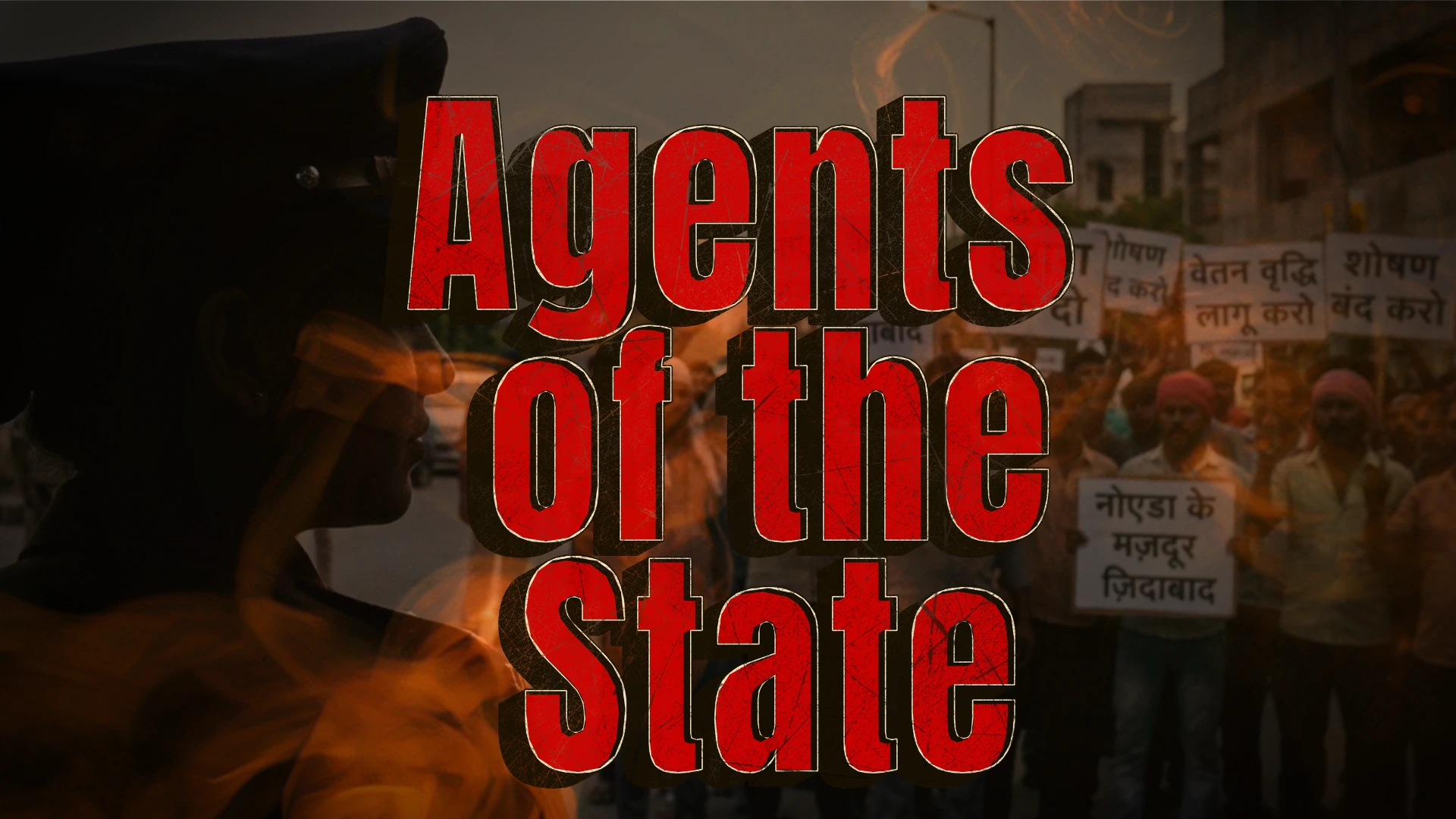


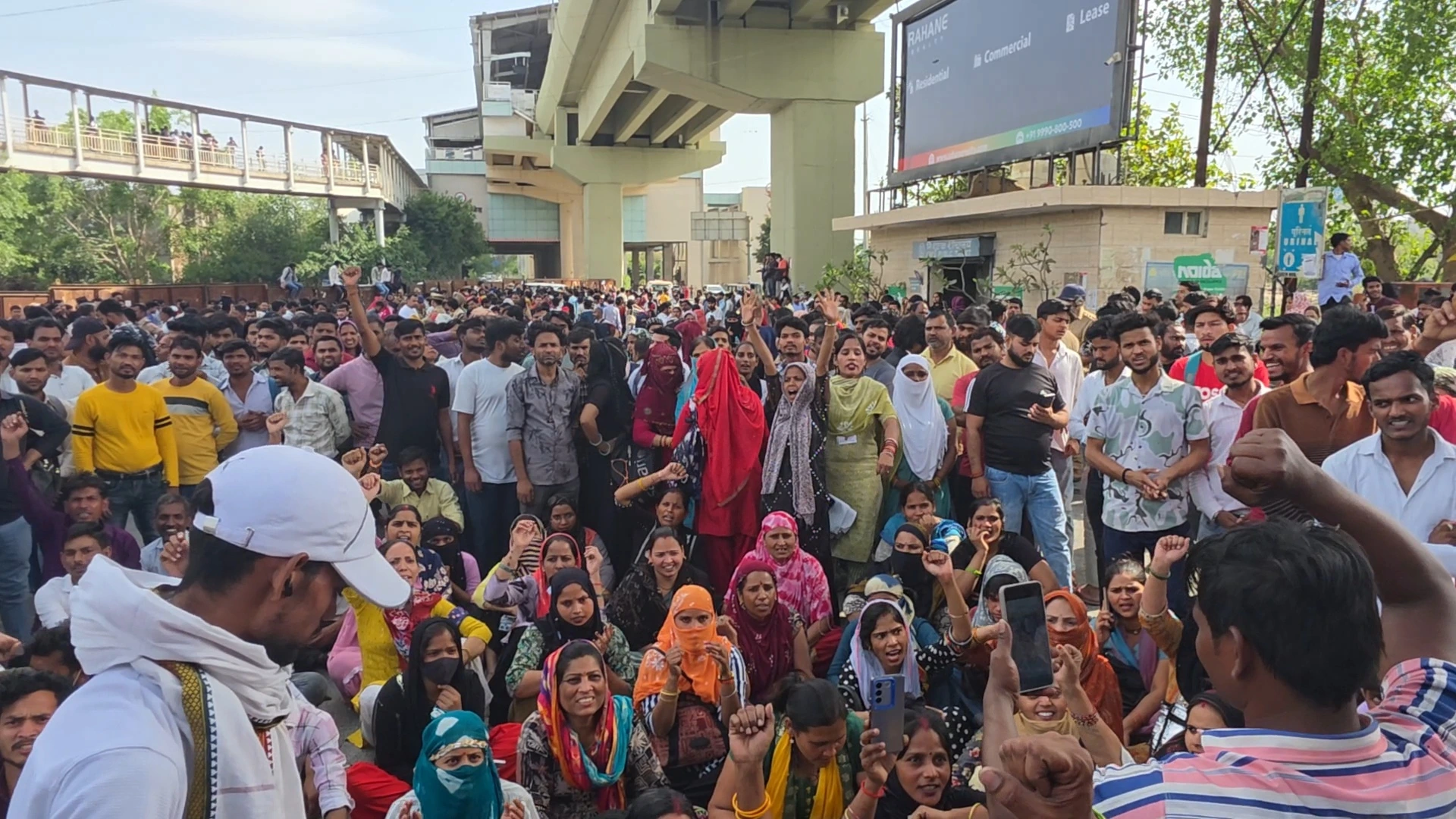
Noida, Uttar Pradesh: On April 13, Noida’s industrial belt was on fire. It was the fourth day of a workers’ protest. Several vehicles, including police cars, were set ablaze, and violence was reported across multiple sectors. A heavy police presence could not prevent it.
Unhappy with stagnant wages, workers in Noida took over the streets, protesting against their employers. Much of the coordination for the gathering happened over WhatsApp groups including one called Richa Global (Noida), whose members were mostly workers and a few activists. The group was created on April 9, the same day the protests started in the city.
More than five months later, this 1,024-member WhatsApp group remains at the centre of a police investigation that casts the strike as part of a larger criminal conspiracy.
At least two members of the WhatsApp group, however, appear to have escaped the scrutiny applied by the Uttar Pradesh (UP) police to others in the group. We could not establish whether there were others.
One, Beena Kaur, is a sub-inspector with the UP police. The other, Anil Kumar, holds a temporary pass from the Ministry of Home Affairs, identifying him as a driver for a Department of Revenue official at the Union Ministry of Finance.
On the day the violence broke out, both sent provocative messages to the same WhatsApp group.
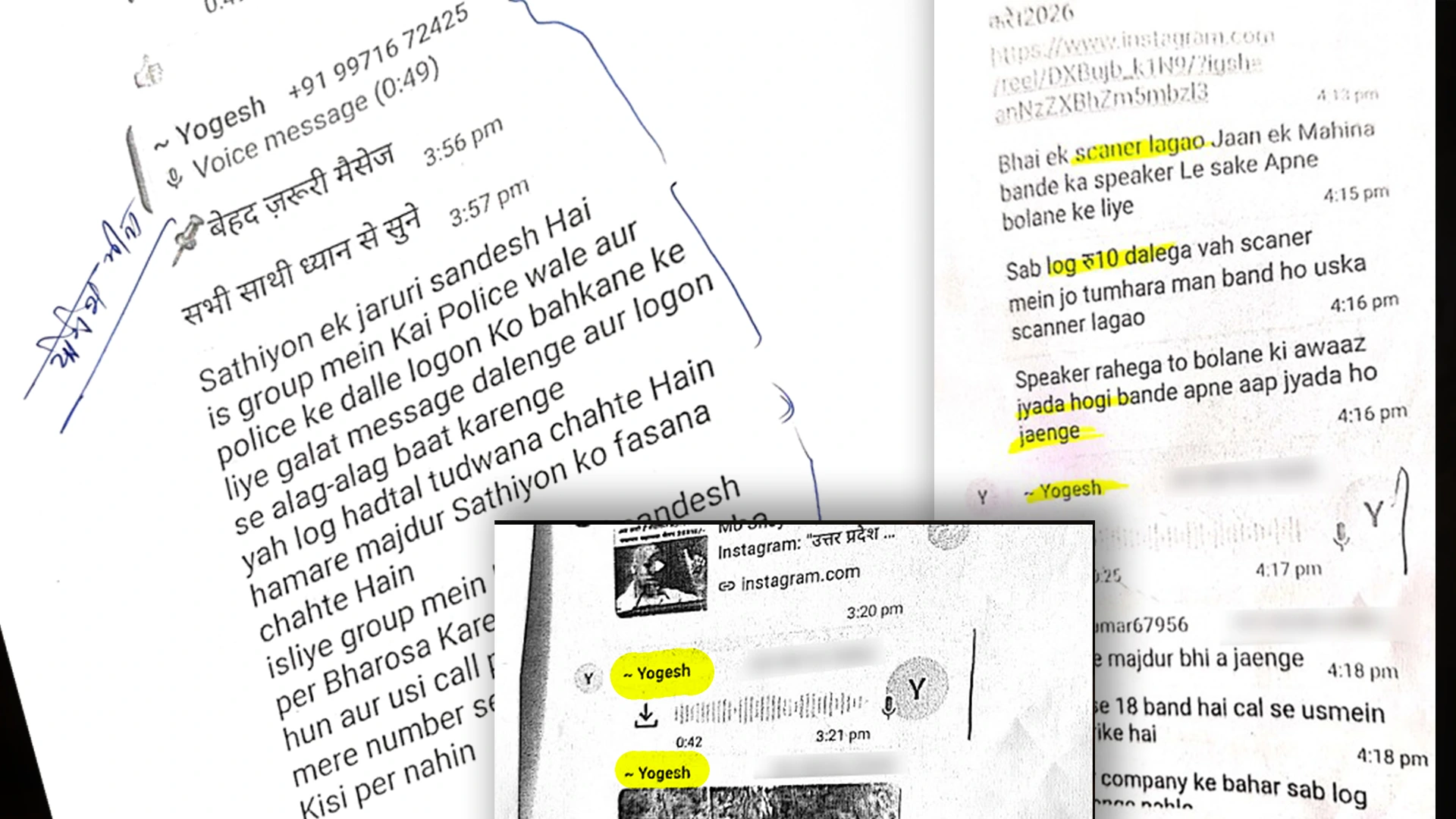
Kaur shared a screenshot of a video showing a vehicle on fire. Kumar sent a voice message instigating members of the group to block a “bypass road” being inaugurated by Prime Minister Narendra Modi the next day, possibly referring to the inauguration of the six-lane Delhi-Dehradun expressway on April 14.
Kaur has not been investigated by her colleagues in the UP police. Kumar was arrested only when the judiciary raised uncomfortable questions, and was released on bail within just two weeks.
Last month, an investigation by The Indian Express found that protesters spent an average of 53 days in custody, with courts granting bail in 84 percent of cases. In comparison, at least eight activists and artists, some of them students, have been in jail for more than 165 days.
For a single event, the UP police have registered 11 First Information Reports (FIR) in five police stations across Gautam Buddh Nagar. At least 155 workers and activists have been arrested under these FIRs.
Among the arrested, two were booked under the draconian National Security Act (NSA). The NSA case against Akriti Chaudhary, a student activist, was quashed by the Allahabad High Court on September 2, which called the state’s version a “concocted story.” Later, the same court pulled up Noida District Magistrate Medha Roopam, Chief Election Commissioner Gyanesh Kumar’s daughter, for passing the NSA order, observing that “despotic” conduct by errant bureaucrats could turn UP into an Orwellian dystopia. Roopam was asked to pay Chaudhary five lakh in compensation from her salary. The Supreme Court, however, stayed the fine and those remarks of the high court.
Lucknow-based journalist Satyam Verma too was arrested under the NSA for allegedly provoking protests in Noida. He has been granted bail in four of the 11 FIRs he is named in, but remains behind bars under the NSA.
The Reporters’ Collective went through all 11 FIRs, four chargesheets, 29 bail applications, and case diaries related to the incident, along with screenshots and recordings from the WhatsApp group Richa Global (Noida).
Our investigation shows how the UP police went to great lengths investigating workers and activists, at times in violation of due process, while ignoring the role of Kaur and Kumar.
Petitioners have cited their messages in court as evidence of “police infiltration” in what was a labour movement against stagnant wages. They continue to demand that the two be investigated as “agent provocateurs” in triggering the violence.
For over a month, Kumar was not named in any of the FIRs. A magisterial inquiry was ordered, headed by an additional commissioner of police, which called for the public to submit oral, written and electronic evidence related to the incident by May 15.
However, on May 14, advocate Manik Gupta, who is representing some of the activists, wrote to Gautam Buddh Nagar Police Commissioner Laxmi Singh, alleging that the inquiry had refused to take evidence against Kumar and Kaur into account on multiple occasions.
The UP police investigation has treated the Noida workers’ protest as a case of organised, pre-planned violence, with sections of mainstream media amplifying police claims of an “internationally coordinated activity” linked to “urban naxals,” and even Pakistan. Commissioner Singh told reporters on April 16 that two X (formerly Twitter) handles “operated from Pakistan” were found “spreading false and provocative information to disturb the situation.” Neither claim finds mention in the chargesheets we assessed.
Singh also claimed that several WhatsApp groups were created in which workers were added through QR codes, suggesting an “organised and well-orchestrated syndicate.”
How do the UP police sub-inspector and the driver working for the Union government fit into this ‘conspiracy’? We tried to do what the UP police should have. Investigate.
We sent questions to Commissioner Laxmi Singh, officials of Gautam Buddh Nagar police, and officials of the home and finance ministries. UP police’s investigating officer Swatantra Singh declined to comment because the case is pending in court.
Not an Isolated Incident
The unrest did not begin in Noida. It is believed to have started at the Indian Oil refinery in Panipat in February, and spread along one of north India’s largest industrial corridors, through the major manufacturing hubs of Gurugram-Manesar, Faridabad and, more recently, Haridwar and Dehradun.
One factor that fuelled the strikes was the four new labour codes that came into effect late last year. What was sold by the Union government as a solution for dismal working conditions and irregular payments, was criticised by trade unions as anti-labour. Nevertheless, these promises triggered a rumour of a wage hike among workers. The Noida workers’ protest was one link in that chain of events, part of a wave of contractual workers demanding fair wages this year.
In Uttar Pradesh, the minimum wage revision under the Minimum Wages Act, 1948, has remained effectively pending for about a decade, with the last revision notified in 2014. The state government admitted as much, that wages should have been revised in 2019 and 2024 but were not. Rising inflation and room rents in Noida fuelled workers’ anger. Their living conditions worsened further because of black-market cooking gas and a rise in fuel prices due to the war in West Asia.
Workers earned as little as Rs 11,000 a month for 12-hour shifts, and struggled to make ends meet. These conditions pushed contractual workers to withdraw their labour and bargain for their rights.
Activists say the recent unrest in the National Capital Region began with the Honda workers’ strike in Manesar on April 2, and quickly spread across the industrial hub within a week. Workers at Industrial Model Township (IMT) Manesar’s Richa Global Exports joined the strike, and the Haryana government raised wages by 35 percent, to between Rs 15,220 and Rs 19,425. The ripples from Manesar reached Noida soon after, with workers at Richa Global’s unit in Noida’s Special Economic Zone going on strike.
In Noida, workers from more than 10 companies in the Phase 2 industrial cluster organised a collective strike demanding a minimum wage hike, double pay for overtime and improved working conditions. It was only after these protests that the UP government heeded their demands, raising wages by 21 percent, to between Rs 13,690 and Rs 16,868, but only as interim relief.
Artist and writer Shuddhabrata Sengupta said workers move between industrial clusters in search of work, and that contractors and workers both use WhatsApp groups to coordinate.
“There is a clear pattern of migration that could be traced along the sites of strikes in the northern belt of the country,” he said. This precarity, combined with existing WhatsApp networks among workers, allows workers to mobilise, including to demand fair wages.
The chargesheets call the WhatsApp group Richa Global (Noida) the “centre point of violence,” and its admins the “conspirators.” This conspiracy case, however, overlooks key evidence against Kaur and Kumar while selectively scrutinising others in the group.
Why Was Sub-inspector Beena Kaur in the WhatsApp Group?
A serving police official was inside the WhatsApp group her own force called the centre of a criminal conspiracy.
Beena Kaur is stationed at the Sector 142 police station. FIRs against protesters have been registered in at least five police stations across Noida, but Kaur’s police station did not register any. A police official, however, claimed that the station was involved in investigating the case.
On the day of the violence, Kaur posted a screenshot of a video of a burning car, which another member had sent to the group. Avishek Kumar, a journalist with The Times of India, reported on May 23 that Kaur was an undercover agent “placed” in the group to gather intelligence. The article quoted an anonymous senior police officer claiming that Kaur shared the screenshot as a tactic “hoping someone would claim responsibility” for the arson.
.webp)
On her presence in the group, the officer was quoted as saying, “We have sufficient evidence to establish that Beena was an undercover intelligence operator. The information she shared helped police handle protestors effectively.”
However, the station house officer (SHO) of the Sector 142 police station, Vinod Kumar Mishra, denied that Kaur was undercover, saying junior officers are not placed undercover. Instead, he said she made “two mistakes” — that she joined the group, and then accidentally sent the screenshot, meant to be “sent elsewhere,” to the same group.
When asked how she got into the group, Mishra made an absurd claim. “Beena thought that Richa is someone’s name and Global is the last name, and joined the group,” he said.
Apart from the screenshot, Kaur had also sent a few photos to the group. This contradicts Mishra’s assertion that her message was a one-time mistake. We could not verify the content of the messages.
The Collective called Kaur multiple times, but she declined to speak. She has been on leave since April. Together, these gaps raise questions about her presence and role in the group.
Under Section 56 of the Bharatiya Nyaya Sanhita (BNS), if a public servant instigates, aids or provokes an offence, they are legally considered an abettor to the crime.
Kawalpreet Kaur, one of the lawyers representing the arrested activists in the Supreme Court, said that there are no clear legal guidelines for undercover police operations, which creates a grey zone, often misused by the authorities.
Who Is Anil Kumar and How Did He Evade Police Scrutiny?
Anil Kumar, the driver holding a Home ministry pass, has escaped the scrutiny applied to others despite his “provocative” messages. Instead, his case was used to pin the blame for his incitement on one of the activists named as a conspirator.
We met Kumar in the chamber of his lawyers, Saurabh Kumar Yadav and Jitender Bhati. Kumar told us that he worked as a helper at Richa Global four years ago, before he started working as a driver.
According to a temporary pass issued by the Home ministry, attached to his bail order dated June 3, Kumar worked as a driver at the Finance ministry’s revenue department. The pass was issued to him on April 9 for a six-month period. Before this, Kumar claimed that he worked for a DCP in UP police, named Anil Kumar.
.webp)
Kumar told us that he drove for an official named Vijay Kumar Gupta. A senior director by the same name works at the department’s National Informatics Centre.
The pass also mentions that Kumar is associated with a car service provider named Hybrid Fleet Management Pvt Ltd. It provides services to several government bodies, including the finance and civil aviation ministries and Niti Aayog, as well as the media houses India Today, TV9 and Zee News, and other corporate clients.
On a visit to the company’s registered address in Delhi’s Vikaspuri, their staff refused to confirm whether Kumar works for Hybrid Fleet, saying they would disclose information about him only if asked by a court. Later, however, the company’s marketing director, Manmeet Singh Sahni, claimed that Kumar is not associated with the company.
Despite the evidence, the UP police were not as prompt in arresting Kumar as they were with workers and activists.
Petitioners had approached the Supreme Court in May, alleging custodial torture of activists and fabrication of evidence. It was in this case that evidence against Kumar and Kaur was placed before the court. On May 19, the bench asked the respondents, the UP police, to file a reply to all the allegations.
A day later, Kumar was arrested; he was out on bail within 15 days.
Case Diary 24, attached to the chargesheet, filed on June 24 under FIR 169/2026, under which Kumar was later booked, states that Kumar had been in contact with Yogesh Meena, a law student at Delhi University and a member of the left-leaning youth group Disha Students Organisation, who was part of the same WhatsApp group.
The police alleged that in a “conversation” between the two, Meena had incited Kumar to send the “provocative audio message” to the group.
In his voice message, Kumar said, “Modi aa raha hai bypass ka udghatan karne, kal pura road jam karna chahiye (Modi is coming to inaugurate the bypass. We should block the entire road tomorrow),” among other allegedly provocative messages.
“Mai toh naam bhi nahi jaanta, Yogesh hai ya kya, (I don’t even know this person, or any Yogesh),” Kumar told us.
.webp)
Asked why he sent the message, Kumar contradicted the police claim recorded in the case diary: “Mujhe ye kisi ne daalne nahi bola. Maine maze maze mein audio daal di thi. (Nobody asked me to send the message. I sent it for fun).”
He further said that had he known he would get into trouble, he could have asked “Vijay sir” to get the audio message removed. “He is very powerful,” he added.
However, earlier in our conversation, Kumar did claim that someone asked him to keep sending the information after he sent the video, which he later denied.
Kumar’s testimony in the case diary claims that he received a WhatsApp call from Meena when he joined the group, three or four days before April 13, and that Meena had asked him to take part in a ‘violent strike’ they were planning.
The only evidence of any “conversation” between the two is a screenshot of Kumar’s WhatsApp call log from April 13. It shows that he got a call from Meena’s mobile number at 8.47 am.
The WhatsApp group’s messages from the day of the violence show that at 8.46 am, a minute before Meena’s call, Kumar had shared a video in the group. Kumar claims he made a video of a traffic jam and sent it to the group.
“Then I received a call from this [Meena’s] number. I don’t know the name of the person. We only talked for half a minute, and he only asked me where the video was from,” Kumar told us.
.webp)
Besides the lack of evidence, the case diary also records contradictory statements by Kumar on two consecutive pages. First, Kumar, as recorded by the police, says that Meena had asked him to send the provocative videos and audio messages to the WhatsApp group. Then, on the very next page, Kumar states that he sent the message on his own.
Meena has been in police custody since May 30, booked under 10 FIRs for his alleged provocative messages and association with Kumar, while Kumar, booked under just one FIR, is out on bail.
Same Rules Did Not Apply to Others
FIR 169/2026, registered on April 23, initially named just two people and hundreds of unnamed others. By May, the number of named accused in this FIR had grown to 27, according to bail applications. By August, it had reached 37.
The chargesheet for this FIR names dozens of workers and activists as conspirators. It spares Kumar and Kaur.
The Collective assessed the bail orders of 29 people booked under FIR 169/2026, including Kumar. Most were granted bail for lack of material evidence, with no chats, videos or photographs showing their participation in violence.
Kumar’s bail order stated that he was not present at the site of the violence, and so any “inflammatory” message he sent to the WhatsApp group did not translate into violence. The court accepted this despite his audio message calling for the road to be blocked.
The same reasoning did not help others who were also absent.
Meena was not at the site on the day of the violence either, as one of his bail orders acknowledges. The only evidence of provocation against him in the case diary is a series of screenshots of his messages and voice recordings in the WhatsApp group. Most of the voice messages reviewed by The Collective were pleas to keep the strike peaceful. The police have not provided any proof that he incited anyone.
Srishti Gupta, a 28-year-old artist and activist, was also booked under FIR 169/2026, and 10 other FIRs. She was ‘illegally’ detained at the Botanical Garden metro station in Noida on the evening of April 11, along with Akriti Chaudhary and two others. A video recording of her detention was posted online.
Like Kumar, she was not at the site on the day of the violence, a fact her bail order acknowledges. But unlike him, she was denied bail on the grounds that she had a role in “organising the workers” and had sent “inflammatory messages,” an allegation the police did not specify.
For the police, mere presence in the WhatsApp group or on the site was treated as sufficient to attribute intent, an approach the courts have since criticised.
What Counts as Conspiracy?
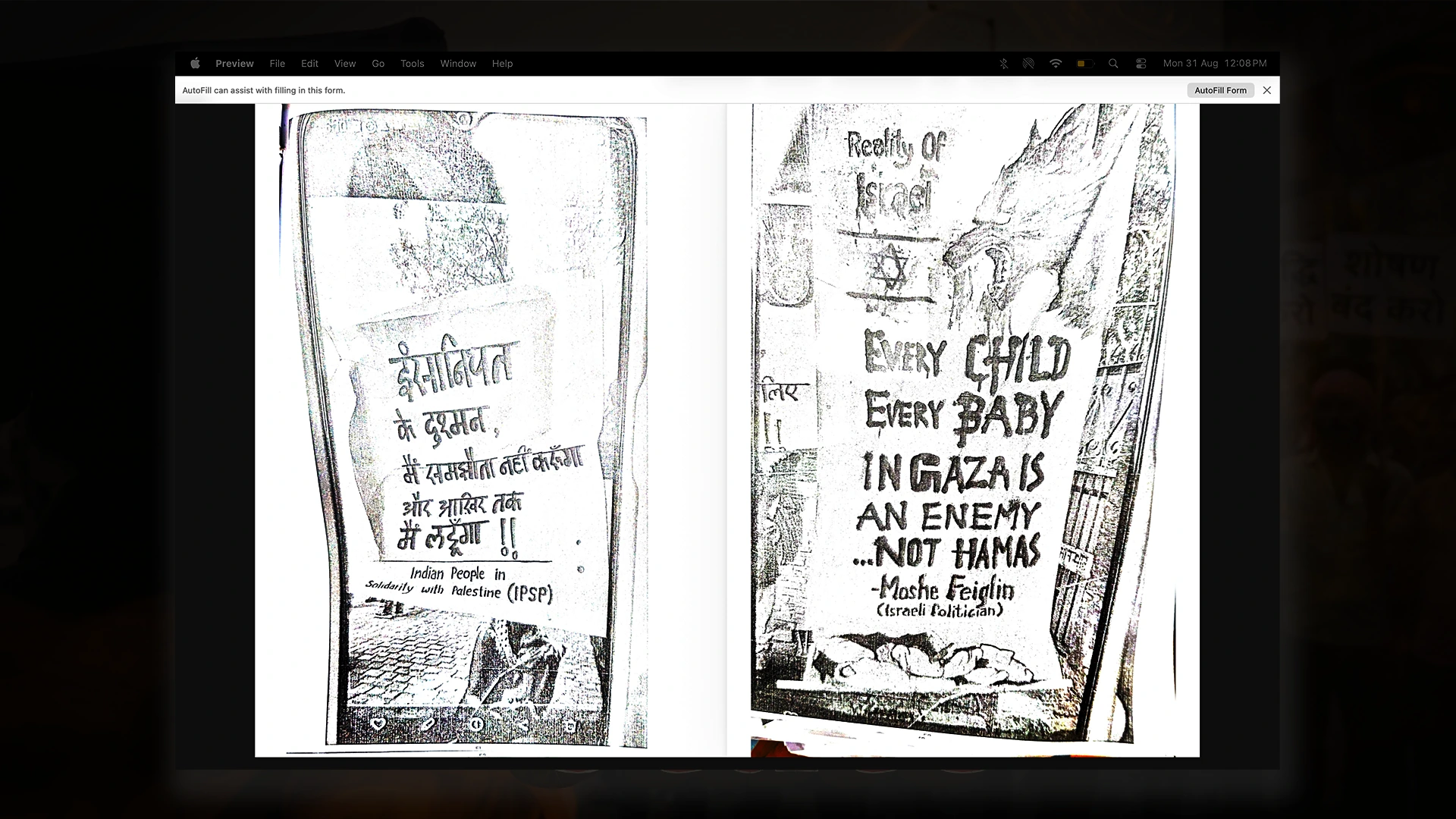
The kind of evidence used to build this case of a larger conspiracy is visible across case diaries maintained by the investigating officers. They document the recovery of Marxist literature, pro-Palestine posters, and details of WhatsApp groups the activists were in, including one named “MA History 2022-2024.” The UP police have not explained how any of this establishes a conspiracy against the state.
Allegations against student activist Himanshu Thakur, for instance, illustrate this pattern. The case diary cites, among other things, that he used words like “exploitation” to “provoke the crowd”, and that literature related to “Maoist ideology” was recovered from his laptop.
Engagement with Marxist ideology has remained a recurring presumption of criminality for Indian police. The Supreme Court has previously held that possession of books, pamphlets, or sympathy for political ideology alone cannot establish an offence.
The Allahabad High Court’s order in Akriti Chaudhary’s case reads like a rebuttal to such pattern. The grounds of her detention accused her and her friends of being “supporters of a specific ideology that believes in fulfilling its objectives through violent means rather than non-violent means.”
Quashing her detention under the NSA, the bench called the state’s version “a sham and nothing more,” and found that the state had failed to submit any concrete evidence for its allegations, which were repetitive, speculative and based solely on opinion. The bench found no material evidence to suggest her call to support the labourers’ agitation was ever meant to be violent, noting that the freedom to gather and protest peacefully is constitutionally protected.
A peaceful protest, the court noted, can still be “scuttled by mischievous elements”, and that the violence “which thereafter gets attributed to the entire group… is patently unjust.”