.avif)
.webp)


New Delhi: Since 2024, when the Indian government resumed long-term coal power purchase agreements, the Adani Group has won government contracts that will earn it revenue of more than Rs 13.27 lakh crore over the next 25 years.
All but one of these power purchase contracts were won from states governed by the Bharatiya Janata Party (BJP).
Between March 2024 and January 2026, twelve such long-term contracts have been bid out. Eight of them were by states governed by the BJP. The Adani Group won all of them, either on its own or as one among multiple awardees.
Meanwhile, in the four remaining instances from this period, The Reporters’ Collective found that when opposition-ruled states issued tenders of comparable size and duration, the Adani Group won a bid once. In at least one case, in West Bengal, then governed by Trinamool Congress, the Adani Group backed out of the bidding even though it was found eligible.
Correlation is not causation. But in some cases, The Reporters’ Collective had earlier reported how BJP-ruled states tweaked tender conditions in a manner that advantaged the Adani Group.
The estimated revenue of Rs 13.27 lakh crore for the Adani Group from these contracts is based on the tariff announced for each power purchase contract and the period of the respective contracts.
The power purchase deals we analysed are long-term, binding the state to buy coal-fired electricity from private companies for over two decades. Some of them come with an additional need for providing renewable energy alongside coal power. For a private player, these deals guarantee business running into thousands of crores of rupees over the lifespan of the contract.
There is no publicly available official repository of these thermal power purchase deals signed by states. For the analysis, we relied on data culled from orders passed by state electricity regulators, proposals received by the Union Coal Ministry from state-owned companies for sourcing coal, compilations by independent power-sector watchdogs, rating agencies’ analysis, press releases by the company and government, and submissions to the stock exchange.
We then sent detailed questionnaires to the Union Ministry of Power, the Central Electricity Authority, the Central Electricity Regulatory Commission, and the Adani Group.
Adani Power replied saying, “The PPAs have been secured following competitive bidding process and the tariffs have been approved by respective electricity regulators of various states after ensuring that the bidding process was transparent and the discovered tariff is competitive.”
The company added, “Where Adani Power has participated, it has done so through open, transparent and competitive bidding processes and the political affiliation of any state government has no bearing on Adani Power’s participation in statutory procurement processes. It is also pertinent to highlight that we have not been absolute winners in all BJP-ruled states and have been successful in winning PPAs in non-BJP states as well.”
The company’s complete reply can be read here.
Power Play
One way for states to ensure an assured electricity supply to their citizens and industries is to buy it from power producers through contracts that are tendered out.
The size of the tender, measured in terms of power capacity, is based on future electricity demand projections that are approved by the Central Electricity Authority. States are required to stick with it.
By signing long-term deals based on economic projections, state governments try to ensure an uninterrupted power supply over the time period. However, experts have often warned against locking the states to such deals where tariffs for the purchase of power get set for the long-term. States are forced to pay these tariffs even if they are unable to consume the electricity. Ultimately, the financial burden is transferred by governments to the consumers, directly or indirectly.
India witnessed a sharp decline in the number of such long-term thermal power contracts during much of Modi’s first and second terms as Prime Minister. The decline came, factoring in three concerns. India’s projected economic growth numbers, used to calculate power needs, did not match the sluggish economic activity on the ground. India’s commitment to wean itself away from coal under its climate change commitments to the international community. And, the push for renewable energy as prices for solar power fell.
But in 2024, this trend reversed.
Power sector watchers pointed to one key reason: Despite a dip in the cost of renewable energy sources, the power source itself remained intermittent in nature. Solar power is produced only when the sun is out and storing it for later use is still a costly affair. Coal, on the other hand, can be burnt around the clock to produce and supply power. The impact of geopolitical tensions on the renewable energy supply chain also played a part in India’s consistent emphasis on coal to ensure energy security and energy dependence.
“Thermal power acts as a reliable base-load supply, aiding grid stability, amid expectations of power demand growth,” noted Ankit Jain, Vice President & Co-Group Head - Corporate Ratings, ICRA, in a release.
“The post-COVID boom in electricity demand shook the government,” an expert told us on the condition of anonymity. “This prompted both states to issue these tenders and the centre to nudge them towards it.”
In fact, the trend reversal began in 2024 near India’s parliamentary elections. By then, the Union government was tweaking the policy to provide assured coal, more easily and quickly, to power producers who held long-term thermal power contracts.
The Union government would ensure an easy and assured supply of raw material (coal) and the states would provide an assured buyer for the product (power). Thermal power players hadn’t had it so good in a while.
The Thermal Market Starts to Heat Up
The Maharashtra government jumped first. It floated a tender for buying both thermal and solar power from a single entity.
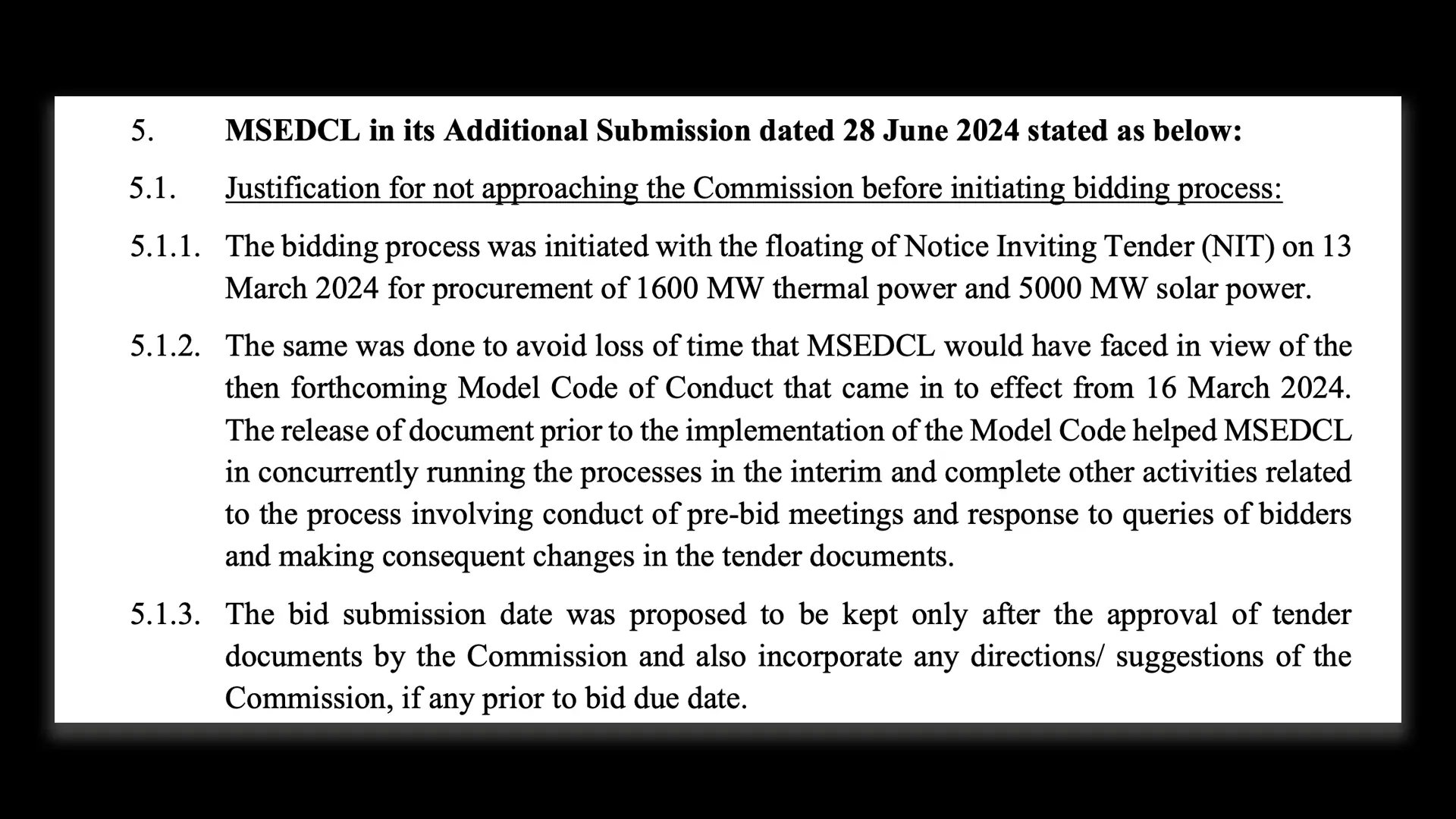
In violation of government rules, this tender was issued without the mandatory prior permission of the state’s electricity regulatory commission, which approves tenders only after the state PSU has justified its need and the nature of the contract it wants to bid out.
The Maharashtra government-owned company claimed it skipped this approval because, with the polls around the corner, the process would be delayed by the model code of conduct. Legally, this was not a tenable excuse.
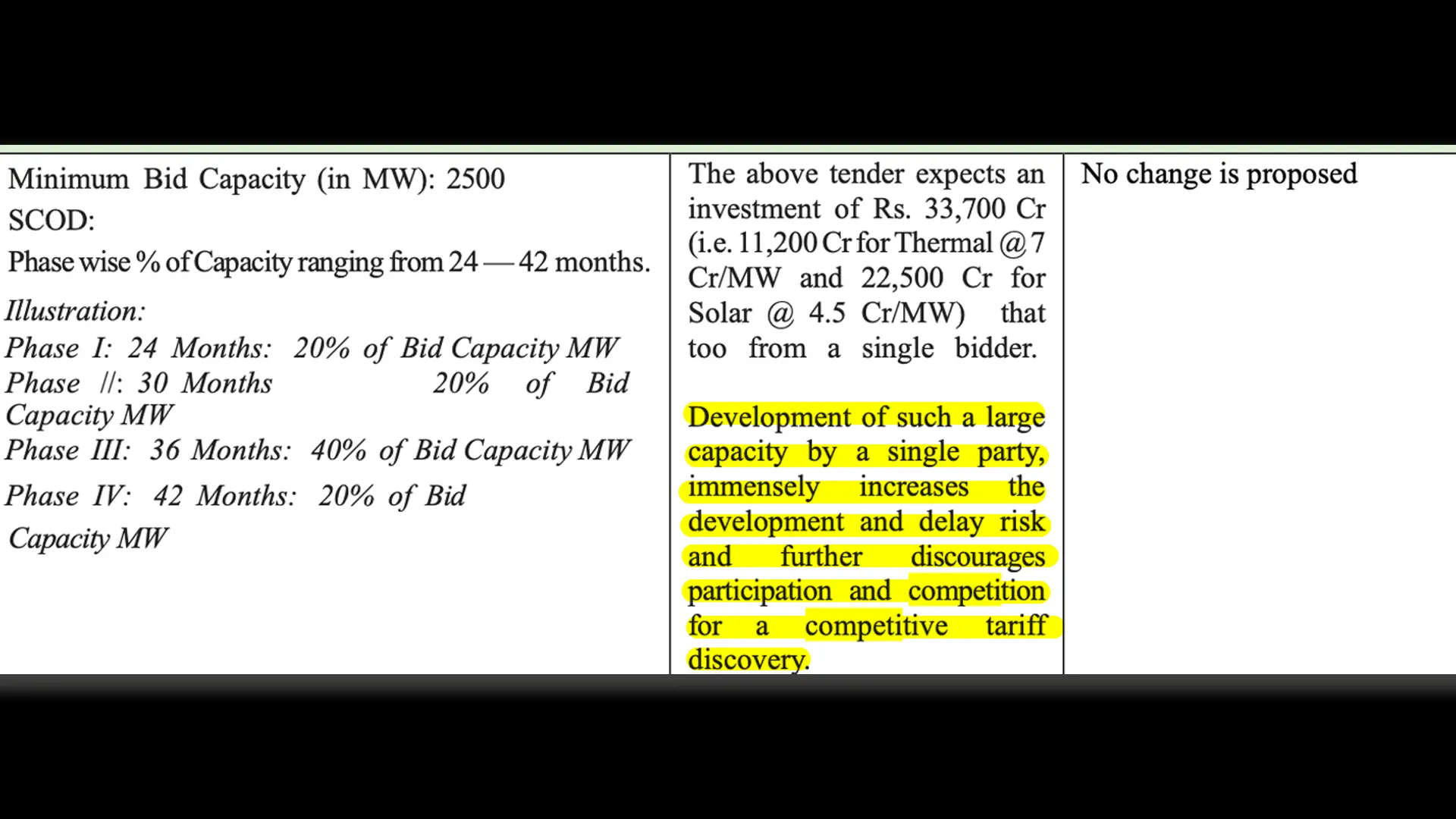
The tender was designed to buy thermal power from the same company that could also provide an ample amount of solar power. Only a few power producers in India could. The Adani group was one of them.
Some companies complained, “Development of such a large capacity by a single party, immensely increases the development and delay risk and further discourages participation and competition for a competitive tariff discovery.”
The Maharashtra government did not budge.
The Adani group responded to our query on this to say, “The Maharashtra bids saw participation of several bidders, and hence it is incorrect to say that it narrowed competition.”
Adani bagged this contentious tender.
The Reporters’ Collective has previously reported on how this tender, and a similar one announced by the BJP-ruled Rajasthan government later that year, were tailor-made in a fashion that they advantaged the Adani Group. The Rajasthan tender was eventually scrapped after our reporting.
The Maharashtra tender marked the end of the “hiatus” of long-term power purchase agreements.
While the bidding for the Maharashtra tender was on, the Union government announced it was reigniting the coal power market. In August 2024, the union government said it would add 80 GW by 2031-32. A jump of 36.8% over the thermal power capacity India had in 2024.
Within a year of the Union government’s announcement, which would have warmed the cockles of private coal power players’ hearts, credit rating agency CRISIL noted in July 2025, “Investments to set up thermal electricity generation capacities will double to Rs 2.3 lakh crore over the three fiscals through 2028.”
A majority of this ramp-up that the private players are cornering is by expanding their existing power plants. The Reporters’ Collective looked at only the coal power projects linked to long-term purchase commitments being offered by state governments. This adds up to a total thermal power capacity addition of 16.7 GW.
The Adani Era
Adani’s dream run in the sector is at times partly powered by extraordinary concessions from state governments.
In Assam, for instance, the state government pledged its own funds to buy excess electricity from the Group’s upcoming 3200 MW thermal power plant. The decision came on the heels of protests by the state’s power sector employees’ union, which pointed out that the state does not need such excess capacity. The Reporters’ Collective scooped the letter pledging state funds and pointed out other discrepancies in an earlier investigation.
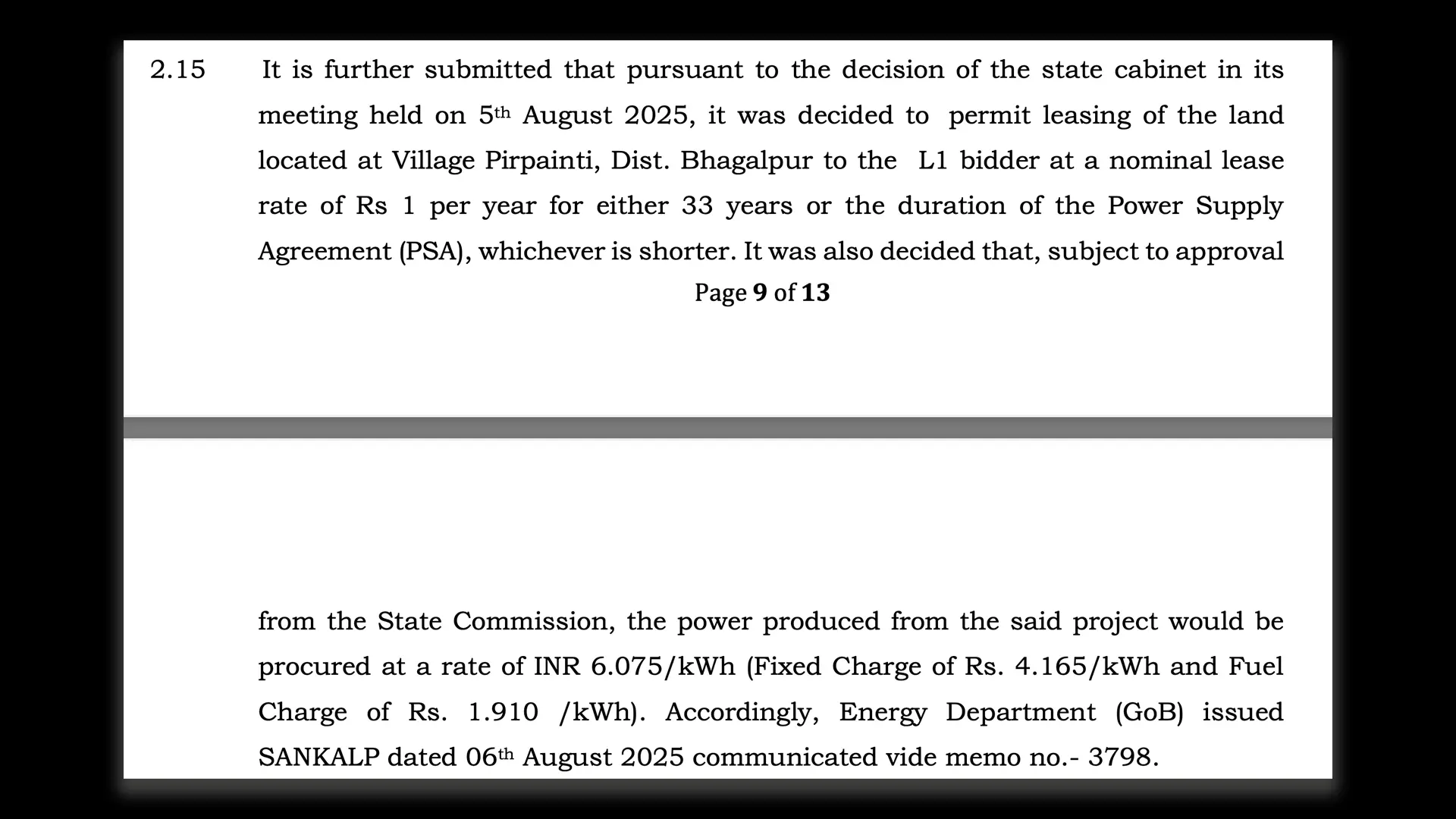
In Bihar, the state handed over 1,000 acres to the Adani Group for building a thermal power plant at “Re 1 per year”. Bihar government had committed to providing land at ‘nominal lease rent’ to the winner.
In other instances, there are no apparent smoking guns, and a transparent process has been followed on paper. The Adani Group has won big here too.
Consider Madhya Pradesh’s tender for buying 4,100 MW of thermal power. It was issued in January 2025 after approval from the BJP-led government.
Hindustan Thermalprojects Limited, Torrent Power Limited and Adani Power emerged victorious for 800 MW, 1600 MW and 800 MW, respectively. This was in July 2025.
In August, the Union Ministry of Coal granted additional coal supply to the state. This allowed the state-owned power procurer to ‘offer’ an additional 800 MW under a first-ever “greenshoe option” under which the state-owned distributor can contract more electricity from the winning bidder at the same rate at which the original tender was won. This saves the state-owned power distributor from launching another auction. But, it gives the existing winner of the bid a leg-up as well.
On 29 August 2025, the Madhya Pradesh government tasked the government-owned power distributor with using this greenshoe option.
In the first week of September 2025, this additional capacity was offered first to Hindustan Thermalprojects, which refused it, then to Torrent Power, which also rejected it, and then finally to the Adani Group, which accepted it on 8 September 2025.
A jubilant press release from Adani Power read, “This development marks a first-of-its-kind adoption of the greenshoe option in a thermal power tender in India.”
“This is the fifth major power supply order received by the company in the last 12 months, taking the total awarded capacity to 7,200 MW,” it added.
The Adani Group also bagged a 2,500 MW Round-the-Clock PPA in Maharashtra earlier this year. The tender specified that 51% of this power must come from a “traceable green energy” source, while the remaining can be from any energy source. Because renewable energy is intermittent, for the Group to supply Round-the-Clock electricity, it would have to rely on coal-fired power.
With multiple projects in its kitty, the total estimated earnings for the Group will be a whopping Rs 13.27 lakh crore.
The cost estimates are based on the assumption that the power plants operate at three-fourths of their capacity throughout the year. The yearly cost of each power purchase agreement was calculated by multiplying the expected annual electricity generation by the tariff discovered after bidding. While the contracts require the government to increase the revenue to cover for inflation over the lifetime of the projects. We have not factored that into the calculations, so the revenue estimates are conservative and have also not been discounted for the time spread. To estimate the total cost over the life of the contracts, the analysis assumes that the cost of electricity remains unchanged for the full 25-year duration of the agreements, without accounting for any future increases in fuel, transportation, or other costs.
With the union government’s ambitious targets for expanding coal-based power, and Adani’s undisputed pole position in the sector, the sector’s future remains a crucial space to track.
Adani Group makes no bones about it. In its investor calls, it has said, “The Government has already given a target of 80 GW of additional thermal power capacity to meet this demand and now this target is being raised again to 95 GW in view of emerging trends. This gives rise to a very attractive opportunity and financially strong and experienced private sector players are ideally positioned to capitalize on it. ”
The new coal power king has emerged in India.