.avif)
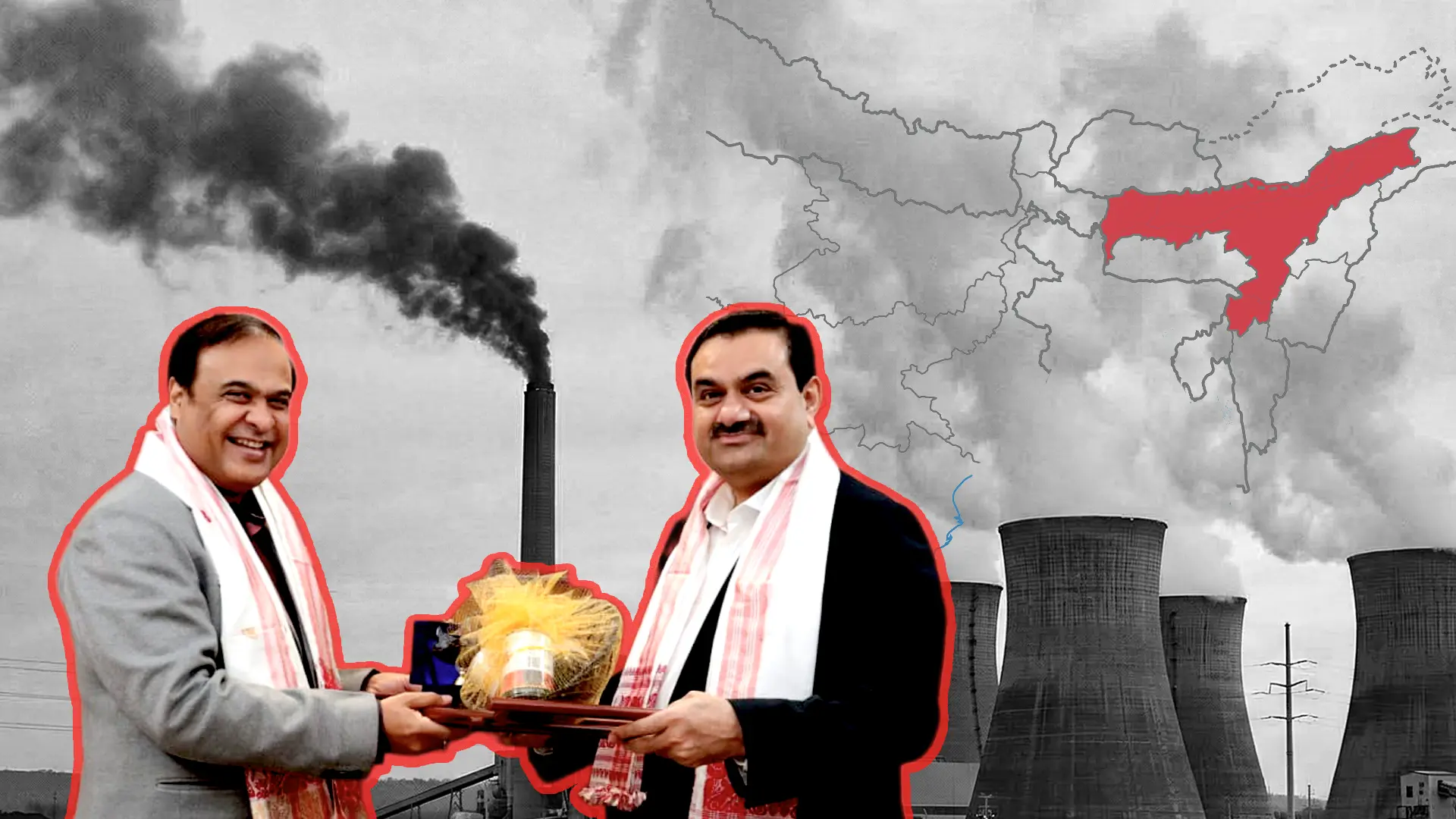


New Delhi: Months before it goes into elections, the BJP-led Assam government pledged to pay the Adani group for coal power that the state will not be able to consume, shows a tranche of internal and publicly available government documents accessed by The Reporters’ Collective.
The state issued a letter of award to Adani in November 2025. Under the deal, the state government could end up paying more than Rs 12,500 crore over five years to the Adani group for not being able to consume the surplus electricity, our calculations show.
These calculations are based on documents of the Assam government and the Central Electricity Authority. The estimate is conservative and relies on the Assam government’s claim that the state will witness high economic growth in the coming decade.
The payout by Assam to the Adani group for not buying its excess power could go as high as Rs 19,000 crore over the same period if Assam’s ambitious economic growth projections turn out to be unreal.
The Reporters’ Collective accessed a letter by a secretary to the Assam Power Department acknowledging the provision in the Adani 3,200 MW coal power deal that would require Assam to pay for power it does not consume.
The Resource Adequacy Plan, which we reviewed, states that Assam requires only 2,829 MW of additional coal power by 2035-36 to meet all its energy needs, even if the state sees high economic growth. Against this, Assam has now committed to buy 3,200 MW from the Adani group starting in a phased manner from 2030.
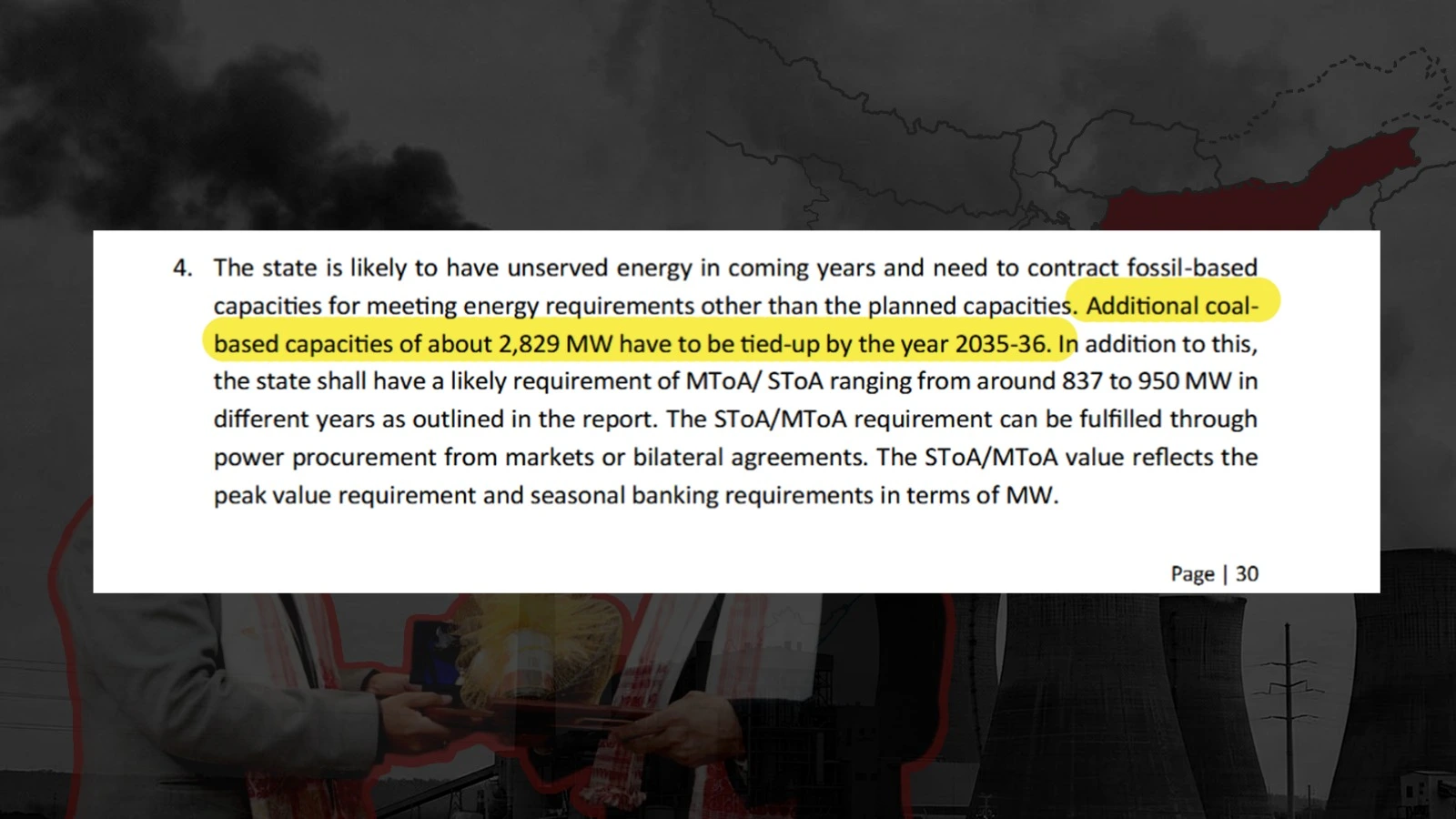
Resource Adequacy Plans are mandatory and meticulous reports that project a state’s future power needs. They are prepared by the Central Electricity Authority or CEA in consultation with the states and must be followed by the latter in contracting for power agreements.
Documents reveal the state significantly inflated its power requirements in its communications with the union government. The Assam power utility told the union government that the state needed an additional 6,000 MW of coal-based capacity. This was more than double the power capacity the CEA had estimated Assam would need to add.
The tender also carries extraordinary exemptions. It waives the standard requirements for the winning bidder to acquire land and forest clearances. The Assam government has pledged to do so for the Adani group. This would further bring down the cost of construction for the Adani group.
The BJP-led Union government, for its part, sweetened the deal. Despite the proposed new power plant being located far from its coal source, a condition that ordinarily disqualifies projects from receiving guaranteed coal supply under a union government policy, an empowered committee comprising the union coal and power secretaries and the CEA chief granted it special exemption. The union government did not disclose to the public its reasoning for granting this exemption.
Ironically, Assam’s top bureaucrat, its chief secretary Ravi Kota, took a swipe publicly at such long-term binding coal power purchase contracts. In his opinion published by The Indian Express on February 13, he flagged these agreements for the “financial stress” and “contractual rigidity” they impose on state-owned power distributors, hurting their capacity to buy renewable energy. “The challenge is harnessing our energy surpluses efficiently,” says the column. He flagged the fact that navigating power surplus, and not scarcity, is the new challenge.
Kota did not specifically identify Assam as one of the states that had signed such a coal power purchase contract. But his description matched the deal his state government had struck. That the Adani deal had also stirred discussion within the government over monetary losses from surplus electricity adds to the coincidence.
Power sector watchdogs have been decrying decades-long power purchase deals, particularly for coal power, for years. It leads to higher costs and locks the states to dirty coal power at a time when India has internationally and domestically committed to ramping up its use of renewable energy.
But the deal has now got the approval of the state electricity regulator.
We sent detailed questions to the Assam government and its chief secretary, the Adani group, the state electricity regulator and the Union Coal and Power ministries. The questions can be read at the end of the story. None, except the chief secretary, Ravi Kota, replied despite repeated reminders.
Assam chief secretary, Ravi Kota, in his reply, said, “The conclusion that this (3200 MW power plant) capacity would lead to sustained surplus power does not appear consistent with the demand projections available with the state utility and the Government of India,” he said in response to specific queries on power surplus resulting from the Adani Power project.
Suggesting that his original opinion piece did not allude to the Assam-Adani power deal, he added, “The article addressed a broader national issue: as India transitions rapidly toward renewable energy, distribution companies across the country face structural challenges arising from legacy long-term contracts signed during earlier periods of power scarcity.”
His complete reply can be read here.
{{cta-block}}
Tender Games
Here are the details of the Adani Assam deal.
On 1 August 2025, Assam Power Distribution Company Limited or APDCL, the state’s power distribution agency, claimed that Assam needs 6,000 MW coal-based power by 2035-36. Its claim was before top officials of the Coal and Power Ministry who had huddled to discuss coal supply to proposed power plants.
In the same meeting, the Ministry of Power had quoted a much smaller figure: that Assam needed just 3,483 MW of coal-fired power by 2035-36.
The minutes of the meeting do not record any dissent over the wildly different figures the two quoted. APDCL’s egregious claim went unchallenged. In the same meeting, the mandarins decided that APDCL’s proposed plant should apply for a coal supply linkage despite it being likely to be located far from the coal mines. This key exemption was later granted on a discretionary basis as official guidelines allow such linkage only when the plant is close to the source of coal. The union government has not made public its reasons for granting this exemption.
This set the tone for the rest of the process.
In the same month, Assam issued a tender for building a 3,200 MW power plant in the state.
Soon, prospective bidders sent in their comments on the tender. Several suggested the tender stifled competition and should be changed.
Jindal India Power Limited wanted the auction to do away with the requirement to build an entire new power plant in the state. It recommended allowing companies with existing plants but with “untied capacity” to participate to enhance competition and “discover better tariff”. Untied capacity refers to power capacity that a company has not already tied up with another state to sell.
Jindal pointed out, “The Fixed Cost of the already commissioned and operational power plant will cost lower than the new Power Project.”
APDCL’s response was curt: “This tender is only for new power plants to be set up within Assam. This is a clarification only.”
Tata Power Limited, meanwhile, called for amending the capacity for which a bidder competes: Request for Amendment to: “Keeping overall Bidding capacity as 3,200 MW, bidders shall be allowed to quote for capacity of 1,600 MW (2x800MW) or higher. Rationale for Amendment: This will increase bidder participation by reducing the financial burden and risk on a single developer.”
Torrent Power Limited, too, called for a similar amendment offering the same logic.
APDCL’s response to both, yet again, was curt: “No change proposed.”
The Assam Electricity Regulatory Commission, which has to approve such power purchase tenders, went with the Assam government.
The tender itself deviated from standard practice. It did away with the established norm of requiring the winning bidder to acquire land and green clearances for the power plant, further sweetening the deal for Adani Power which eventually bagged the contract.
Next came the auction.
Failed Negotiations
On 10 October 2025, five companies bid their initial per unit price at which they would sell electricity.
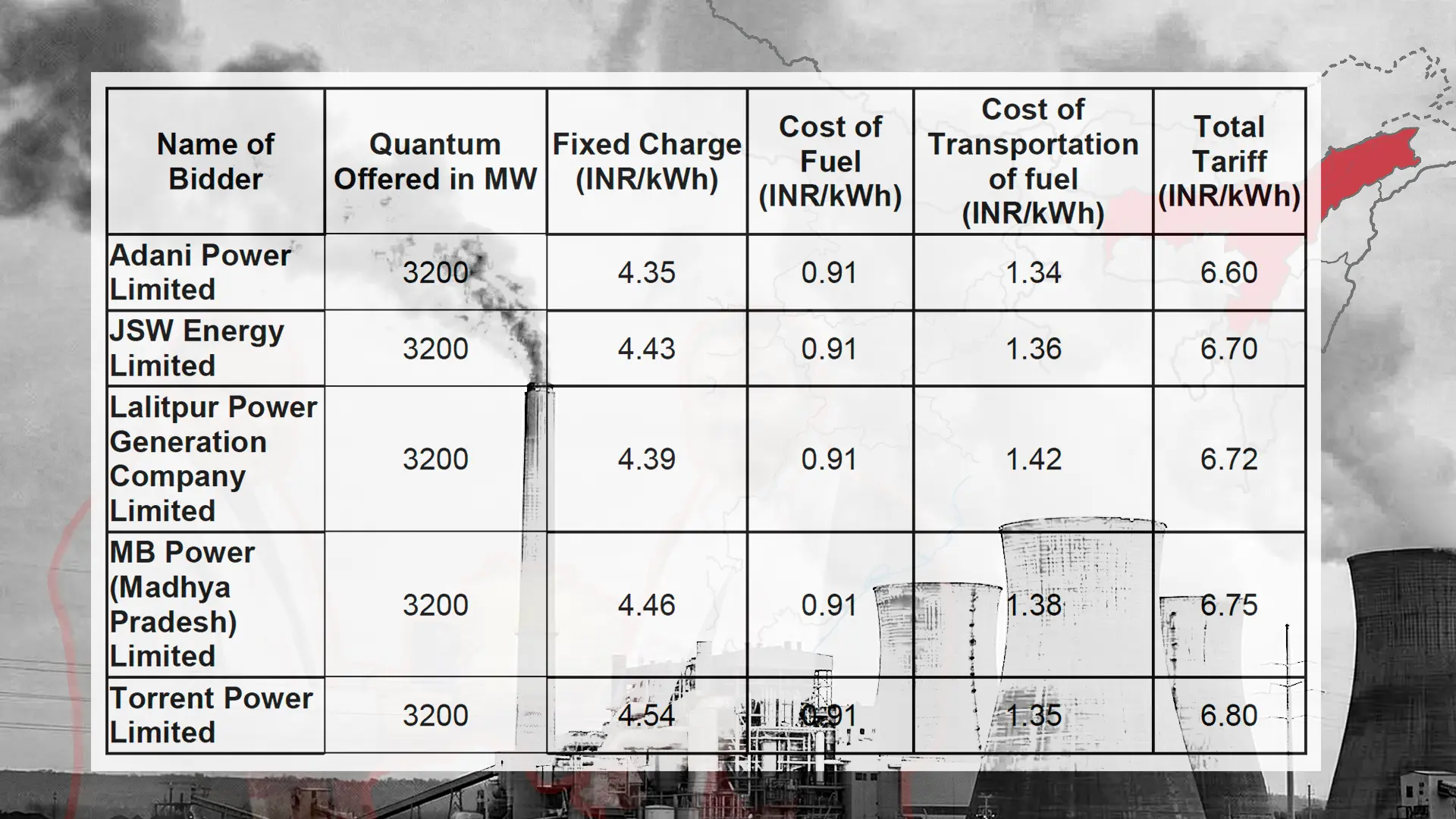
After another round of bidding among the qualified players, Adani Power emerged victorious with the lowest rate at Rs 6.3 per kilo Watt hour.
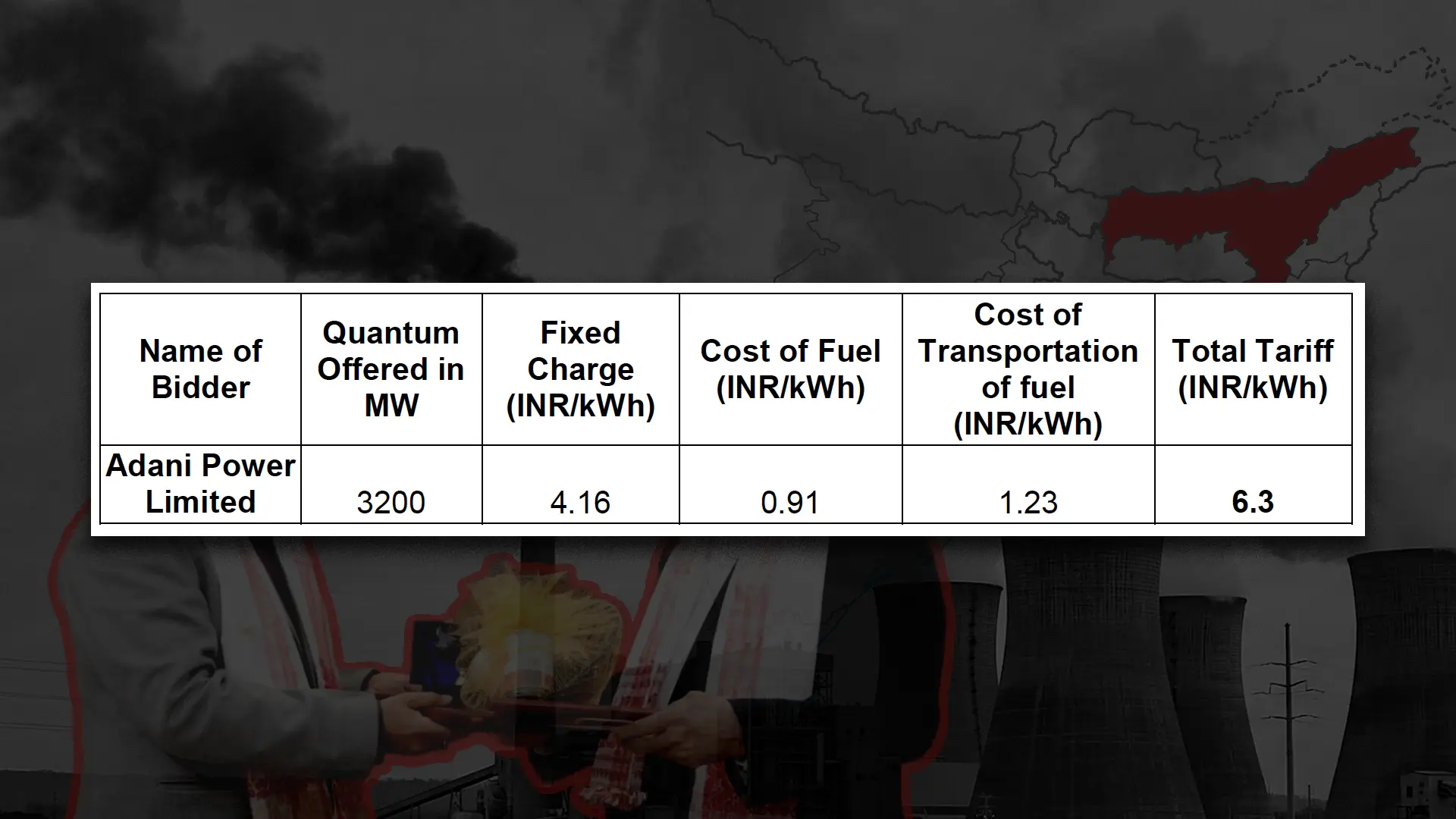
Going by the norms, the Assam state agency submitted these details before the state’s power regulator on 15 October 2025. It is only after the regulator’s stamp of approval that the power purchase agreement is inked and the process of building and setting up a power plant begins.
The state utility was in a hurry to get the regulatory nod citing the time it takes for setting and then firing up a thermal power plant.
The state power regulator, however, was unimpressed. It pressed the state power distributor to negotiate with Adani Power and lower the price which it said, “appears to be on a slightly higher side”.
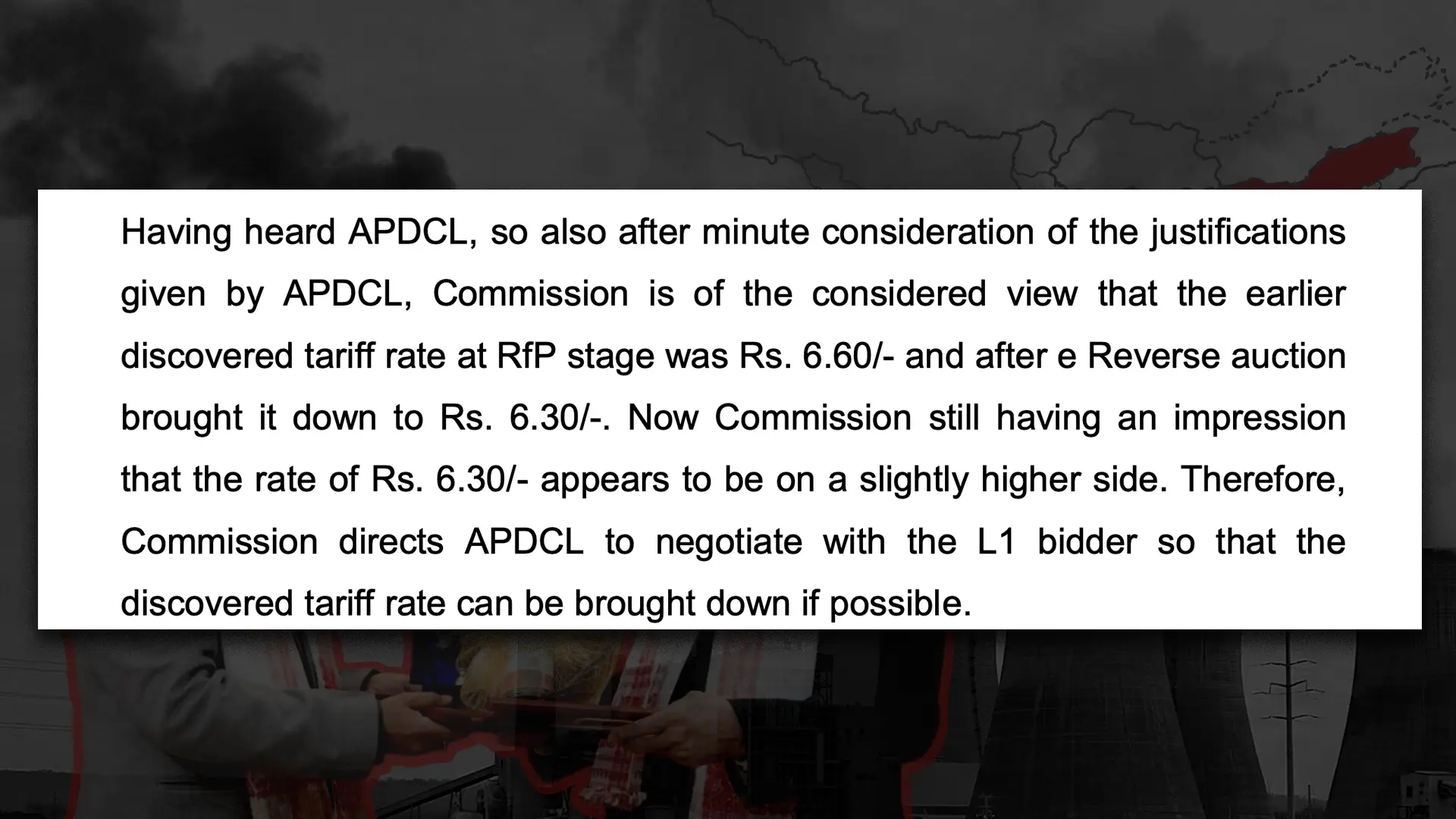
Five days later, Assam came back to the commission and said it had failed to get Adani Power to lower the price. It sided with the Adani group to justify the tariff.
Adani Power, in its submissions, cited Assam’s difficult terrain and rising equipment costs among reasons for its price point.
The regulator in its October 22, 2025 order accepted the tariff. It said that its earlier view, of the price being “slightly on the higher side” was based on rates discovered in “some of the thermal projects in neighboring states in East India” and the fact that the project would use “latest technology which will make the plant more efficient in using coal”.
With this, Adani Power’s path was cleared. But soon, apprehensions arose.
Government to the Rescue
On 21 November 2025, the Coordination Committee of Electricity Employees, Engineers and Pensioners demanded the immediate suspension of all proceedings related to the project in a formal letter to the APDCL chief.
The committee expressed concern over reports that authorities issued a Letter of Award to the Adani Group for the project. The committee stated that decision-makers took this step without adequate transparency, public awareness, or consultation with stakeholder associations linked to state-owned entities and the people of Assam.
It criticised authorities for not assigning the government-owned power generation company, Assam Power Generation Corporation Limited, the responsibility to initiate, construct, execute, and manage the project. The committee argued that the state must ensure government-owned company’s leadership in a project of this scale to safeguard long-term public and consumer interests.
The committee also questioned the need for the project’s proposed capacity. It stated that Assam’s current peak power demand stands at around 2500 MW. The committee asked authorities to explain how they assessed the need for an additional 3200 MW within five years. It asserted that the state will not require such a large increase in power generation during that period.
It warned that excess power generation could create financial risks. It said APDCL would have to sell surplus electricity in the open market at lower prices, which could lead to significant losses. The committee added that authorities would ultimately pass that financial burden on to consumers through higher tariffs.
The letter, addressed to the Assam Chief Minister and the Labour Minister as well, called for making all documents related to the proposed project public along with a halt on all its activities.
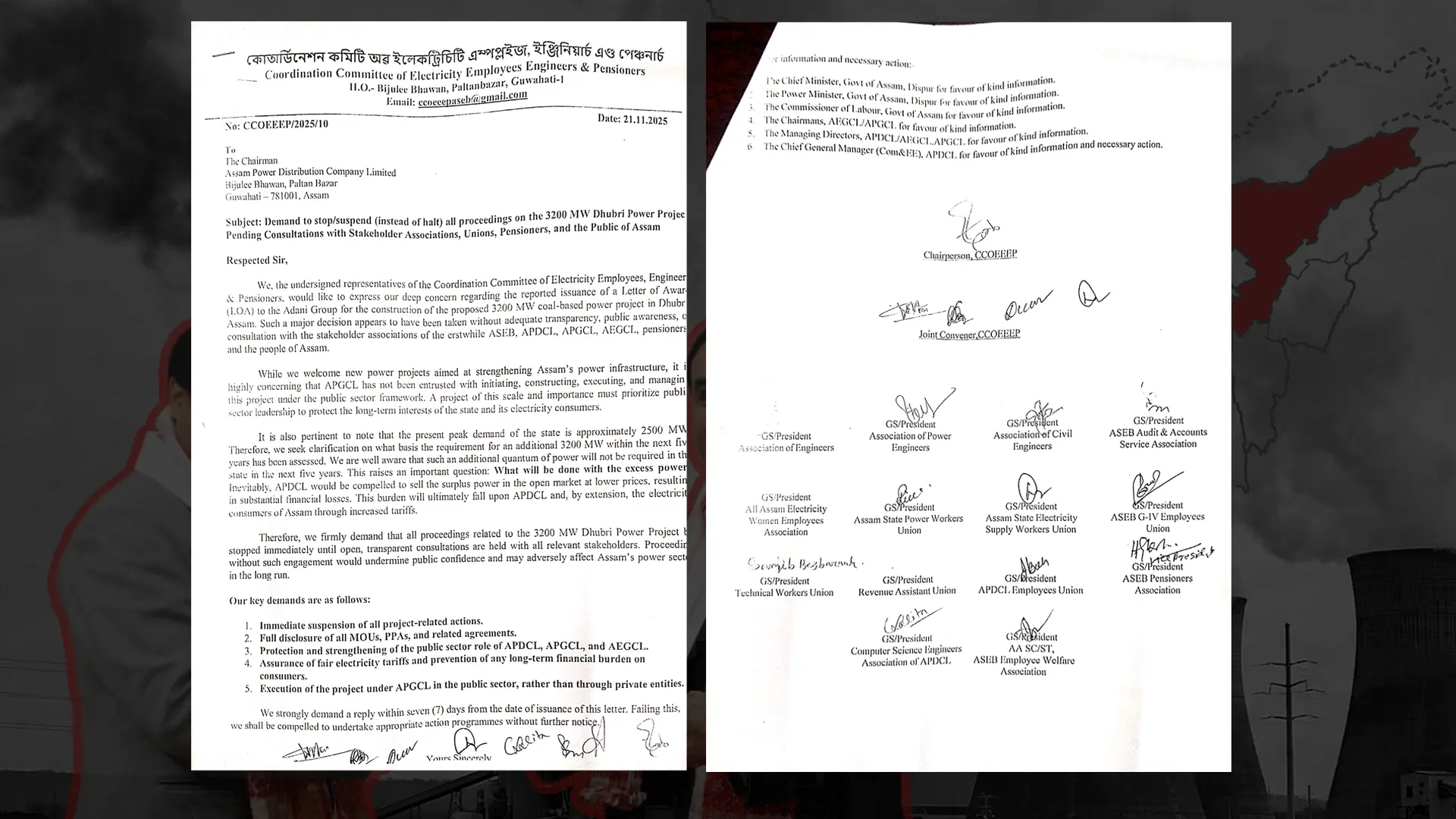
The electricity workers’ union’s stiff opposition forced officials to take notice.
The next day, 22 November 2025, prompted by the union letter, APDCL reached out to the state’s power department. Within hours, the latter responded.
The Collective accessed the letter from secretary to government of Assam in the Power Department, Jadav Saikia, to APDCL bosses.
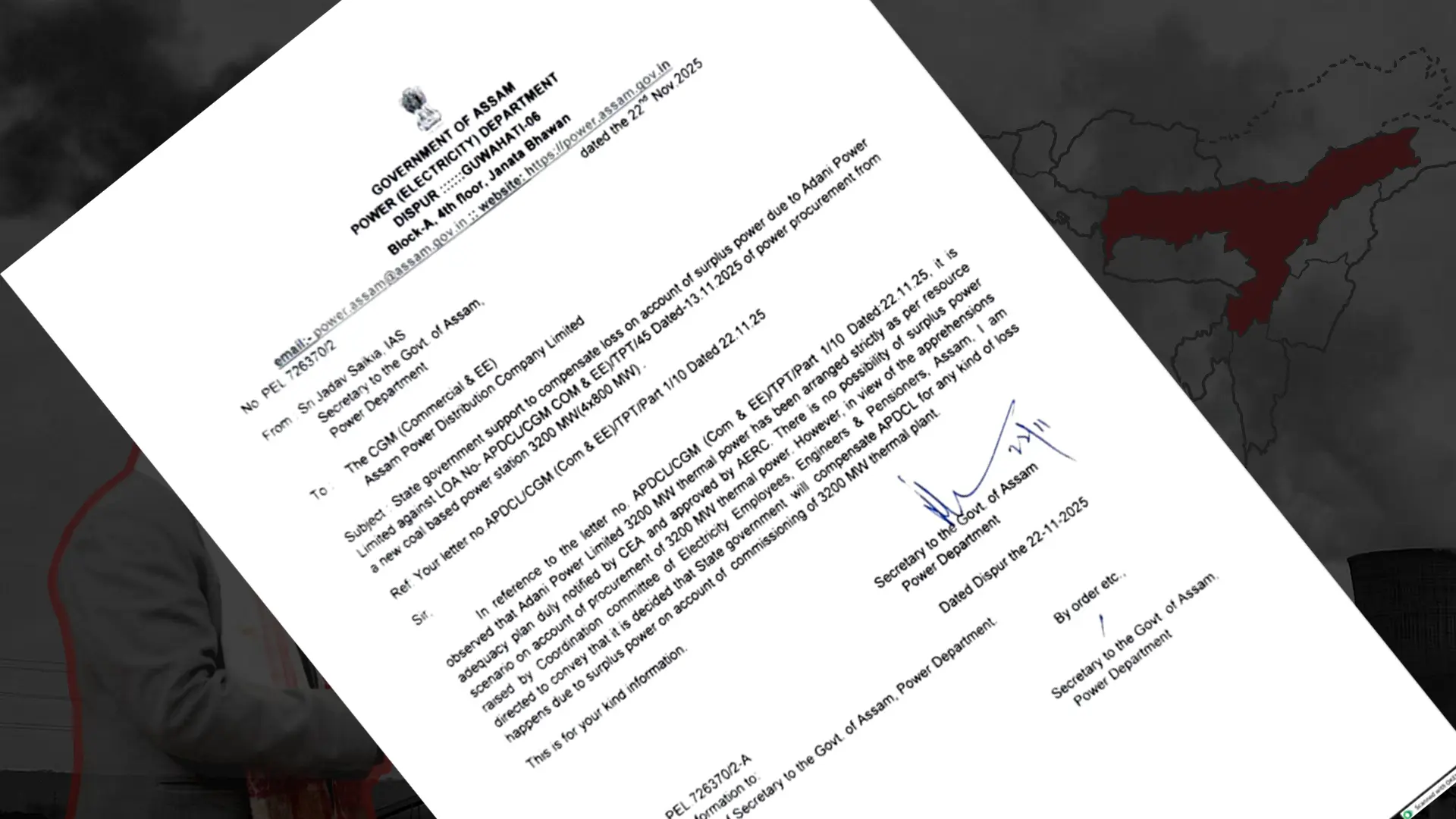
The subject line of the letter was explicit. It read: “State government support to compensate loss on account of surplus power due to Adani Power Limited”.
Saikia wrote that he was “directed to convey” that “there is no possibility of surplus power scenario”. But in the next sentence he declared: “State government will compensate APDCL for any kind of loss happens (sic) due to surplus power on account of commissioning 3,200 MW thermal plant.”
A Price to Pay
When a utility fails to use the electricity capacity it has paid for, a little-noticed contractual clause ensures that power suppliers don’t get left holding the bill. Under this, any contracted capacity that goes unused by the utility can be sold to other buyers on the open market. The catch? The fixed charges, those baseline fees that accumulate regardless of whether a single unit of power is consumed, must still be recovered. If no alternative buyer steps in, the original utility remains on the hook.
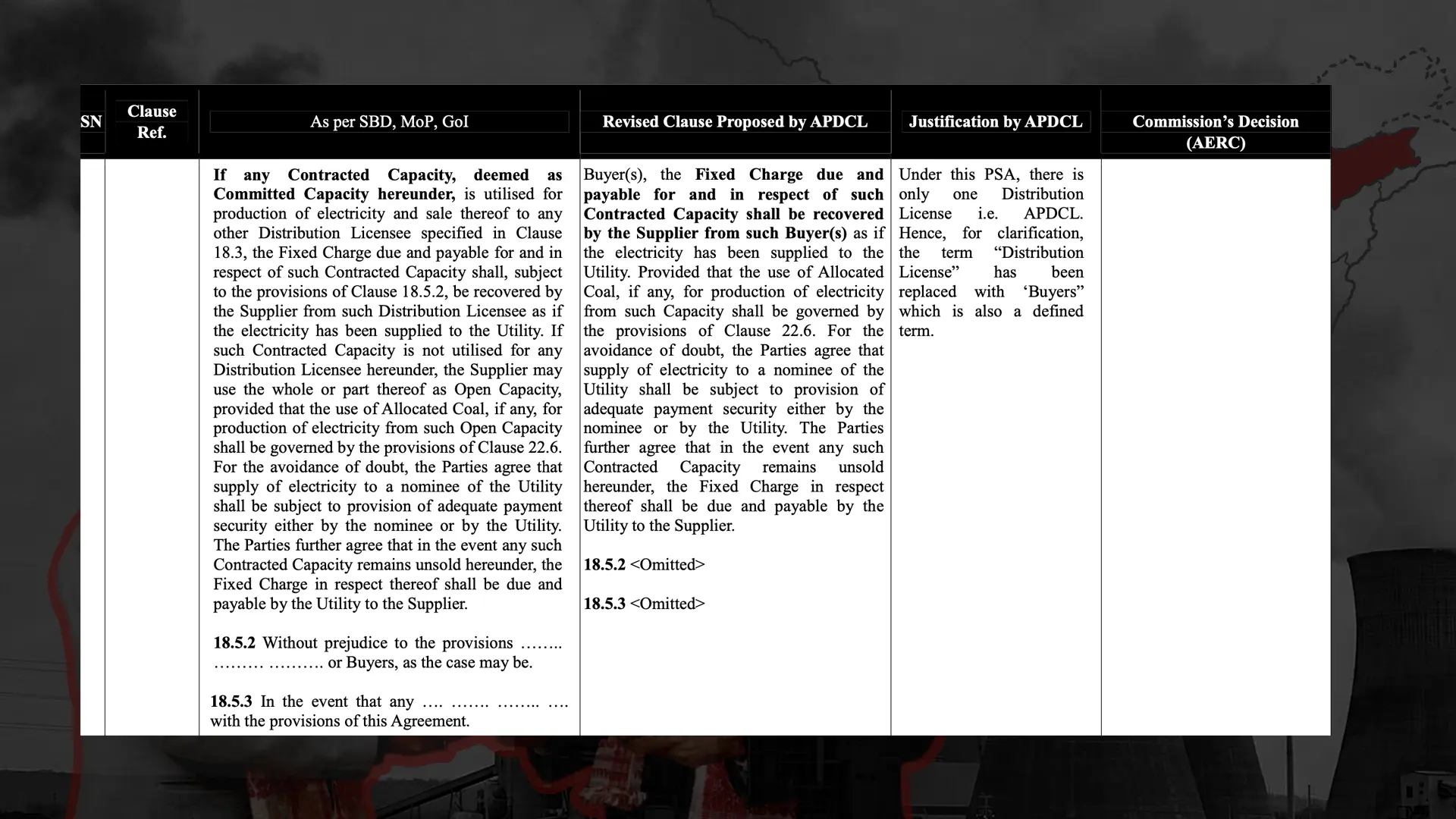
This is a standard practice in Indian power tendering. However, to avoid paying power generators out of the exchequer’s pockets, state governments should design tenders in a way that aligns with realistic estimates of future power demand. The Central Electricity Authority’s resource adequacy plans are a tool to help achieve an efficient tendering process. Assam, however, has strayed from these estimates.
Based on the resource adequacy plan of the state, the tender details and other internal documents, The Reporters’ Collective assessed how much excess power had Assam gov’t locked itself to potentially and what would be the price the state’s people would have to pay while not consuming this energy in future.
India’s Central Electricity Authority, a body functioning under the Union Ministry of Power, oversees the technical aspects of electricity consumption and distribution. For this, it predicts how much electricity will be needed in the upcoming decade based on existing and planned power capacity. If its calculations show that higher levels of electricity would be needed to meet future demand than what currently exists or is already in the pipeline, then governments use that data to build up more capacity to meet the shortfall.
Based on union government guidelines, the Authority also estimates how much electricity should come from fossil fuels and how much from renewable sources.
The Authority calculated how much power Assam would need between 2025-26 and 2035-36.
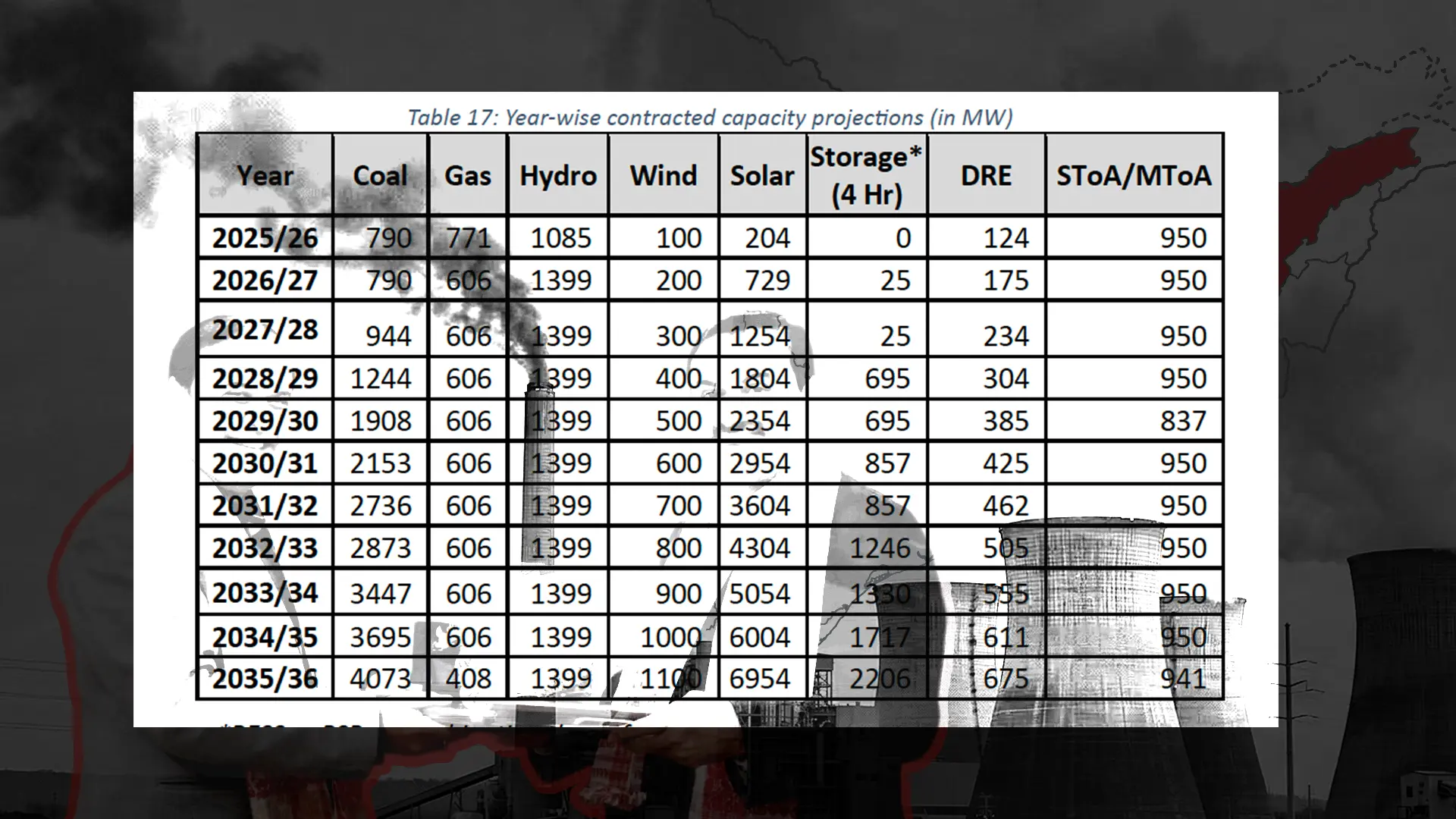
To estimate how much unused electricity the government will pay for, The Reporters’ Collective looked at the excess generating capacity sitting idle, measured in megawatts (MW). We then calculated how much power that capacity could produce over a year. Power plants don’t operate at full output all the time, so we assumed the typical utilisation level of 75%. This converts surplus capacity into total unused electricity over the year, measured in million units (MU). Finally, we applied the fixed payments that Adani Power is guaranteed for keeping the plant ready, regardless of whether the electricity is used or not.
The result is the total amount the government would end up paying for power that was never needed.
In 2031-32, the state will be sitting on an excess capacity of 908 MW going by CEA’s “optimistic” projections. This power capacity is estimated to go unused for that single year. This would translate to an estimated 5,966 million units of electricity that will lie unused.
The state-owned power distributor will pay Adani Power Rs 4.16 per unit of electricity that lies unused.
This means the government will foot a Rs 2,482 crore bill in 2031-32 alone.
We calculated the cost to exchequer over the five-year period for which the CEA has published its projections. For its projections, the CEA assumes two distinct scenarios: one where Assam’s power consumption trends continue as they are, known as “Business as Usual”, and the second where power management is more efficient, called the “optimistic” scenario.
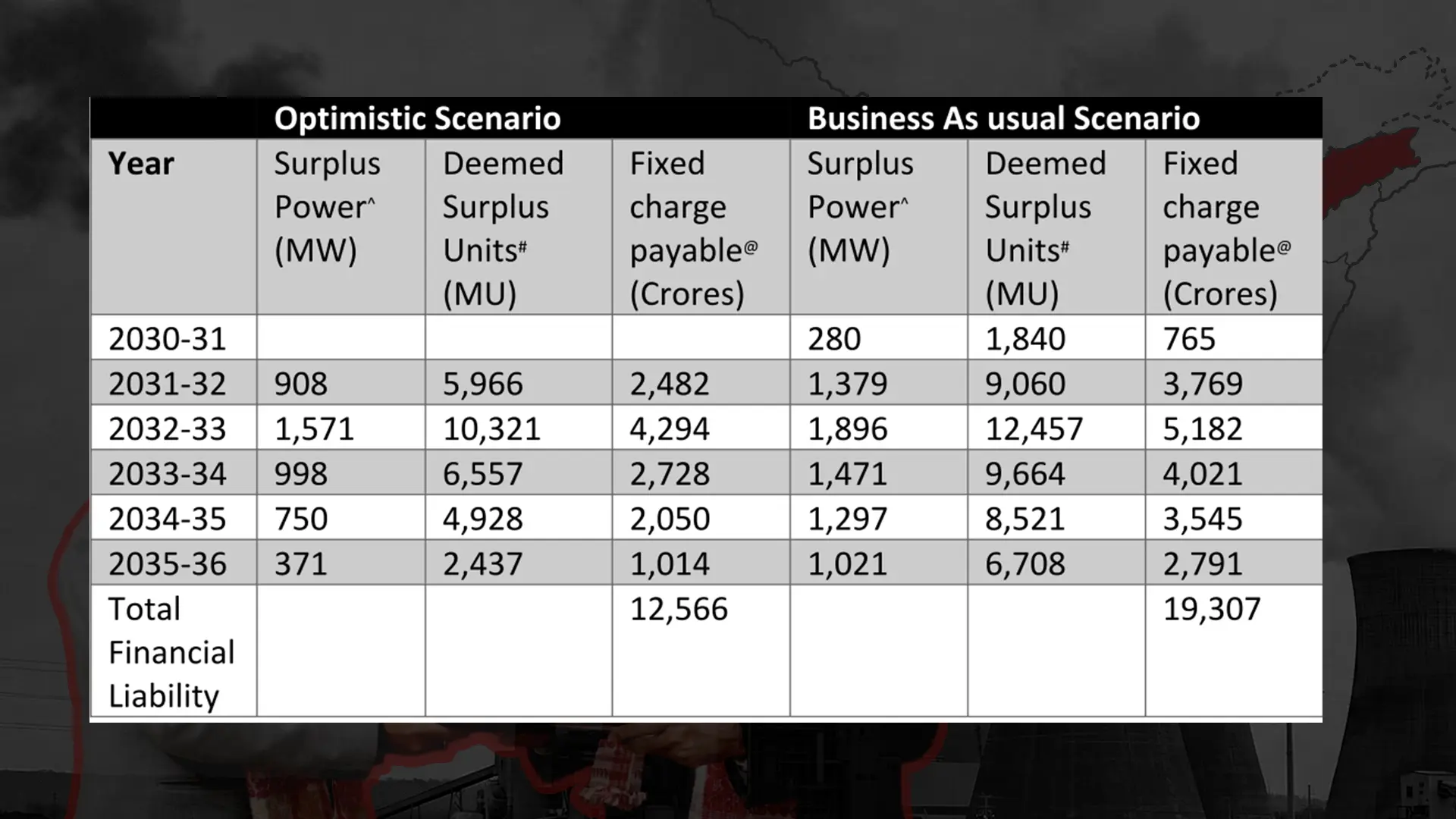
The total cost assuming an “optimistic” scenario comes to Rs 12,566 crore.
If what the CEA calls “Business As Usual” projections hold true, the exchequer may well have to shell out over Rs 19,300 crore for surplus power.
Apart from the undue burden on the exchequer, this would spell bad news for India’s renewable energy push as well. An argument that the state’s top-ranking bureaucrat, to some surprise, made in public.
Top Assam Official’s Public Warning
Ravi Kota, Assam’s Chief Secretary, wrote an opinion on Assam’s progress in the power sector and how India should take notes from the state.
“For decades, India planned for an energy-deficient economy. Today, however, the central challenge is no longer scarcity. Driven by renewables and aligned with India’s net-zero target for 2070, the country’s energy sector must now navigate surpluses,” he wrote.
Kota lauded what he sees as India’s faster-than-anticipated entry into renewable energy. But he warned that roadblocks remain.
“A large share of electricity procurement by state discoms is locked into legacy contracts,” he said, referring to the deals as “structural hurdles”. “Industry estimates suggest around 85-90 per cent of power procured by discoms is tied to long-term power purchase agreements, many signed years ago with fossil-fuel generators at fixed tariffs. This leaves limited flexibility to absorb cheaper renewable power even when available. Financial stress and contractual rigidity have made discoms cautious about signing new renewable PPAs.”
“Cheap, clean power is not a subsidy. It is a strategy. The challenge is harnessing our energy surpluses efficiently,” reads the column’s last line.
Before ending his piece, he praised his chief minister, Himanta Biswa Sarma. “Under CM Himanta Biswa Sarma, it (Assam) has pursued power-sector reform focused on distribution efficiency, financial discipline and capacity creation.”
We sent Kota detailed queries on his published article.
On the assurance to Adani group that it would be paid the fixed costs of electricity even when Assam is unable to purchase it, he said, “The communication you refer to was intended to reassure APDCL that, in the unlikely event of temporary financial stress arising from unforeseen market conditions, the state government would ensure that the utility’s financial position remains protected.”
Suggesting that Assam had not purchased more than needed power, he added, “Peak demand is projected to reach approximately 5,000 MW by FY 2032–33.”
We found he had conflated peak demand (the maximum power supply needed at a given time) with what additional coal power contracts Assam needed to meet it. The Central Electricity Authority’s mandatory Resource Adequacy Plan has pegged it at 2,829 MW by 2035-36, lower than the single contract Assam has signed with the Adani group for 3,200 MW.
Kota’s reply along with all the questions sent by The Reporters’ Collective can be read here.