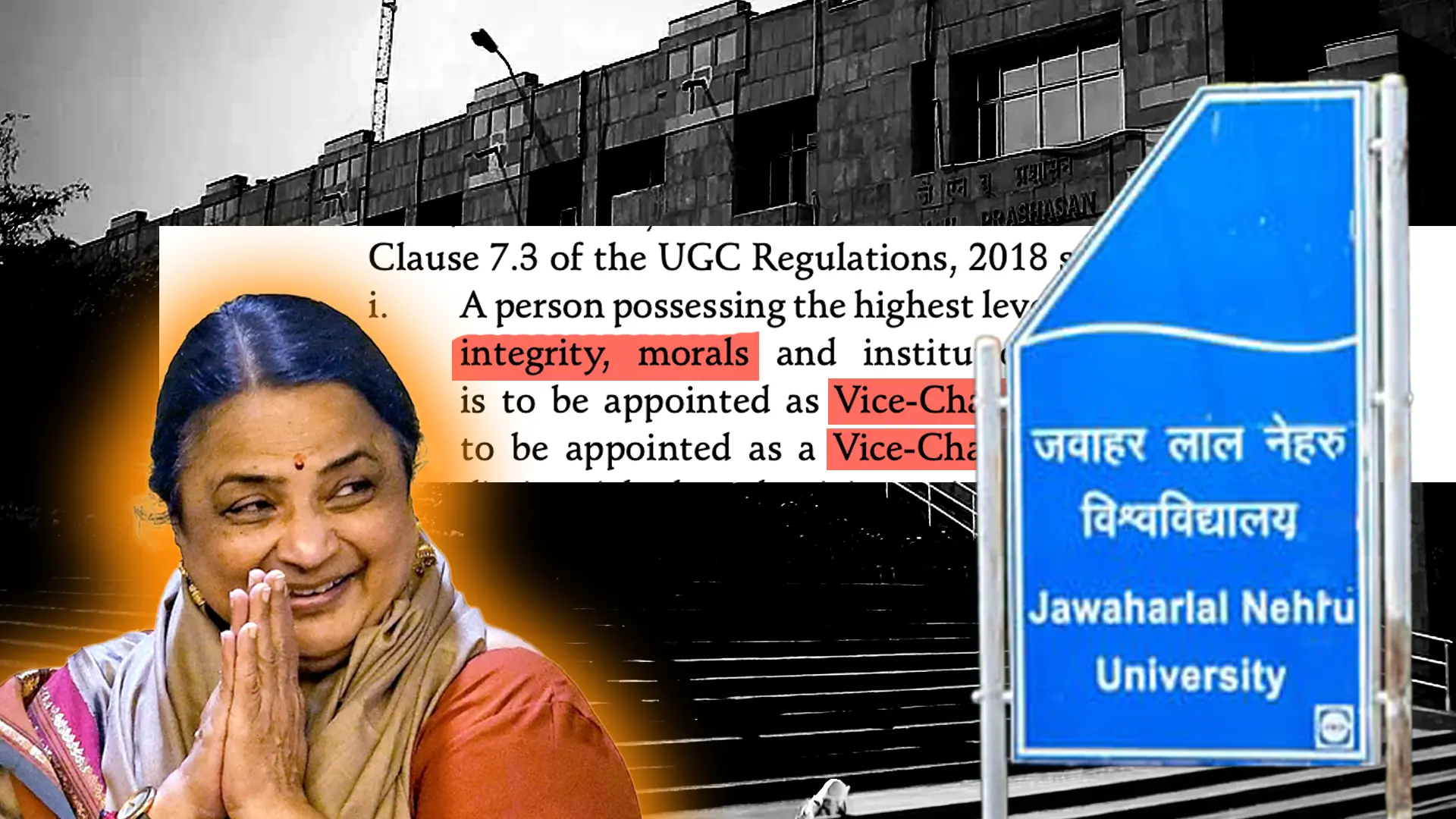


New Delhi: Santishree Dhulipudi Pandit is no stranger to controversy. The Jawaharlal Nehru University’s Vice Chancellor has dominated headlines over the past few weeks, facing backlash over alleged casteist remarks, escalating student protests, and now a JNU Student Union-led campus referendum on her removal. Student protests at the central university in Delhi began in early February and have since intensified – snowballing into suspensions, clashes, and demands for Pandit’s resignation.
Led by the student union and a section of professors, Pandit is being accused of corruption in recruitment and rigged exams at the varsity. Amid demands of her removal, the unrest within the campus has also brought older allegations back into focus – and the JNU student union is making these the plank of its case against her.
Pandit was appointed JNU’s VC on February 7, 2022. She was then a professor at the Savitribai Phule Pune University, earlier University of Pune. Her elevation came with much fanfare – she was the first woman to lead the hallowed institution, and from a backward caste at that, facts she often mentioned in interviews. Her predecessor Mamidala Jagadesh Kumar was himself no stranger to controversy. But Pandit’s arrival drew more attention. She was JNU’s first woman VC, and her closeness to the ruling party made her a media favourite.
But even amid the praise and talk of shattered glass ceilings, a select few reports that year noted her alleged misconduct at her previous institution. In 2008, Pandit had faced an inquiry at the University of Pune, where she served as director of the International Students Centre, an additional role to her professorship.
While no formal convictions came of it, her detractors believe her involvement in a corruption case should have been handled more seriously. Pandit has often dismissed these allegations, arguing, at least in one interview, that those “who make these allegations should produce some proof to back it. Nothing was proved against me.”
She wasn’t being straight about it.
With her past now back in the spotlight, The Reporters’ Collective obtained documents from that case. They show that in 2009, Pandit wasn’t merely described as guilty of “moral turpitude”, she was formally punished for it. A separate set of documents reveal something else – the North-Eastern Hill University (NEHU), a central university in Shillong, had found her unfit to serve as its VC. That was a year before she was named JNU’s new Vice Chancellor.
Another set of exclusive documents points to how the selection committee that eventually picked her at JNU was constituted by steamrolling dissenting voices.
Reviewing these documents raised an obvious question, that JNU and NEHU are both central universities, governed by near-identical rules for appointing a VC under their respective Acts.
So, those within JNU’s student union and teachers’ association argue, if the charges of irregularities against Pandit were grave enough for NEHU to pass her over, why did JNU – a far larger and prominent university – fail to scrutinise her record before handing her the top job?
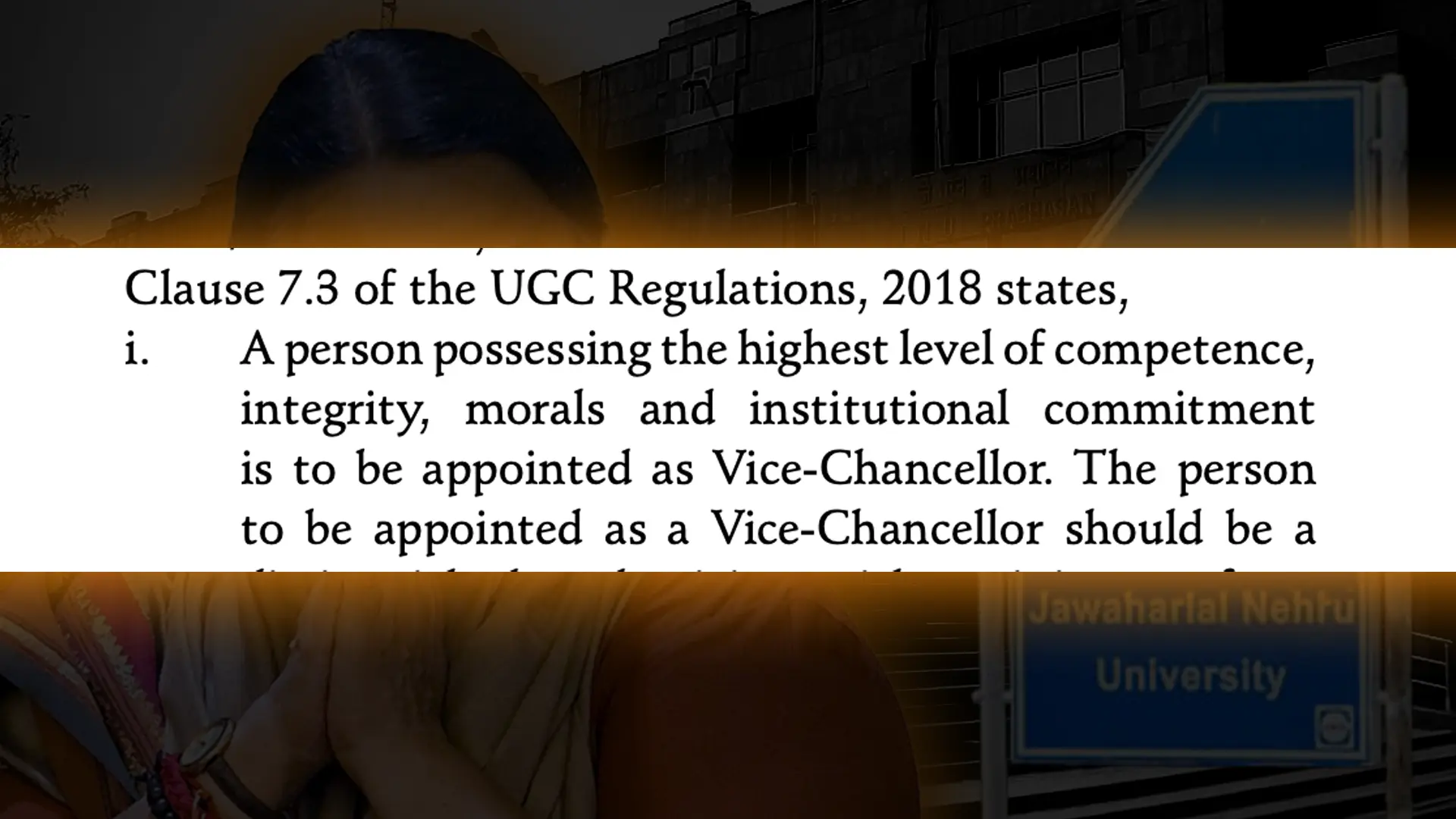
This question carries more weight given what India’s top-most higher education body, University Grant Commission (UGC) mandates. Its 2018 recruitment rules state that “a person possessing the highest level of competence, integrity, morals and institutional commitment is to be appointed as Vice-Chancellor.”
{{cta-block}}
Abuse of Power
In 1998, Pandit was appointed Reader in the Department of Politics and Public Administration at the University of Pune. On April 5, 2001, she was given additional charge as Director of the university’s International Students Centre (ISC). The centre handled admissions for foreign students – including persons of Indian origin (PIO), children of Indian Gulf workers, and Indian workers from Southeast Asia holding foreign passports – under a 15% quota set by the All India Council for Technical Education (AICTE) and the University Grants Commission (UGC).
Pandit led the ISC from 2002 to 2007. Shortly after she left the centre, a complaint landed. In early 2008, Atul Govind Bagul, an Executive Council member of the Pune University Teachers Association, alleged that under Pandit, the university had admitted about 1,800 ineligible Indian students to PIO-reserved seats across various professional courses, bypassing rules by quietly redefining who qualified as PIOs or foreign passport holders.
Soon after, the University of Pune set up a four-member committee, headed by Sunanda Pawar, to look into the complaints. In its report dated August 6, 2008, the committee unanimously found that under Pandit there was a “possibility of financial misappropriation.”
On the Pawar committee’s recommendation, the then University Vice Chancellor eventually started formal disciplinary proceedings against Pandit. The disciplinary inquiry committee, headed by retired Justice JA Patil, makes a categorical observation, that unfilled seats from the PIO quota cannot be allocated “to any student other than the students of above mentioned categories” under any circumstances. By August 28, 2008, she had been charge sheeted.
A Slap on the Wrist
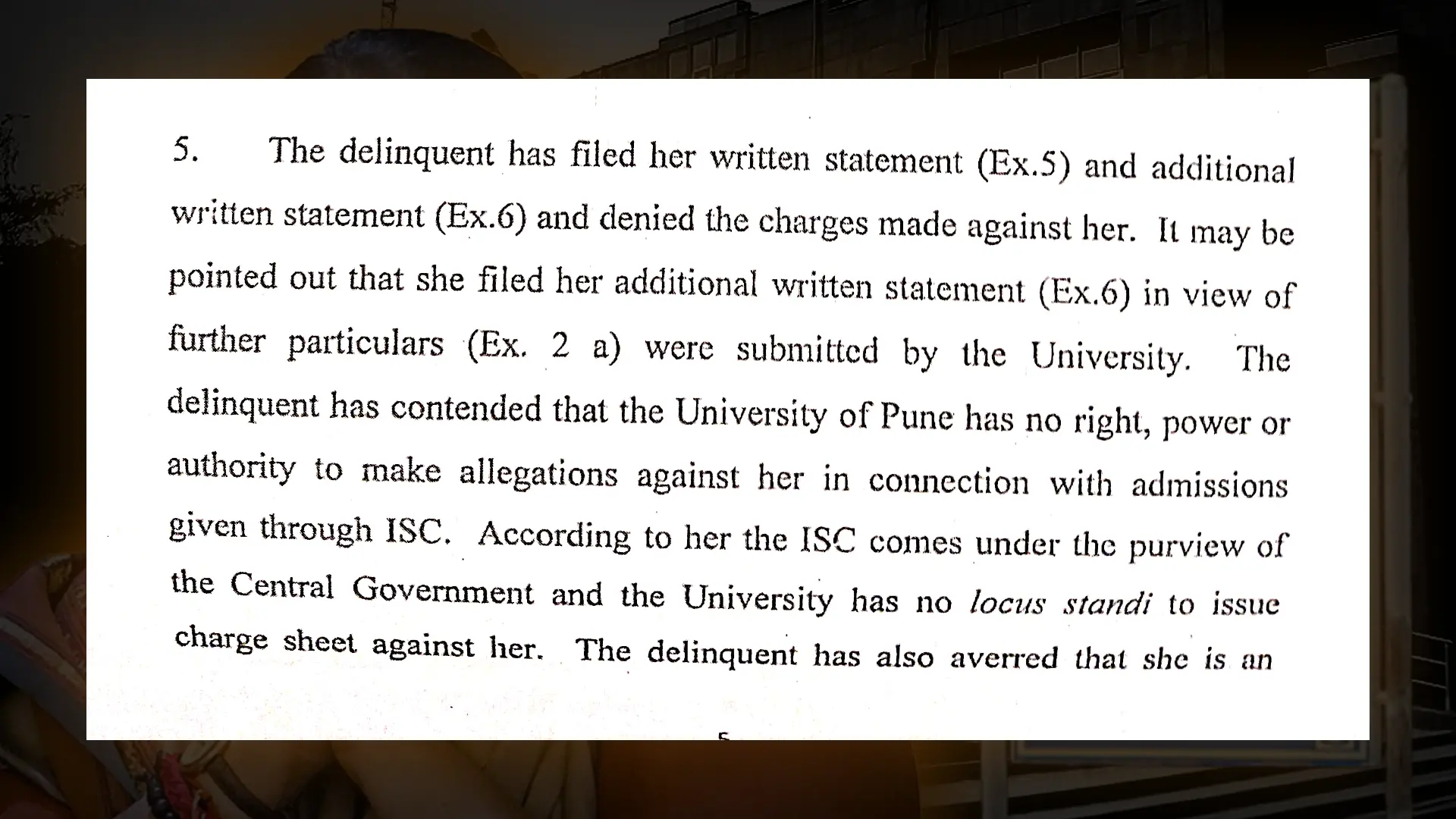
During the inquiry, Pandit and her lawyers fought tactically to save her. In one written submission, she argued that the ISC fell under the Ministry of External Affairs, not AICTE or UGC, and that their reservation rules therefore didn't apply. She also contended that the university had no locus standi to issue a charge sheet over ISC admissions, as the ISC fell under the purview of the central government.
Pandit also argued that she couldn’t be held accountable under the Teacher Statutes since her ISC role was an unpaid additional charge, making her legally not a teacher under the Maharashtra Universities Act, 1994.
Justice Patil dismissed majority of her arguments. Invoking Statute 431 of the University of Pune’s Teacher Statute book – backed by the Poona University Act, 1974, and the UGC’s Code of Professional Ethics – he found her guilty of “misconduct” and “moral turpitude.”
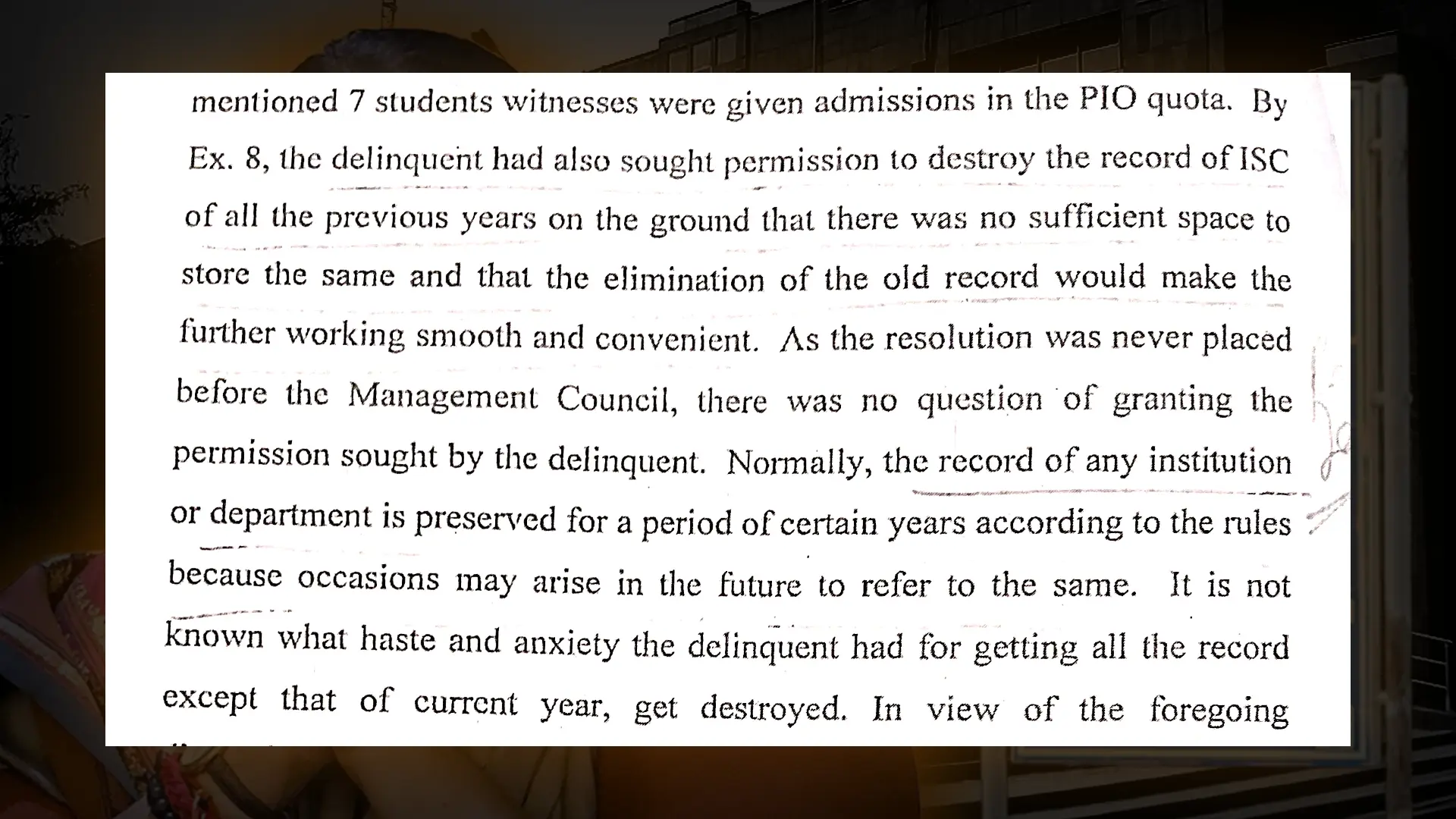
Patil was pointed in his findings. The way Pandit had interpreted the 15% reservation rule, he wrote, “shows her anxiety to widen the scope of the definition.” Her conduct, he added, “does not appear to be fair and proper and stinks with dishonesty... This [he added] was obviously misuse or abuse of her power and office.” He also noted that she had sought to destroy ISC records, remarking it was “not known what haste and anxiety (she) had” for doing so. Patil was also clear on one point, the standard of “proof beyond reasonable doubt” does not apply to disciplinary proceedings.
As punishment, we learn from another set of documents from NEHU, seven of Pandit’s salary increments were permanently withheld – five from 2011 and two more from 2017 as penalty for violation of admission rules.
Speaking to The Collective, Bagul called the punishment too soft. “University should have filed an FIR against her because what she did was a criminal offence,” he said. “Despite being found guilty and subsequent punishment, she is holding a position in JNU.” The question that lingered, and has resurfaced now, is whether any of this was considered before she was handed the keys to JNU.
Punishment yet Ascension
Pandit’s punishment stretched across seven years. But by 2021, when she applied to become NEHU’s Vice Chancellor, her past caught up with her again.
Between January 5 and 7, 2021, officials interviewed 38 shortlisted candidates at the India International Centre in New Delhi. The list was then narrowed to five. Pandit made the cut. As part of standard vigilance checks for all the shortlisted, NEHU wrote to her last institution, the University of Pune, asking whether any misconduct with a vigilance angle had been examined against her in the previous ten years. Of the five, according to the NEHU document, only Pandit’s vigilance status came back flagged. The document revealed that under Statute 431 of the Teachers Statutes book, she had been punished with salary increments permanently withheld.
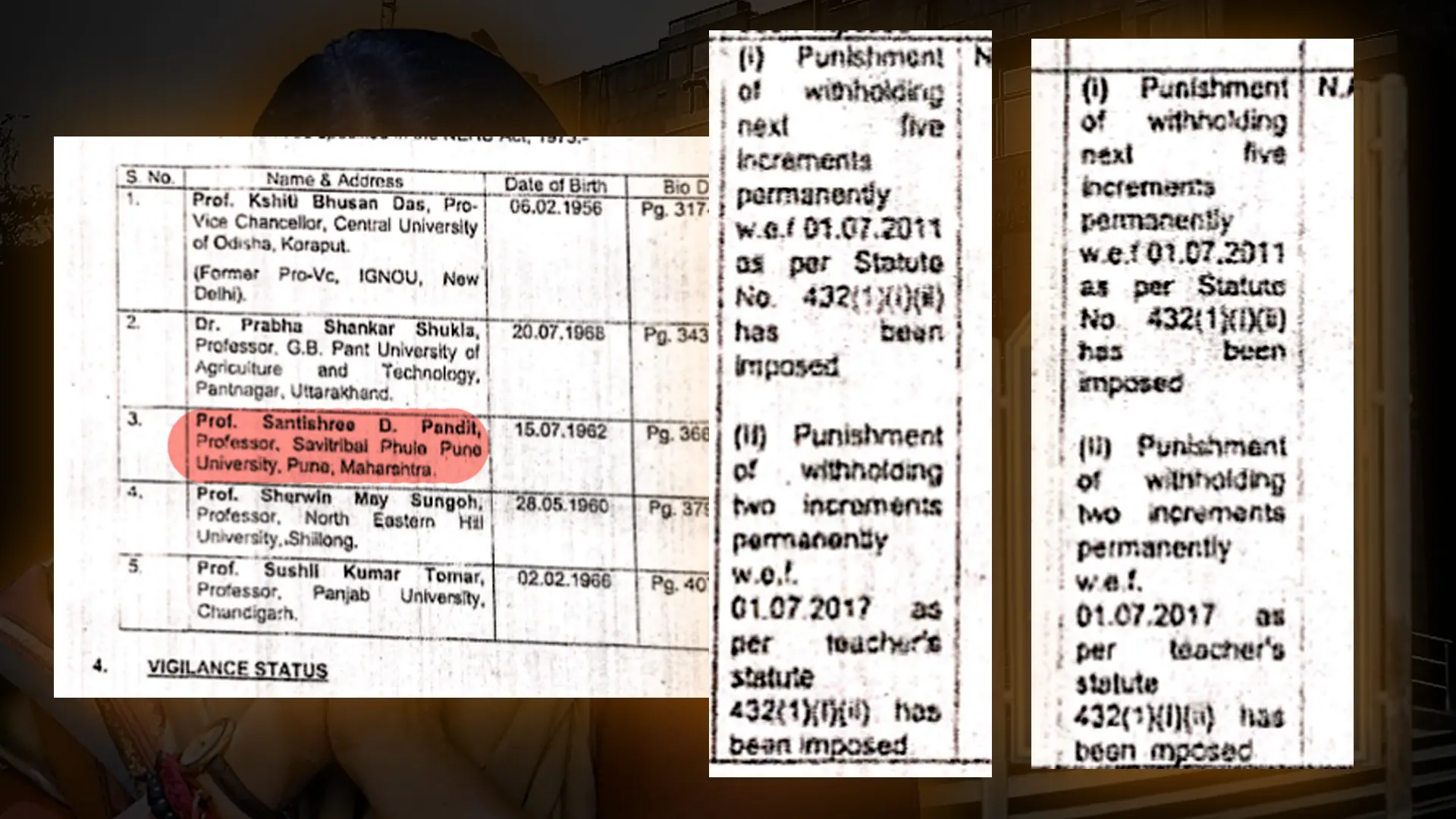
Pandit did not get the job. Surajit Mazumdar, former president of the JNU Teachers Association, believes her disciplinary record was the reason. “She was apparently excluded from consideration for NEHU’s VC position,” he said.
Just a year after being passed over at NEHU, Pandit was appointed VC of JNU.
Student and teacher bodies, media reports and even political leaders have publicly questioned whether the central government and its selection mechanism took the disciplinary proceedings at University of Pune into account when appointing her.
Maharashtra’s then higher education minister Uday Samant claimed that the vigilance report and related documents were sent to central vigilance authorities. He said that if those authorities cleared her despite the documented punishment, someone needs to answer for that, implying that clearance was given at the central level.
“When Prof Santishree Pandit came to our varsity as VC, despite it being known to us that she had been found guilty of misconduct at the University of Pune, and punished after disciplinary proceedings… we didn't raise this point for a long time,” said Mazumdar. They, according to him, chose instead to judge her by her conduct as JNU’s VC. But when in September 2025, her alleged “personal vendetta” led to illegal dismissal of a faculty member of the Centre for Political Studies, things changed.
“It is when that conduct went from bad to worse... we found ourselves forced to highlight that she herself had been found guilty of the sort of moral turpitude,” he said.
Under the JNU Act of 1966, the Vice Chancellor is appointed by the Visitor, a constitutional role held by the President of India. In practice, it is the central government that holds decisive influence over this process. The selection committee includes three members: two external members nominated by the JNU Executive Council and one by the president. Since the president also holds the discretion to reject any nominated member, the government’s preference tends to prevail.
In Pandit’s case, the composition of that committee raised further questions. The three-member search-cum-selection committee comprised KK Aggarwal, current Vice Chancellor of South Asian University; Yogendra Narain, a retired IAS officer serving as the President’s representative; and Ashok Gajanan Modak, an academician and former national president of the ABVP – the student organisation affiliated with the RSS.
The search for a new VC began in September 2020, during the Covid-19 pandemic. According to minutes of the meeting accessed by The Collective, a Zoom call of a VC-appointed committee was held in which six names were suggested for the search-cum-selection committee. But when JNU’s Executive Council met to finalise the two JNU-nominated members, the decision appeared already made.
The only three elected faculty representatives – of the council dominated by nominated members – formally dissented.
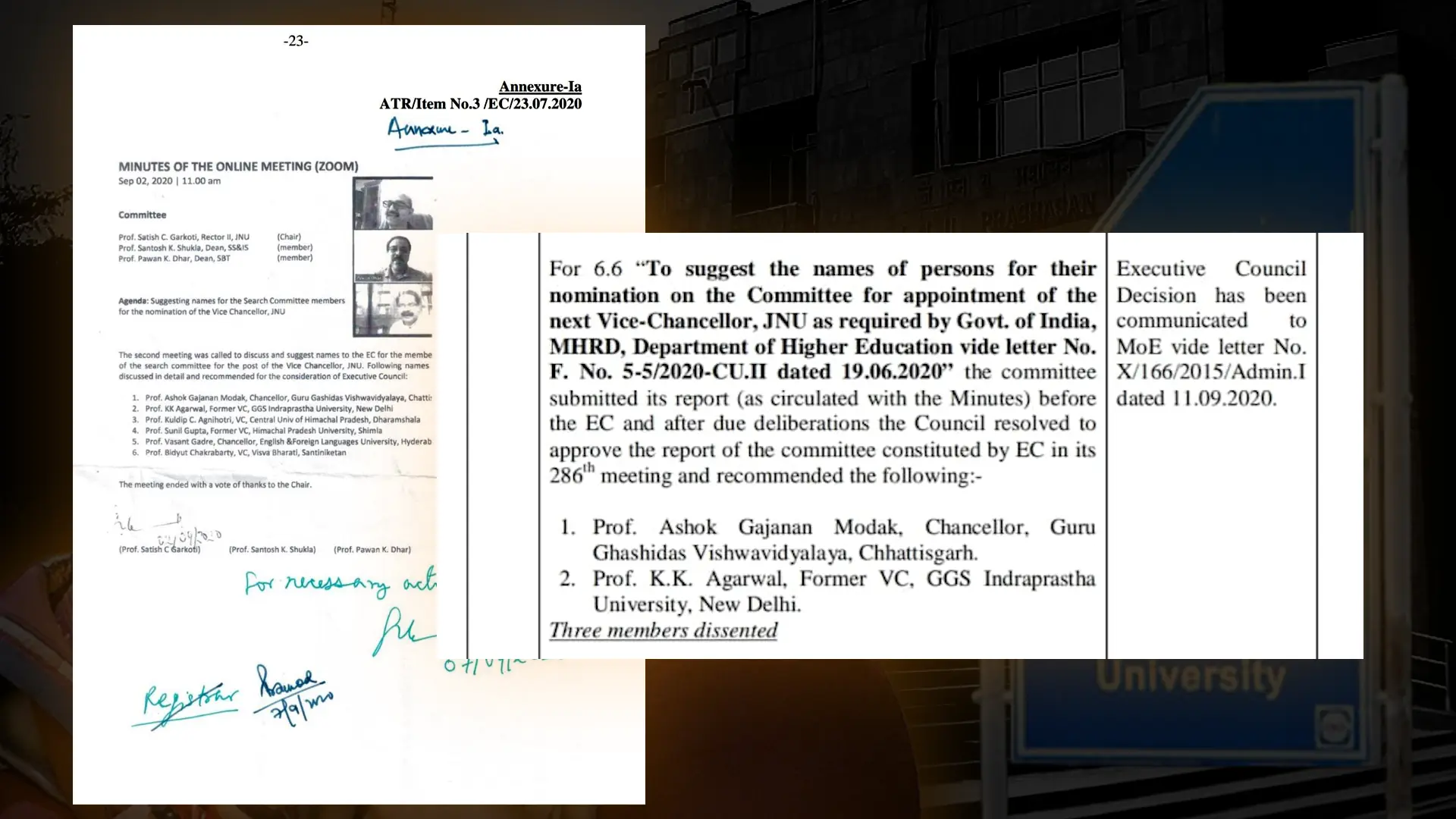
“The video meeting in which JNU administration proposed the first six names for the selection committee was very sudden which the rules do not permit,” said professor Moushumi Basu, one of the dissenting members. She later wrote to the JNU Registrar that the discussion “was sprung on members as a surprise” and that “by not allowing members to suggest new names, the scope for an open discussion on (the VC appointment) was compromised” – a convention, she implied, that had not been followed.
When this reporter asked Aggarwal – one of the two JNU-nominated members – whether he had seen Pandit’s vigilance report from the University of Pune before recommending her, his answer was unambiguous. He had not. Had he seen it, he said, he would have considered it.
Both JNU and NEHU are central universities established by Acts of Parliament – in 1966 and 1973 respectively. Their procedures for appointing a VC are nearly identical, with the President of India holding formal authority, though in practice the central government steers the process.
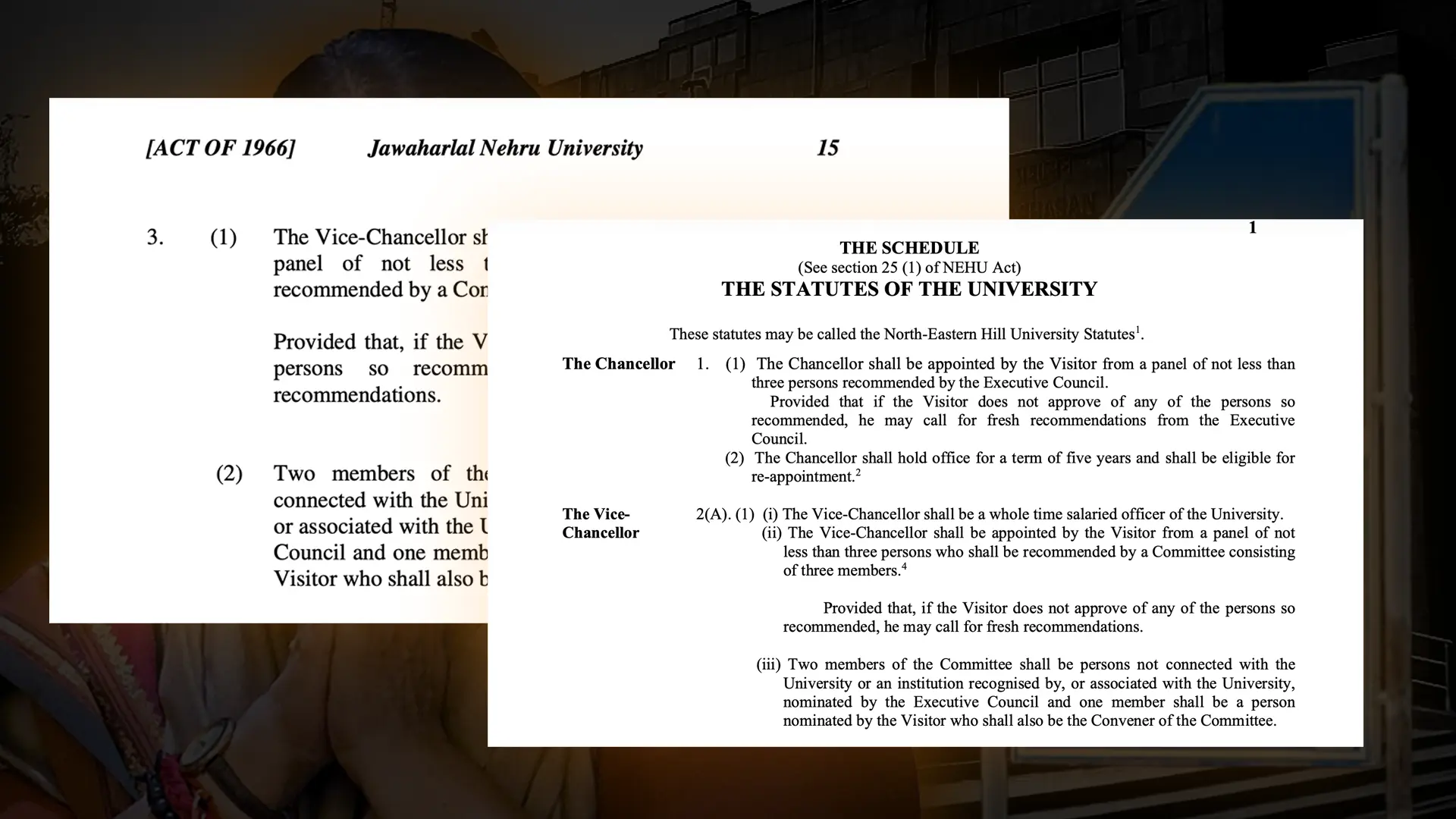
So how did the same record that potentially weighed against her appointment at NEHU clear her path to JNU just a year later? Differing opinions appear within JNU’s student and teacher groups.
The reasons behind these decisions could not be independently verified. The Reporters’ Collective has sent detailed questionnaires to the registrars of all three universities seeking answers about her rejection at NEHU and her appointment at JNU. This story will be updated when responses are received.