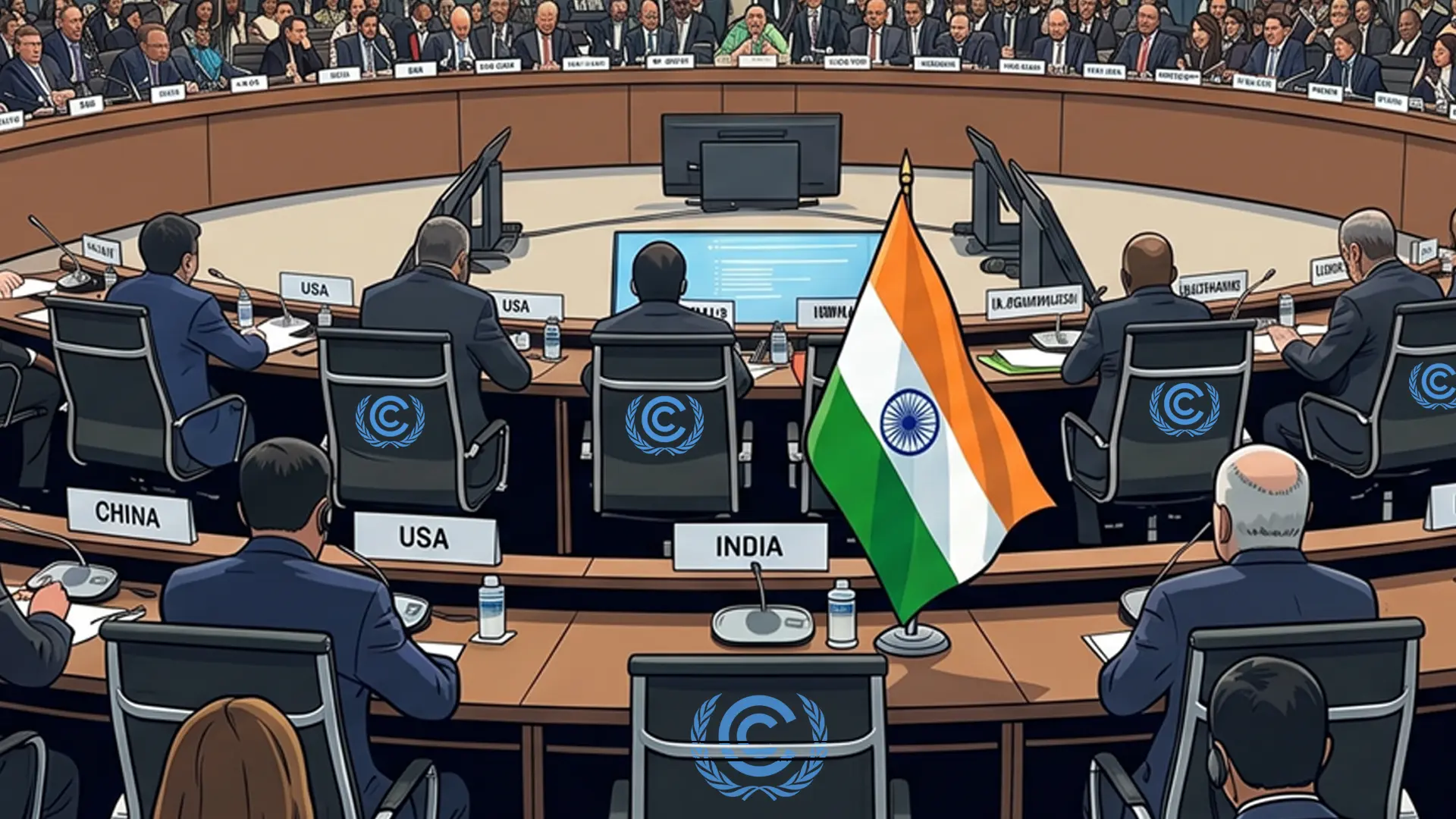


New Delhi: For the first time in decades, India has skipped the critical United Nations climate negotiations that opened on June 8 in Bonn, Germany. The Indian delegation was set to attend the negotiations, with logistics in place, when the Union Ministry of Environment, Forests and Climate Change, which leads the Indian delegation, pulled the plug.
Most people only hear about the high-octane Conference of Parties (COP) that happens at the end of the calendar year and is attended by ministers and heads of states along with an entourage of diplomats. It is the highest decision-making body of the United Nations Framework Convention on Climate Change (UNFCCC). The Subsidiary Body (SB) Sessions, such as the one that began on June 8, are the technical sessions where issues are advanced and deals get locked.
To put it simply, a COP is where deals are announced. SB sessions are where deals are actually built, line by line, clause by clause, often late into the night. India won’t be physically present this year when these deals are cut.
It has instead decided to attend the negotiations virtually, from Delhi, a handicap that could hurt the country’s economic interests.
The SB session negotiations are held through multiple tracks that run in parallel through two weeks. Through these multiple tracks of negotiations, countries agree to large parts of the ‘package’ which political leaders then sign on at the COP at the end of the year.
The process entails many discreet bilateral and group meetings between key countries, informal meetings and negotiations that are required at short notice, to settle a bargain that agrees with the powerful groups and countries. A virtual presence at these meetings, even when possible, diminishes the chances of a country to strike the bargains.
The negotiations this year at the SB session are to decide on areas crucial to Indian economic and energy security.
“We heard that India may not participate in person. If this is true, that would be most unfortunate given India’s leadership in this process in the past. We hope the circumstances in the country allow it to attend COP31 in person,” said a developing country negotiator attending the climate talks in Bonn.
We sent questions to the Union Environment ministry asking why the government had decided not to send the delegation of diplomats to attend the negotiations in person. The copy will be updated when we receive a reply.
{{cta-block}}
Fossil Fuels
One of the key tracks of recent climate negotiations that India has strongly engaged and intervened in is the roadmap to phasing out fossil fuels. This is to be advanced at the ongoing SB sessions.
India was one of the countries that argued against a uniform phasing out of fossil fuels. It has emphasised that phase-out of fossil fuels must be driven in balance with rich countries making the committed resources available for a green shift for developing countries. It calls for a plan which is not ignorant of national realities and is rooted in ensuring energy security. This prevented a lopsided decision in the previous rounds of negotiations that forced climate change mitigation measures on large developing economies while letting the rich nations off the hook.
In April, as part of climate goals (Nationally Determined Contributions) communicated to UNFCCC for 2031-2035, India promised to achieve about 60 percent of its installed power capacity from non-fossil fuel-based energy resources by 2035. It also committed to reducing emissions intensity of its GDP by 47 percent from 2005 level, and creating a carbon sink of 3.5 to 4.0 billion tonnes of carbon dioxide equivalent through forest and tree cover as compared to the baseline year of 2005. India has already achieved 52.57 percent non-fossil fuel capacity in February 2026, which is something it had targeted as part of its NDCs until 2030.
With Australia, a country that usually negotiates as a pack with the US, Japan, and Canada, being the president of the climate negotiations this year, India and other developing countries have been cautious of the talks turning one-sided and accelerating disproportionately on the phase-out of fossil fuels while slowing down on areas of interest to poorer nations. While Australia is the president of the negotiations at COP31, it is being physically hosted by Turkey in Antalya, from 9 to 20 November later this year.
While presidents are expected to play the role of a neutral facilitator at the climate talks, countries remain alert to biases and inclinations of the countries at the helm holding enough discretionary power to shape the agenda and the substance of the negotiations.
Some of this balancing of interests emerges from emergency informal parleys, responding at short notice to emerging negotiating texts during the negotiations. India often parleys with other like-minded countries to establish common ground for protecting its interests.
Countries cannot back out of decisions taken at these talks using excuses of lack of presence in the rooms.
The Just Transition Operation
The other piece of negotiations that India has a large stake in is the operationalisation of the Just Transition Mechanism. This track is to decide what kind of support countries like India would get when they transition away from fossil fuels like coal, an industry on which millions of workers are dependent as of today. The mechanism was established earlier, but now its governance and running have to be decided. India has been keen that this mechanism runs in a fashion that is not intrusive – giving other countries leverage and rights over its domestic issues.
Again, this time at Bonn, the meeting is set to flesh out the details and recommend a draft decision which will be undertaken at the end of the year by ministers and heads of states.
Draft decisions, once set in place, are difficult to counter at the COP. Some leeway exists in negotiations to bargain for the final chips, but substantive additions or deletions at the last moment, expending one’s diplomatic heft in undoing damage in draft decisions, depletes a country’s negotiating space on other counts.
Therefore, while the SB sessions remain less visible to the world, countries fight hard to make sure the draft decisions sit as close to their national interest as possible before ministers are brought in at the COPs to reach the finishing line.
The decision to not travel to Bonn follows India’s decision to pull out of hosting the climate talks. In December 2023, at the Dubai Climate Summit, Prime Minister Narendra Modi announced India’s plans to host COP33 in 2028. However, a couple of months ago, in April 2026, India cancelled its plan to host the annual global climate conference.
Union ministry for environment, forests and climate change responded on 7:17 pm, June 8, 2026:
The Indian delegation comprises officers from various Ministries and Departments, including scientists from the MoEFCC. A team comprising diplomats, Ministry officers and climate experts are attending the Subsidiary body meetings of the UNFCCC/Paris Agreement physically, while other delegates are attending the same virtually. This arrangement has been put in place to ensure India's effective participation in all negotiations.
The Reporters' Collective response:
The MoEFCC's response hides the fact that only one official from India, that too from the finance ministry, is attending the climate talks in person. A diplomat from the Indian embassy, already posted in Germany is the other one attending in person. It is unprecedented that the the Indian diplomatic team leadership is attending the talks remotely. This decision was take by the MoEFCC to cut costs.