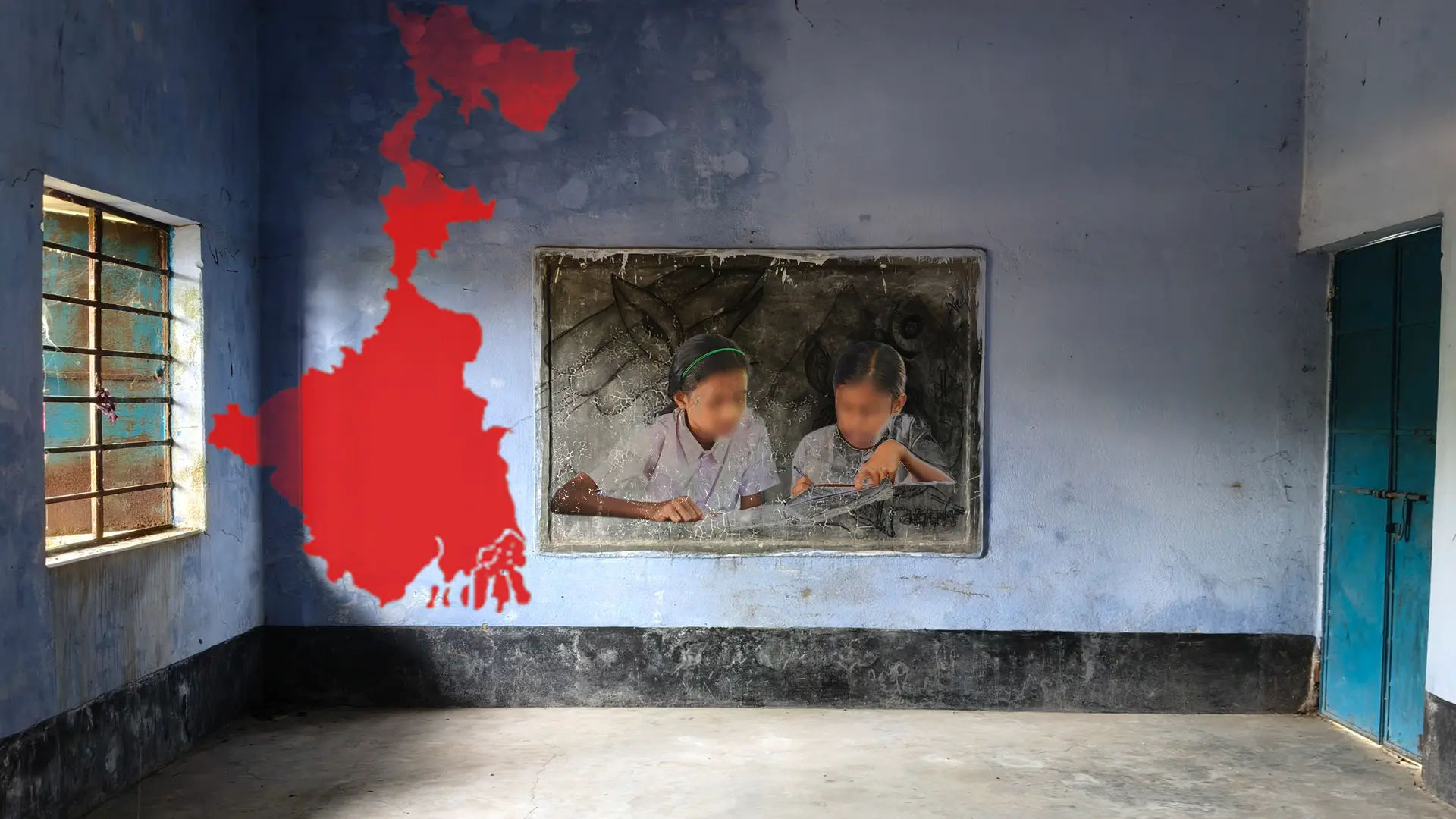


Bankura: Deep inside the Adivasi-dominated jungles of western West Bengal, a government high school in Ranibandh is running on just five teachers. The Government Model High School here caters to students from classes six to twelve. The school staff blame the infamous cash-for-jobs scam for the paucity of teachers.
On April 22, 2024, appointments of 25,735 teachers and school support staff, recruited in 2016 through the West Bengal School Service Commission (WBSSC), were cancelled when a division bench of the Calcutta High Court found the entire recruitment process riddled with corruption. The fallout triggered a domino effect that has since emptied classrooms across villages and small towns of the state.
A year later, the Supreme Court upheld the high court’s decision. The investigation into the case revealed several irregularities, including irregular appointments, rank jumping, and the destruction of physical OMR sheets – answer scripts that could have separated genuine candidates from those who had bribed their way in. Thousands of people who had secured their teaching jobs on merit lost them alongside those who had not.
The cancellations came on top of a halt in SSC recruitments since 2016, when the first petition was filed, creating a backlog that left schools like the one in Ranibandh with only a skeletal teaching staff, instead of the mandated minimum of eight teachers.
The ripple effects reached student enrolments too. Sixteen-year-old Sunil Mahato was studying at the Ambikanagar Government School in Bankura’s Ranibandh when the court order came into effect. With teachers and other staff gone, classes began getting cancelled for days at a stretch, without notice. Mahato’s parents eventually stopped sending him to school.
He was not alone. Shefali Shabar, 16, dropped out of Dhanara High School in Ranibandh last year after eight of the school’s teachers lost their posts following the court order. Holudh Kanali High School lost three teachers, Dabri High School four, and Rudra High School five. The same story repeats across public schools in Bankura.
The Reporters’ Collective reviewed documents from state’s school department and the All Bengal Teacher’s Association, combined with field visits to at least 25 schools in Bankura district in November 2025 and March 2026, to assess the impact of the corruption case. The pattern points to a systemic crisis in government secondary and higher secondary schools across West Bengal, one that traces back directly to the 2016 WBSSC appointments and the nine years of recruitment paralysis that followed. Reports have captured similar patterns in other districts. The ongoing crisis is reflected starkly in student numbers. For 15 years, an average of eight lakh students appeared for the higher secondary examination in West Bengal every year. In 2025, that number fell to 4.82 lakh.
After the apex court’s judgment, then Chief Minister Mamata Banerjee publicly criticised the decision. Over 11,000 of these teachers were teaching students of classes nine and ten, she told reporters, and nearly 5,600 were posted in classes eleven and twelve.
“Who will now teach these kids? Is BJP-CPM trying to trigger collapse of state’s education system?” she had asked, but stopped short of explaining why her government had left WBSSC recruitments frozen for nine years.
Defeated in the recently concluded state assembly elections, Banerjee’s party is out of power. The burden of undoing the damage caused by the corruption scandal now falls on the new BJP government led by Suvendu Adhikari, the new chief minister.
{{cta-block}}
The Initial Shock
The West Bengal School Service Commission (WBSSC), the government body that recruits teachers for state-run schools, last held a regular recruitment drive in 2016. What followed was not just a prolonged pause in hiring, but a scandal that would land the Banerjee government’s education minister in jail and eventually reach the Supreme Court.
After initial allegations in 2016, many petitioners approached the court in 2021-22 accusing the WBSSC of irregularities in the recruitment process. The anger about deserving candidates getting bypassed, as public teaching jobs were handed out in exchange for bribes, spilled onto the streets. And, what began as a recruitment dispute snowballed into a high-profile corruption case that pulled in politicians and sparked a long legal battle.
With no way of verifying who had genuinely qualified – the physical OMR sheets had been destroyed on an internal WBSSC order in 2019, in violation of its own rules – the Calcutta High Court’s division bench declared all appointments invalid, directing those appointed to return all salaries and benefits received.
For teachers who had secured their jobs on merit, the ruling offered no relief.
The state failed to fill in the void, halting fresh recruitments for nine years, between 2016 and 2024. Public schools that lost teachers to retirement, transfers and the court ruling, had no pipeline of replacements. To address the backlog, the Supreme Court directed fresh recruitment for 35,726 vacant teaching positions, which the state conducted in 2025.
Even that number, large as it is, is widely seen as insufficient to make up for nearly a decade of inaction.
Bikash Ranjan Bhattacharya, senior advocate and former mayor of Kolkata, was among those who argued against the state, on behalf of the petitioners, in the WBSSC corruption case in the high court. He was direct about the consequences.
“The last couple of years have seen a major drop in students from high schools. The SSC recruitment halt created a crisis of teachers, and the cancellation of jobs made it worse. The crisis has damaged the entire framework of public education and denied access to schooling for scheduled tribe and scheduled caste communities,” he said.
A Crumbling Education System
To understand why teacher shortage hit so hard, it helps to understand how public schooling in this part of West Bengal was designed – and what public sector jobs mean here.
In a state with few industries and very little private employment, government jobs are one of the few reliable paths to security and out of poverty. WBSSC recruitments are seen exactly as that, a stable, aspirational opportunity. It is through WBSSC, the government acts as one of the highest recruiters in the state. And when this pipeline collapsed, the damage extended well beyond the teachers who lost their jobs.
Jangalmahal, a tribal-dominated belt spread across the districts of Bankura, Purulia, and Paschim Medinipur, is a forested, hilly region where villages are often separated by nine to twelve kilometres. Not every village has a high school. The public education architecture here was built to bridge this distance.
.webp)
Starting in the Left front era, in the late 1990s, the state set up two kinds of what acted as small feeder schools in villages, Sishu Siksha Kendras (SSKs), covering classes one to four, and Madhyamik Siksha Kendras (MSKs), covering classes five to eight. These schools were established close to villages, within two to three kilometres, functioning as stepping stones, funnelling students towards high schools located further away.
For around two decades, the system worked. Between 2006 and 2020, an average of over eight lakh students appeared for secondary and higher secondary examinations every year in West Bengal. The feeder school network, education experts say, was a significant reason for those numbers.
That pipeline which brought students to high schools is visibly breaking down. In 2025, the number of students appearing for higher secondary examinations fell to 4,82,948, the lowest on record, and about half the annual average of the preceding decade.
“The major reason for the decline of students has been the crisis of teachers,” said Animesh Pain, head of the All Bengal Teachers’ Association, a state-level teachers’ union. “It started rising with the WBSSC recruitment halt and hit its peak with the corruption that cancelled standing jobs of teachers. The crisis has impacted the setup of small [feeder] schools that had, until now, contributed to keeping higher secondary numbers up.”
Missing Teachers, Empty Classrooms
The scale of the crisis had a paper trail, even if an accidental one.
In early 2023, while the WBSSC corruption case hearings were under way, a document listing 8,207 schools across West Bengal – nearly 10% of all government-run schools – with critically low enrolment began circulating online and on social media. These schools reportedly were identified for closure. Of the 8,207, 886 were in Bankura alone. Multiple reports at the time identified it as a state school education department document, with some reporting that it had been uploaded to the department’s official Banglar Shiksha portal before being taken down. After the list went viral, then Education Minister Bratya Basu denied that any schools were being closed. The department or the minister, however, never officially acknowledged the document. But for those who worked in the Jangalmahal belt, the numbers came as no surprise.

Most of the schools on that leaked list are not urban institutions with alternatives nearby. They are the feeder schools, the SSKs and MSKs, in remote villages. The decline in their enrolment is not a story of parental preference, rather a story of classrooms that no longer have enough teachers to hold a full school day.
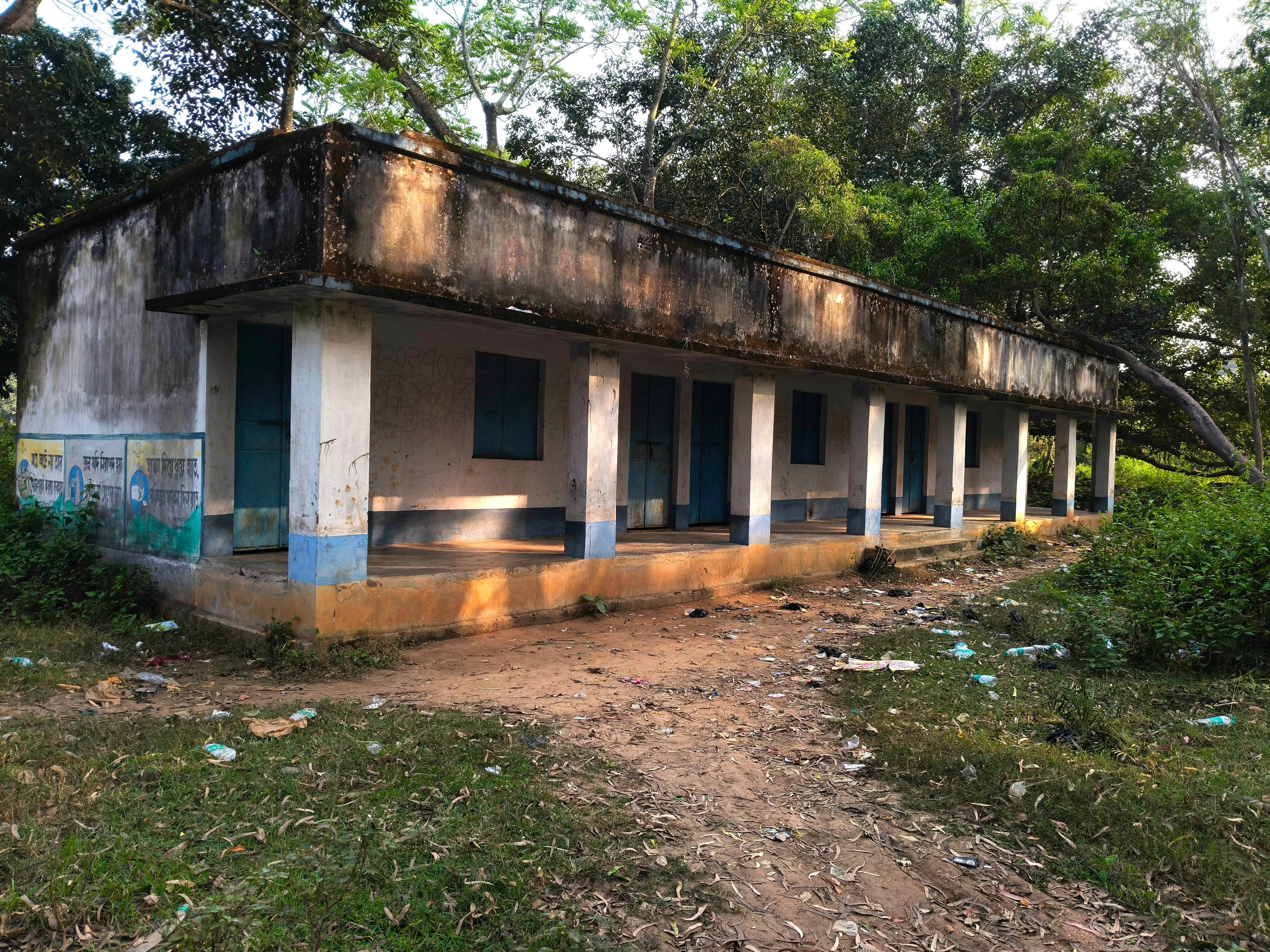
The Collective visited at least 25 schools across Ranibandh block in Bankura. Many were simply locked and shut, others, like the Pandit Raghunath Murmu Secondary School, had abandoned classrooms filled with trash or were crumbling.
At Bethuala Junior High School, 23 students share two teachers for eight subjects. A few years ago, the school had 150 students and the mandated minimum of eight teachers. One of the two remaining teachers, Habugopal Mondal, recalled a visit from a government official some months back. “When I reported about students dropping out, the official told me to go house-to-house to motivate students,” he said. When asked whether he did, Mondal replied: “Do you think parents will send their children to schools with just two teachers?”
A similar story repeats in Dhakidihi Junior High School. Enrolment has fallen from over 200 students to just 25. The school sits inside a scheduled tribe settlement and is the only school within six to seven kilometres. There is nowhere else for these children to go.
.webp)
In many of these schools, teachers have been pushed to teach subjects outside their expertise. At Bhulagara Junior High School, two teachers and one Group D staff member run the entire school. Even the Group D employee, hired for administrative and support work, has had to step in to take classes. The nearest alternative for students here is ten kilometres away.
“Students have stopped coming to schools,” said Jaganath Khan, a school teacher and district head of the All Bengal Teacher’s Association in Paschim Medinipur. “The crisis of teachers has directly impacted student enrolments.”
It is no different in the Jangalmahal belt of Purulia. Byomkesh Das, the district head of the Association there, said numerous schools there are not functioning properly. “At a time when families have lost motivation towards education, the state has taken no initiative to spread awareness,” he said.
The general secretary of the Bankura district unit of the Association, who spoke on condition of anonymity, was more specific. “Bankura is one of the worst-affected areas, with schools running on completely uneven student-teacher ratios,” they said.
According to the latest UDISE report for 2024–25, West Bengal is among the poorest performers in the country on pupil-teacher ratio. The Union Education Ministry mandates a ratio of 30:1. In some schools in the state, the ratio has reached 60:1, twice the recommended figure.
An email sent to the state education department and the commissioner of education seeking a response has not been replied to.
There Is No Alternative
The collapse of government schooling might have pushed parents to seek out private schooling elsewhere in West Bengal. In Jangalmahal, that option barely exists.
West Bengal already has one of the lowest shares of private school enrolment in the country, at just about 4.3 percent, according to the Education Ministry. But within the state, the numbers are not consistent across regions. Siliguri in north Bengal has a private enrolment share of 22.5 percent; Bankura’s, in comparison, is 4.7 percent, among the lowest in the state, according to data from the Central Square Foundation.
Private schools follow economic opportunity. The Jangalmahal belt is rural, remote, and economically weak. There is no market for private education here. Families depend entirely on government schools. When those schools stop functioning, children stop studying.
.webp)
Madhusudhan Mahato, a researcher based in Ranibandh, has watched this play out in his own neighbourhood. “The West Bengal education sector is majorly dependent on government schools,” he said. “Lack of it snatches access to education from tribals and scheduled castes. Some families are able to send their children to private schools. Those who cannot are dropping out or moving out of the state.”
The dropout crisis in Jangalmahal is not only about children stuck at home. Research suggests it is also a reflection of a migration wave out of the state.
A study by academicians Rajkumar Ghosh and Shibshankar Mal on rural labour migration in the Jangalmahal belt of Bankura found that 62 percent of migrants from the region were below the age of 20. Of those, 47.1 percent had studied only up to the primary level and 15.5 percent up to secondary; barely 1.4 percent had studied beyond that. Separate research points to lack of access to education as the contributing reason behind increasing dropout rates. The pattern is consistent: the further a child gets in school, the less likely they are to leave. The teacher shortage is cutting that journey short.
An ongoing study by Sabar Institute, focused on the Paskura area in Paschim Medinipur, goes a step further. Researchers found the primary driver pushing students – particularly boys – out of school and into migration for work is the absence of economic opportunity after education.
“Even after finishing their studies, students are not finding work that justifies the years spent in school and the cost of not earning during that time,” said Ashin Chakraborty, a researcher on the project.
The WBSSC recruitment was, for many young people in this region, an answer to that problem. With few industries and little private employment, a government teaching job was one of the most reliable paths out of poverty. The scam didn’t just cancel nearly 26,000 appointments. In Jangalmahal’s remote areas, it cancelled an aspiration.
The political cost of dismantling this system has since been paid. Corruption cases, like the WBSSC recruitment scandal, dominated public discourse in the run-up to the state assembly elections and became a part of the BJP’s anti-incumbency campaign against the Mamata Banerjee government. Suvendu Adhikari, the new chief minister, has cleared CBI action in the recruitment corruption cases. While he promises swift action against corrupt officials, his government faces a harder task, of bringing children back to classrooms, emptied on his predecessor’s watch.