.avif)
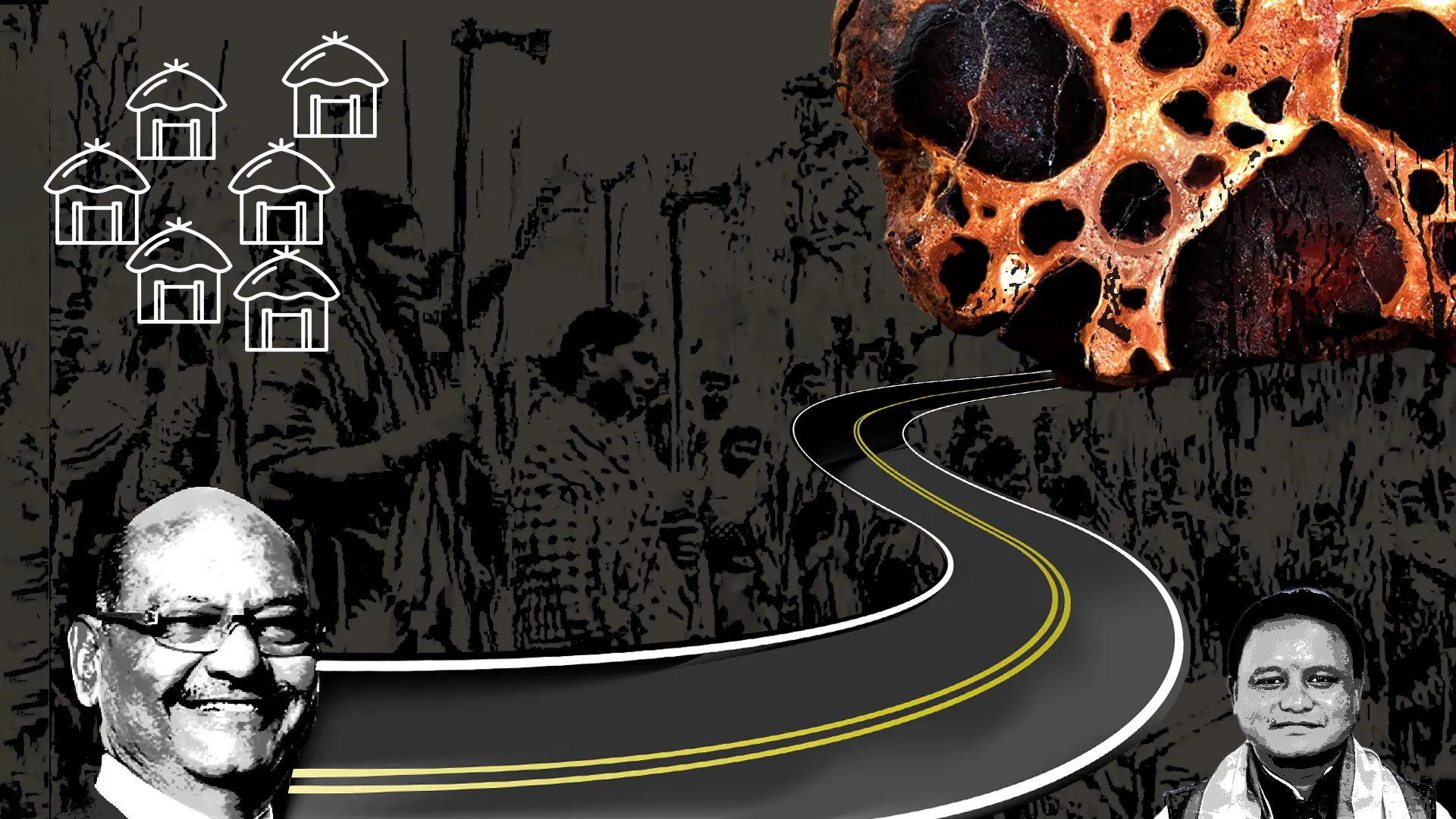


Editor’s Note: Recently videos went viral of tribals and dalits protesting against a road Odisha government claimed it was building for them. Some were arrested, and asked to clean the police station as part of their bail condition. Were those protesting anti-development? Or did they know something, the rest of India didn’t? In this part of the series, we reveal the tricks Odisha used to help Vedanta circumvent green laws, in the name of its people.
New Delhi: Tension hung over Odisha’s Sijimali hill last month. Bulldozers had moved in to clear a three-kilometre stretch of forests amid heavy paramilitary presence. The hill sits atop one of the largest bauxite reserves in the state. The government had been eyeing these reserves for years.
The Odisha government had already taken special steps to fast-track the bauxite mining project. Working with mining conglomerate Vedanta Limited, it split a single mining project into two separate projects, getting it the much sought access to Sijimali, located around 450 km from Odisha’s capital Bhubaneswar.
Revered by the Dalit and Adivasi communities from surrounding villages of Sijimali – locally called Tijmali, the abode of their god, Tij Raja. They were angry at the development, clashing with the local police and paramilitary forces deployed there.
This is the second of the two stories about southern Odisha’s bauxite belt. In Part I, The Reporters’ Collective had shown how the Odisha and Union government worked together, misrepresented facts and hid the truth to delete a portion of a wildlife sanctuary and elephant corridor and make bauxite mining, a bauxite belt Vedanta has been interested in for many years. In this second part, the story tracks how the state enabled a mining company to quickly set up a bauxite mine and jump through regulatory hurdles to clear forests.
Documents obtained by The Collective show that Vedanta’s own regulatory filings described the mine and its access road as a single integrated project. But when the time came for forest clearances, Odisha state’s infrastructure agency helped Vedanta split the project into two, taking over the access road as a “standalone linear project” with lighter scrutiny. The Union Ministry of Environment, Forests and Climate Change saw through the argument, then approved it anyway. Months later, bulldozers rolled in.
As per the new plan, Odisha government’s industrial agency, Odisha Industrial Infrastructure Development Corporation (IDCO), applied for the forest clearance for the access road as a separate project, distinct from the original mining plan, with the Environment ministry. IDCO later called it a non-mining project to serve a “broader purpose” of connecting five villages.
This justification found no takers. One village turned out to be uninhabited, in another village residents would soon be evicted. The ministry, while deliberating forest clearances, did not buy into this characterisation of broader purpose. The smaller ‘IDCO’s road project’ was granted conditional approval by the ministry alongside a Stage I forest clearance for Vedanta’s mine.
Now that it was classified a non-mining project, IDCO could begin clearing forests immediately for the road, a fast-track privilege legally denied to mining projects.
Vedanta secured the Sijimali mining lease in 2023, unlocking access to an estimated 311 million metric tonnes of bauxite ore. But the road to the mine, literally, has been contested at every single step.
Local villagers immediately moved against the mining company in the Odisha High Court in December 2023, against what they called fabricated consent orchestrated by Vedanta in their Gram Sabhas. The court closed the case with a direction to the Union government to simply take their complaints into account.
And when the state attempted to clear the forests last month, angry villagers came out in protest. Many were detained, leading to a much criticised High Court order where they asked detained villagers to clean the premises of a local police station as a bail condition.
{{cta-block}}
A Sudden Change of Plans
Sijimali sits roughly 13 kilometres south of the Karlapat wildlife sanctuary, right at the edge of the sanctuary’s Eco-sensitive Zone(ESZ) .Under environmental protection laws, mining is prohibited within the ESZ of a sanctuary. While several bauxite blocks fall within the ESZ with significant mining interest, the government has dragged its feet in releasing the final coordinates of this protected zone. In Part I, we showed how along with redrawing the boundaries to carve out bauxite reserves, the Union government prompted Odisha to propose its changes to ESZ as well.
At least since 2012, Vedanta Group founder and chairman Anil Agarwal has been lobbying the state government to open its bauxite reserves for mining. Vedanta operates the country’s largest alumina refinery in Lanjigarh, located in the neighbouring Kalahandi district. It sits close to the bauxite belt that holds both Karlapat and Sijimali, blocks strategically located to supply raw ore to the refinery.
Vedanta was officially declared the “preferred bidder” for the Sijimali mining lease in February 2023.
Winning the bid, however, did not mean Vedanta could start mining immediately. It still had to clear several regulatory checks to get a nod from the Environment ministry to start clearing forests.
It is a long-drawn process. This requires the mining company to disclose the environmental impacts of its activities to the ministry and the public, submit detailed proposals to mitigate ecological damage and compensate for the loss. Only then does the Environment ministry grant forest clearances for the project.
To understand how the state helped Vedanta circumvent these hurdles, it helps to know how forest clearances are given. It happens in two stages. A conditional ‘stage 1 clearance’ is given when the applicant fulfils strict compensatory conditions. After verification, the ministry gives an absolute permission called ‘stage 2 clearance.’
Under forest conservation rules, felling of trees for mining can only begin once both stages of clearances are given by the ministry. For non-mining projects, like a road, cutting of trees even on a conditional stage 1 nod is allowed, if the state government passes an order.
But the rules are clear. Any initial access road constructed for a new mine must be treated as part of the mining project itself. The applicant is legally required to apply for the road and mine clearances together, as a single package.
This is where Vedanta’s plans take a turn. The initial plan, made public in September 2023, declared its intent to apply for forest clearance for the new mine and the access road together.
But when Vedanta formally applied to the Union government for the permission to divert more than 700 hectares of forest land for the mine in June 2024, clearance request for the access road was missing.
Seven months later, IDCO submitted a separate application with the ministry requesting clearance of nearly five hectares of land for a 3.4 km road.
In the draft environmental impact assessment (EIA) report submitted in September 2023, Vedanta stated, on three separate occasions, that its ‘project’ was an integrated venture that included both the mine and the access road. Vedanta clearly mentioned that it would acquire the land for the road and had identified itself as the main agency responsible for constructing it.
In that proposal, the road was 7.5 km long, running from the north-west of the mining area to state highway SH-44, passing through Rayagada district. It would be the primary route for transporting bauxite ore.
By December 2025, when Vedanta submitted its final EIA to the Environment ministry, the plans had changed completely. The road was now 3.4 km, starting further south of 7.5 km road proposed earlier. And this time, IDCO would apply for its forest clearance.
The report stated that, “the Company [Vedanta] will construct a road of 3.4 km from NW site of mine area which will connect to the SH-44 (Owner of the Road shall be PWD). For the same forest diversion proposal is submitted for an area of 4.911 hectares…….by IDCO.”
.webp)
By splitting the proposal, Vedanta effectively orchestrated some degree of separation to distance itself from the access road. A single process was turned into three distinct pieces: the Public Works Department took ownership of the road, Odisha’s industrial authority (IDCO) acted as the proxy to secure the forest clearance, and Vedanta, the mining company, would construct the road with IDCO’s permission.
About four months before the final EIA report was submitted, IDCO had already given Vedanta a go-ahead to build the new road. In January 2026, IDCO received a conditional nod from the Environment ministry to clear the forest. The same month, records show, Vedanta deposited Rs 1.6 crore in state funds for compensatory afforestation, on IDCO’s behalf. In April, forces and bulldozers had moved on to the Sijimali hills to begin clearing the forest.
In Public Interest
Under forest conservation laws, the Environment ministry can place matters of forest clearance in front of the Forest Advisory Committee (FAC), the gatekeeper on Indian forests.
The FAC considered both Vedanta and IDCO’s forest clearance requests together, since the two projects were related. As the FAC deliberations started, a site inspection report from the Environment ministry recommended considering “the access road in conjunction with the Sijimali Bauxite mine project” to appraise the two together.
The Collective reviewed the minutes of these FAC meetings on Sijimali that took place from July 2025 to January 2026.
In the first meeting, held on 30 July 2025, the FAC requested the Odisha government to reexamine its proposal, because as per the forest conservation rules IDCO’s road should be treated as part of Vedanta’s mining project.
In response, Rayagada Divisional Forest Officer told the committee that IDCO had acquired this land on behalf of the Public Works Department, whose mandate it is to build public infrastructure. This road, he argued, was not exclusively for the mine, but served a broader purpose. With the PWD ownership of the road, the Odisha government made a case that this was being done in public interest.
.webp)
“PWD road will significantly improve connectivity for five remote villages – Dumerpadar, Porlang, Sagabari, Bichapinda, and Malipadar – which currently have no road access to the valley and the mainland. These villages, with a combined population of approximately 1,500 residents, face serious hardships due to the lack of road connectivity, especially in accessing healthcare, markets, and essential services,” the DFO claimed.
The Collective, with help from local activists, located all five villages. None of them were close to this road.
One of the villages, Malipadar, falls well within the Sijimali mining block which will be mined by Vedanta. Therefore, soon this village will cease to exist, as villagers are evicted once mining begins.
The other four villages of Porlang, Bichapinda, Sagabari and Dumerpadar are much closer to the state highway, than to the IDCO planned road. Of them, two villages, Sagarbari and Dumerpadar, have their own pakka road connecting directly to SH 44, meanwhile Porlang is at a walking distance from the highway. And as of the 2011 Census, Bichapinda village is uninhabited, as per local activists. The Collective could not independently confirm their current status.
.webp)
The government’s claim that the road will help villagers facing “serious hardships due to the lack of road connectivity” does not hold.
The Environment ministry was not convinced either. During the FAC meetings, the ministry flagged the large width of the proposed road. It said that “the specifications of the proposed road (width) indicate that it is primarily designed to support the movement of heavy vehicles.” They concluded that it was being done for mineral transportation and therefore even for a conditional green light, IDCO’s proposal should only be okayed after Vedanta’s mine proposal gets its conditional or Stage 1 nod.
On 31 December 2025, Vedanta received stage I forest clearance for the mine. Expecting an official confirmation soon, Vedanta wrote to IDCO on 12 December that it had received the conditional clearance for mining. In its letter, Vedanta pushed IDCO to “take necessary action on their end” for construction of the approach road. Later, on 5 January 2026, IDCO’s road project received its stage 1 clearance.
Armed with a conditional nod for the road, the Divisional Forest Officer gave a working permission to begin road construction on 27 February. The same office issued a tree felling permission on 26 March.
We sent detailed questions to Vedanta, DFO Rayagadh, IDCO, and the Union Ministry of Environment – they did not reply at the time of publication.
.webp)
What Happened in Sijimali
Soon after stage I clearances were granted to both the mine and the road, violence gripped Sijimali as the construction of the road became imminent.
By early March, local police reported that protests against the mine were intensifying. On 8 March, it claimed, a sizeable congregation of women had marched up to the mining site with traditional weapons chanting, “We won’t tolerate police atrocities, if they do, we will attack.”
A few days later, the local police at Kasipur reported that two activists were discussing strategies to oppose the mining activity with a jail bharo campaign to “overwhelm the local administration.”
Locals claim that on 3 April, 150 personnel including members of the local police, Odisha Special Armed Police forces and Central Reserve Police force came to the villages and announced that the construction of the approach road would begin immediately.
A prohibitory order under Section 163 of the Bharatiya Nagarik Suraksha Sanhita (BNSS), 2023, was imposed for a month, creating a 100-metre curfew zone along the road. During this period no one other than Vedanta officials, authorised contractors, labourers, and government officials could enter this restricted zone.
Assemblies and protests were also banned in this zone.
On the night of April 6, the zone turned into a flashpoint. According to reports, armed police forces surrounded the village of Kantamal, cut off electricity, broke down doors, carried out lathi charges, deployed tear gas and fired at protesters. As tensions escalated in the region, it caught the attention of local and national media. Over 23 villagers were detained. Both locals and police personnel were injured. Construction of the road has since been suspended.
On 5 May 2026, the Environment ministry granted final stage II clearance to IDCO’s road. Meanwhile, on May 27, Vedanta’s separate mining lease for its Sijimali bauxite project cleared another key regulatory hurdle after receiving the Expert Appraisal Committee’s recommendation for environmental clearance. This brings Vedanta’s proposal for diverting over 700 hectares of forest land closer to reality.
The splitting of the road project from the larger Sijimali mine project was placed before the National Green Tribunal on 27 February 2026. So far four hearings have taken place on this matter. The NGT is yet to give its verdict on the case.