.avif)


Editor’s Note: Odisha’s love for bauxite is being framed as its love for the tribal communities living on top of those bauxite reserves. The story caught the national attention when Dalit and Adivasi villagers rose up against the state’s attempts to access the bauxite reserves close to the Karlapat Wildlife Sanctuary, and in the process uproot their lives from these forests. Many were detained, and told to clean police stations. Our two-part series reveals how Odisha’s hunger for the ore led them to rework a wildlife sanctuary’s boundaries, with the national apex body on wildlife protection helping design a proposal to ensure future mining operations remain unhindered. Here’s the Part I of the series.
New Delhi: In 2023, the Odisha state worked with the Union government to strip bauxite-rich forest land of wildlife protection.
To make room for mining, the Odisha forest department applied to remove 4.32 square kilometres of land from the Karlapat Wildlife Sanctuary, a protected area in southern Odisha, about 450 km from the state capital, Bhubaneswar.
The application misrepresented the facts. The Odisha Forest Department claimed the forest land being removed was “degraded,” and under pressure from nearby villages and animals. It was clear the land was not being removed because of degradation.
Across two years of deliberations, the driving concern was always bauxite lying beneath the forest land. Pressure from people was merely a pretext.
The prime minister-headed National Board for Wildlife (NBWL), the apex body responsible for protecting India’s forests, did not push back. It went a step ahead instead, advising the state forest department to resubmit the proposal, this time factoring in all future mining ambitions. It asked the state to ‘rationalise’, or redraw, the sanctuary boundaries even better for mining.
The forests to the south of the Karlapat sanctuary are a critical migratory corridor for Asiatic elephants. They, too, walk and live right above multiple bauxite blocks.
The boundary changes to Karlapat, The Reporters’ Collective verified, have carved out at least two bauxite blocks. Blocks located further south, auctioned to private companies already, will also benefit from the changes in the sanctuary’s Eco-sensitive Zones (ESZ) following this ‘rationalisation’. We could not assess the extent of its impact because the government has not made coordinates of the new protected zone public.
This is the first of two stories about Odisha’s lust and longing for bauxite. The second will show how the same state government, working with the mining giant, Vedanta Limited, split a single mining project into two separate clearance applications, and then sent bulldozers to clear the forests and displace people. And did so claiming it would benefit the very communities it displaced.
Three bauxite blocks fall along the southern border of the wildlife sanctuary – Lingapadar, Karlapat and Kishanmali. All these blocks fall within the ESZ of the sanctuary.
Based on our analysis of the redrawn maps, we established that the Karlapat bauxite block, which lay beneath the sanctuary border, was opened for mining by redrawing the sanctuary’s boundaries. It also ensured another block, Kishanmali , fell further away from the sanctuary.

Further south from the Karlapat block, two additional bauxite blocks – Sijimali and Kutrimali – were recently leased out to private mining conglomerates, Vedanta and Adani groups.
Karlapat block is home to one of Odisha’s largest and highest-quality bauxite deposits. The plateau is spread across 3,113.25 hectares. Close to the sanctuary, these deposits face an ‘environmental conflict’. For the last two decades, the Odisha government has eyed mining these bauxite blocks. In 2004, state mining body Odisha Mineral Corporation applied for a lease to mine Karlapat and supply aluminium ore to Vedanta’s soon-to-be-established aluminium refinery.
Repeated attempts to open these blocks had been made earlier too. In September 2021, for instance, its bid to auction the Karlapat block to private players was struck down by the Odisha High Court.
A few months before the court order, the Odisha forest department had already drawn up a fresh proposal to mine these blocks. The department proposed to push the sanctuary borders “inwards” in two locations. Coordinates for the shift were not publicly disclosed, but it was clear the objective was to open up the bauxite blocks for mining.

This new proposal would make 4.32 square kilometres of protected land available for mining. In May 2023, the state government’s bid to redraw the boundaries was formally executed. But the process that enabled this began nearly two years earlier.
Odisha holds India’s biggest bauxite deposits – over 40 percent, and houses the country’s largest alumina refinery, owned by the Vedanta Group. Given the presence of bauxite reserves and refineries in the region, there is industry as well as political interest in opening up bauxite mining to the private sector, an agenda that former chief minister and BJD leader Naveen Patnaik pushed for. And the current BJP state government is taking forward.
{{cta-block}}
Tailor-Made for Mining
Under the law, removing land from a wildlife sanctuary requires sign-off from multiple authorities, at least at three levels. These checks include the local forest officer, the state wildlife board, and the NBWL.
The Supreme Court, the final arbitrator in this hierarchy, can overturn NBWL’s decisions. It did just that in the case of the Sariska Tiger Reserve in August 2025. The apex court pulled up NBWL for approving the redrawing of the reserve’s boundaries to facilitate marble mining. The court said the board was “acting like a post office” granting its nod in merely 48 hours. In Karlapat’s case, however, the court greenlit the rationalisation process.
Just as in the Sariska case, the NBWL’s Standing Committee approved the exclusion of sanctuary land in December 2022, the very area where bauxite blocks lay adjacent to the sanctuary.
But in Karlapat, the committee went a step further. While responding to the state’s plan, which had only made a passing reference to bauxite reserves, it made recommendations to factor in future bauxite mining and transportation of the ore.
The committee was clear that “the consolidated proposal has to be drafted in a manner to ensure future mining development does not have impact on the Sanctuary.”

First brought before the committee in September 2021, the committee guided the Odisha Forest Department to tailor its proposal in a year-long deliberation process.
The committee also made a recommendation with wider implications. It asked the state to also consider future mining leases and bundle modifications to the sanctuary’s ESZ into the same consolidated plan. In their initial plan to redraw the boundaries, the state forest department had made no mention of changing the ESZ.
All three bauxite blocks, including Karlapat, sit at the southern edge of the sanctuary falling within its ESZ.
ESZs are meant to ensure harmful activity is not allowed in the vicinity of wildlife areas. As a default, a 10-kilometre perimeter around the wildlife sanctuary or national park is defined as an ESZ. These zones fall under environmental protection law, with no industrial activity permitted within. Only by amending ESZs can a state access these areas for industrial activity like mining. To make such changes, the Union Ministry of Environment, Forest and Climate Change must publish a draft amendment notification in the Gazette of India to invite objections.
On 9 August 2019, the Environment ministry published a draft notification proposing a reduction of the Karlapat sanctuary’s ESZ, from ten to zero kilometres in certain areas near bauxite blocks. This amendment, however, is yet to be finalised.
The NWBL standing committee acknowledged as much in its second meeting in March 2022. It noted, “As the final notification has not been made and the ESZ has not been proposed or notified for the Sanctuary, it is recommended that a consolidated proposal including both the proposal for rationalization of the sanctuary boundary and its proposed ESZ be submitted together to SCNBWL.”
In effect, the NBWL handed the state government, which has been trying to clear this ESZ for years, a second chance through the back door of the redrawn boundary.
The Odisha Forest Department incorporated all of NBWL’s feedback. In the third meeting of the committee in June 2022, Odisha’s Chief Conservator of Forests (Wildlife) informed the committee, “the survey work has been done and the DFO has submitted the revised proposal for both the sanctuary and the ESZ along with the kml [map] files. The mining department is being consulted and the revised proposal will be submitted to the Ministry within a month’s time.”

Among the many observations by NBWL, there was one which flagged how a part of the boundary change looked like a “straight line on the map.” Mining blocks are usually mapped as straight-lined polygons. They recommended this boundary be redrawn to follow the “natural contours of the terrain.” This would help visually hide the real purpose of redrawing the sanctuary map.
Just over a year later, the new consolidated proposal was cleared on 29 December 2022. The redrawn boundaries were legally notified on 1 May 2023.
The final notification for the Eco-sensitive Zones was never published. This was despite NBWL clearing the proposed changes in ESZ. The Collective could not independently verify the final amendments to the zone.
Detailed questions were sent to the Environment ministry, Odisha’s forest department and the regional forest officer on the status of the ESZ, misrepresentation of facts, and the role of wildlife boards in steering the boundary rationalisation process.
The story will be updated once a response is received.
With the help of a GIS expert, The Reporters’ Collective redrew the digital maps of the mining blocks. We accessed the digital maps of the new and the old boundaries of the wildlife sanctuary. With these, we attempted to independently verify how the wildlife areas had been deleted on files to benefit miners.
Hiding the Facts
While it was apparent that the sanctuary boundary was being redrawn to open access to the bauxite reserves, the Odisha forest department insisted, at least initially, that the wildlife area identified for exclusion was degraded and under “biotic pressure”, a term used to suggest it was being depleted by people. The minutes of standing committee deliberations reveal how the state department had misrepresented facts.
The State Wildlife Board approved this in a single meeting in March 2021, without flagging any of the discrepancies. For the removal of land from the sanctuary’s boundaries, the forest department gave multiple justifications.
“Considering the facts of movement of wild animals, vegetation density, biotic pressure by villagers and the presence of Bauxite Reserves an inward shift of the Southern Boundary of the Sanctuary is proposed in two locations by which an area worth 4.32 sq km of the sanctuary need exclusion,” they said.
In that meeting, an independent expert member of the state wildlife board, Bivash Pandav, flagged bauxite reserves as an “issue” for exclusions. Officials of the state claimed that the reserves were “not the main consideration for exclusion,” rather “biotic pressure and degraded area” were the main reasons for exclusion.
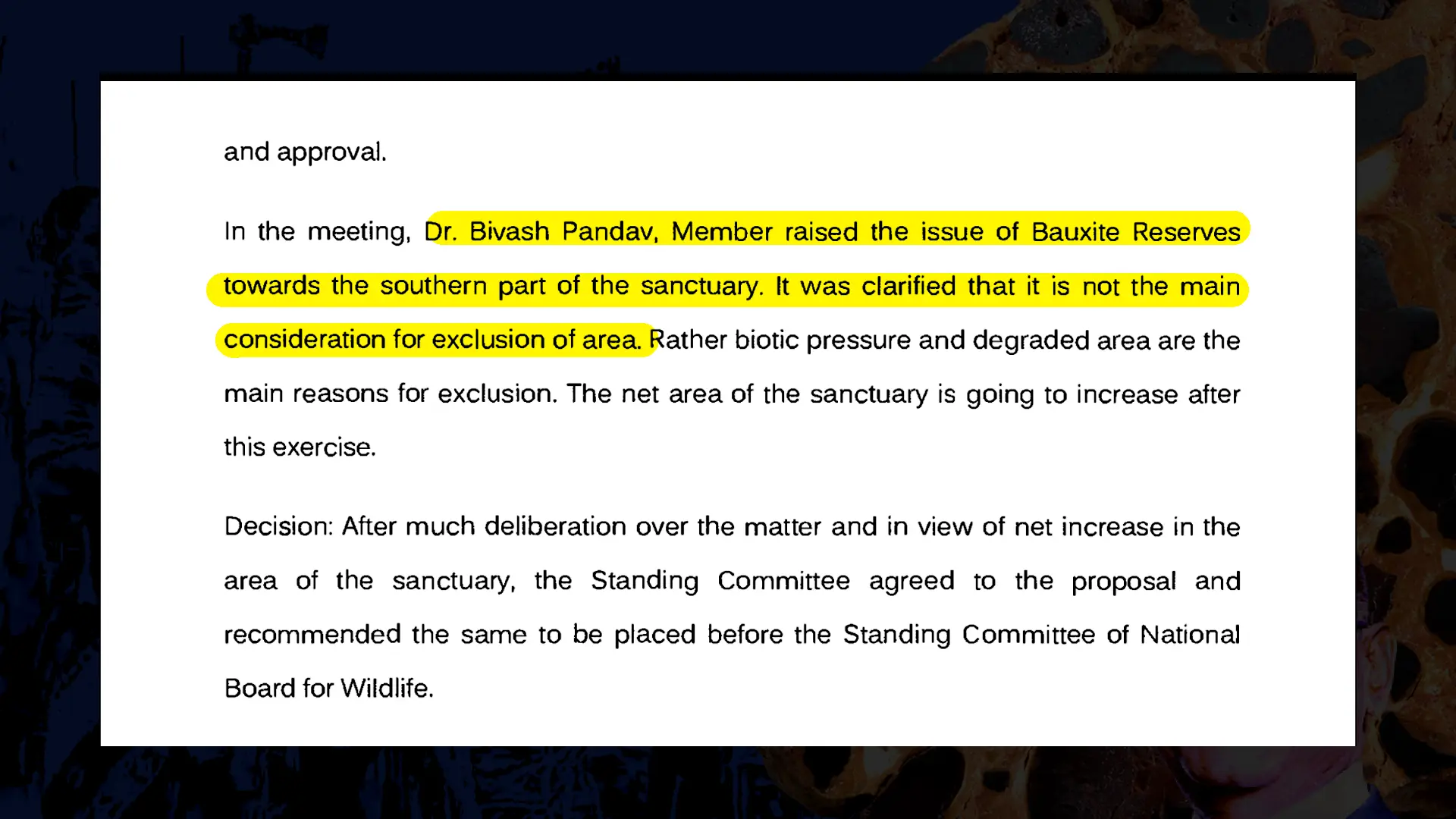
Yet over two years of deliberations across the state and central government, the presence of bauxite reserves remained the primary bone of contention. What was dressed up as biotic pressure from villagers and animals, it became increasingly clear that the only pressure the state faced was to open the bauxite reserves for mining.
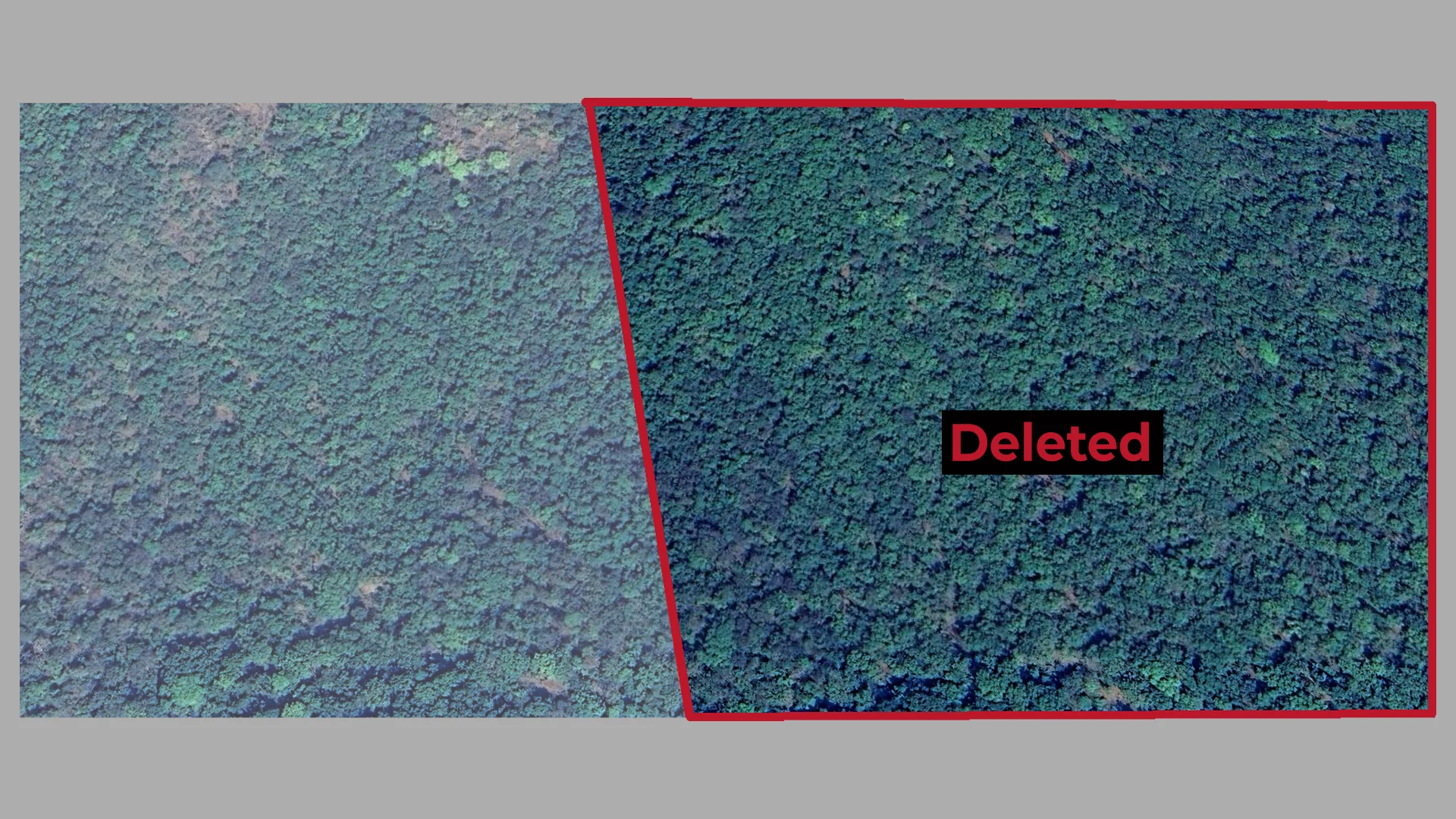
On a quick check, satellite imagery on Google Earth shows the proposed area for exclusion to be fairly good forests, more dense than the parts being included in the redrawn map of the sanctuary.
Under the Wildlife Protection Act, the Divisional Forest Officer (DFO) of the region must physically inspect land sought to be removed from the sanctuary. This is a mandated step to verify the forest department’s claims. No site inspection report of the parts being deleted, however, was submitted along with the mandatory application that the Union government makes public on its PARIVESH portal.
Neither the state board nor the NBWL flagged this omission.
The legal justification for the exclusion was never physically verified.
In our questions to the officials, The Collective asked about the missing site inspection report as well. We did not receive a reply by the time of publishing the story.
The state forest department did upload an inspection report, but it was only for the five new land parcels being added to the sanctuary while the patches sitting atop the bauxite blocks were being removed.
A further misrepresentation emerges from the same DFO’s inspection report. The officer had told the NBWL that the five new land parcels were “uninhabited with no pending FRA claims.” An earlier report from him recorded the presence of nine villages near the five land parcels. Of the nine, at least one, falls within the newly added area.
This key specification was missing from his recommendation in the proposal to the NBWL.
In September 2021, after the proposal reached the NBWL, it had also decided to conduct its own site inspection. A joint inspection team, with an NBWL committee member, R Sukumar, an elephant expert and an Odisha Forest Department official, went to the site.
The site inspection report was not made public.
But the NBWL’s standing committee minutes say, based on the inspection report, the state government was asked to shrink the sanctuary and the ESZ to fit the state’s aspirations to open all possible mines in future.
By now, at least one bauxite block, holding an estimated 153 million metric tonnes of reserves, has been ‘freed’ from the wildlife boundaries. Two other blocks now could be potentially opened to miners when the ESZ also is shrunk by the state and Union government.
With help from the Odisha and Union government, bauxite miners won.
Read Union Ministry of Environment's rebuttal to this story and our response to it here.