
.webp)
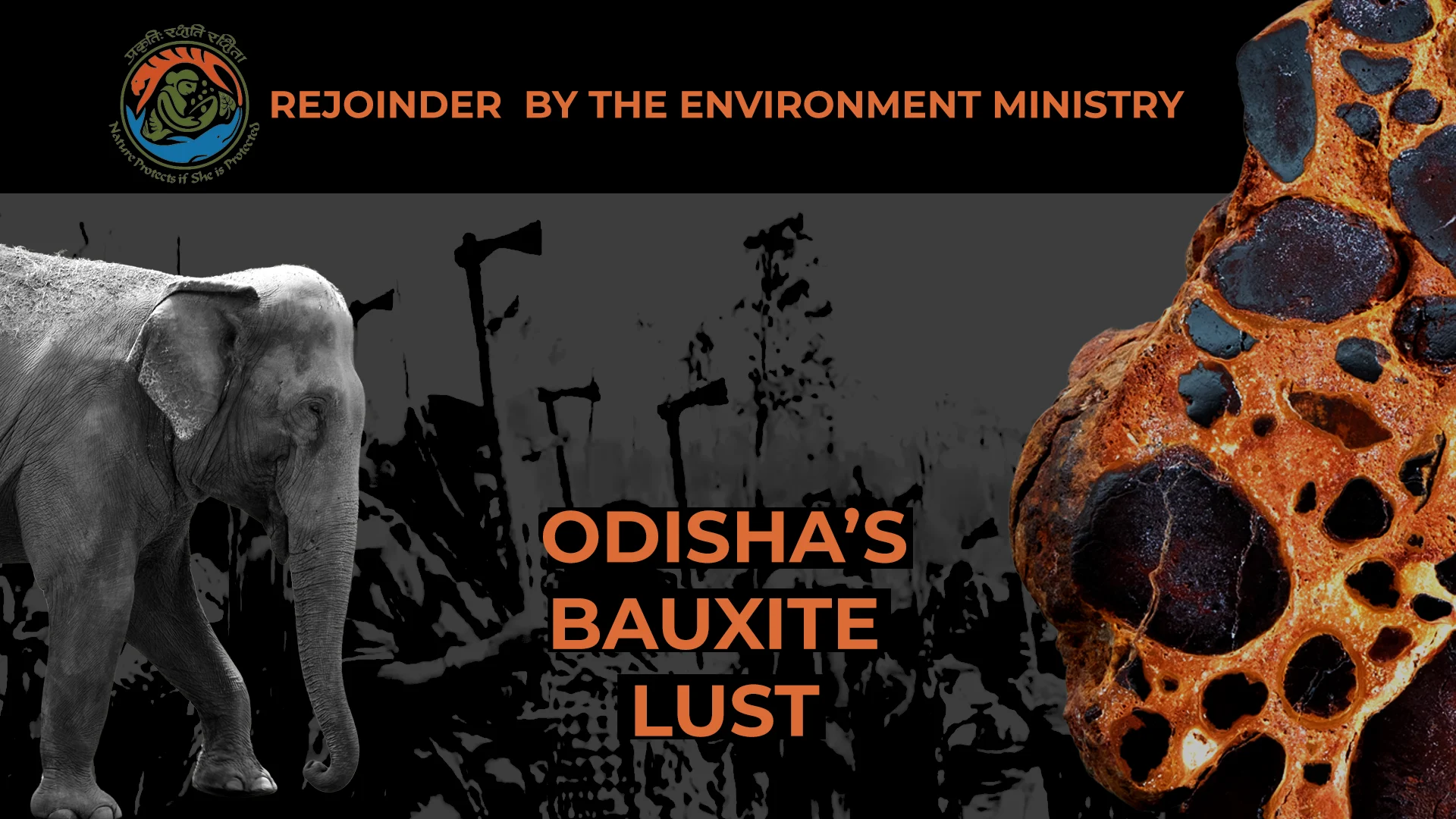

On May 27, we published an investigation on how the Odisha government, the PM-led National Board of Wildlife and the Union ministry for environment, forests and climate change worked together to remove 4.32 sq kilometers of good forests from wildlife sanctuary to open bauxite reserves.
Mining is not permitted in a wildlife sanctuary. So the Odisha government, with the aid of the Union government, redrew the sanctuary boundaries to suit its desire for future mining of bauxite.
The story can be read here: Odisha Govt Altered a Wildlife Sanctuary’s Map to Open Up Bauxite Mining
This was the first part of our investigative project, “Odisha’s Lust for Bauxite”. The concluding part will be published on May 31, 2026.
For this part of the investigation The Reporters’ Collective sent detailed queries to the Union ministry for environment, forests and climate change (MOEFCC), the Odisha Forest Department, the Divisional Forest Officer for Kalahandi South Division. All of them chose not to reply.
On the day of publication, we received an email from the MOEFCC in the form of a rejoinder. The ministry did not explicitly ask us to make it public. But, for transparency and to give every stakeholder a chance to present their views, we are publishing their rejoinder along with our response.
To sum up our response in two sentences: We stand by all assertions, conclusions and facts in our investigation. They are backed by hard evidence from government records presented with the investigation.
Government Claims and Our Response
Government claim 1: “ Earlier, the proposal before SC-NBWL pertained only to rationalisation of the sanctuary boundary arising from discrepancies between the originally notified area and the geo-referenced area determined through reconciliation of cadastral maps and field verification.”
Our response: This flies in the face of records available publicly. The Odisha government’s application to MOEFCC, cited in our investigation, states: “The facts of movement of wild animals, vegetation density, biotic pressure by villagers and the presence of Bauxite Reserves” are the reasons to exclude 4.32 sq kilometers from the sanctuary’s boundaries.
The standing committee of the National Board of Wildlife (NBWL) has recorded discussions over the existence of bauxite reserves under the wildlife sanctuary while discussing the proposal to delete the portions of the protected area. In fact, NBWL went one step ahead and asked the Odisha government to submit a consolidated proposal including all anticipated development activities, like mining, near the sanctuary. This was reported in our investigation with evidence.


Government claim 2: “The rationalisation exercise resulted in a net increase in sanctuary area and was examined in detail by a Site Inspection Committee comprising experts from the NBWL, Wildlife Institute of India and the Odisha Forest Department.”
Our response: We did not assert that the overall area of the sanctuary has been reduced after the boundary rationalisation. We proved that the 4.32 sq km of forest was removed from the southern part of the sanctuary to open up bauxite reserves. The net increase of sanctuary area does not contradict this fact.
A site inspection report has not been made public by the MOEFCC. We had asked the ministry to share the report. It did not. That does not materially change the facts evident from other government records.
Government claim 3: “The Site Inspection Committee specifically emphasized that any future mining activity outside the sanctuary should not adversely impact the sanctuary ecosystem and recommended that associated infrastructure should not be permitted within or in close proximity to the Eco-Sensitive Zone (ESZ). These safeguards were duly recorded in the SC-NBWL.”
Our response: By shrinking the sanctuary on its southern ends, the ministry has ensured that it can claim any future bauxite mining will legally sit outside the redrawn map of the sanctuary. That is not disputed by the story. That is the story.
In 2019 the ministry itself had put out a draft notification to also shrink the Eco-Sensitive Zone as well below the default 10 kilometres of the sanctuary limits. Scrutiny of publicly available records show the final notification has not been passed after altering the wildlife sanctuary’s boundaries.

Government claim 4: “It is categorically stated that, “till date, no proposal for mining activity in the vicinity of Karlapat Wildlife Sanctuary has been received by the Ministry.” Accordingly, the allegation that the rationalisation exercise was undertaken to enable or approve bauxite mining is factually incorrect”
Our response: Our investigation is emphatic and backed by evidence that removing the bauxite mines from the sanctuary limits was the motive as recorded by the state and union government. Our investigation did not assert that the Union government has already received proposals for each or any of these mines, which is a separate process than redrawing the boundaries of a sanctuary. The ministry or the state has not stated anywhere on record that it will not mine these large reserves of bauxite in the future.
Government’s claim 5: “Further, the legal framework governing mining activities around Protected Areas has become more stringent pursuant to orders of the Hon’ble Supreme Court in W.P.(C) No. 202/1995. Mining activities cannot be permitted within a minimum distance of 1 km from the boundary of any Protected Area under any circumstances, and in the absence of a notified ESZ, the default ESZ of 10 km applies for mining activities.”
Our response: We agree and we stated as much in our story. And that's why shrinking the boundaries of the sanctuary to bring the reserves out of the protected area and attendant laws is, as the story conclusively proves, a method of staying ‘technically’ within the law, by breaching the boundaries of the sanctuary.
In fact, the NBWL asked the Odisha government to submit new ESZs demarcations based on the redrawn sanctuary. So far they have not been legally notified.
Government’s claim 6: “The SC-NBWL has also decided in its 88th meeting that no project proposal shall ordinarily be considered in the absence of a draft or final ESZ notification, except in exceptional cases of national or strategic importance with approval of the Chairperson, SC-NBWL.”
Our response: Our investigation did not claim that a specific proposal is already with the Union government under separate provisions of the law. We did prove that when a proposal to mine comes it will not face the higher hurdle of the ban on mining in a sanctuary under Wildlife Protection Act.
Government’s advice on our investigation: “It is strongly advised that your "collective" exercise due diligence and ascertain all relevant facts before publishing information, particularly on matters involving informed and carefully considered decisions”.
Our response: The Reporters’ Collective stands by its investigation and has published all supporting evidence to back it. The ministry’s rejoinder has not pointed to a single factual inaccuracy in our report. It instead attempts to set up a straw man argument.
In other words, The environment ministry made a fabricated claim of what our investigation was about. And, then claimed the report was wrong.
We would encourage the ministry to make all its files, correspondence and documents pertaining to the case public, besides the ones we have already, as required under Section 4 of the Right to Information Act.
We will soon publish the second part of the investigative project. Again, questions have been sent to the ministry and other stakeholders to respond in time before publishing.
The full rejoinder of the MOEFCC can be read here in its original form.
Signed
Nitin Sethi
Founding Editor.

We just survived a finanical crisis.
We need 1,000 regular donors to sustain.


